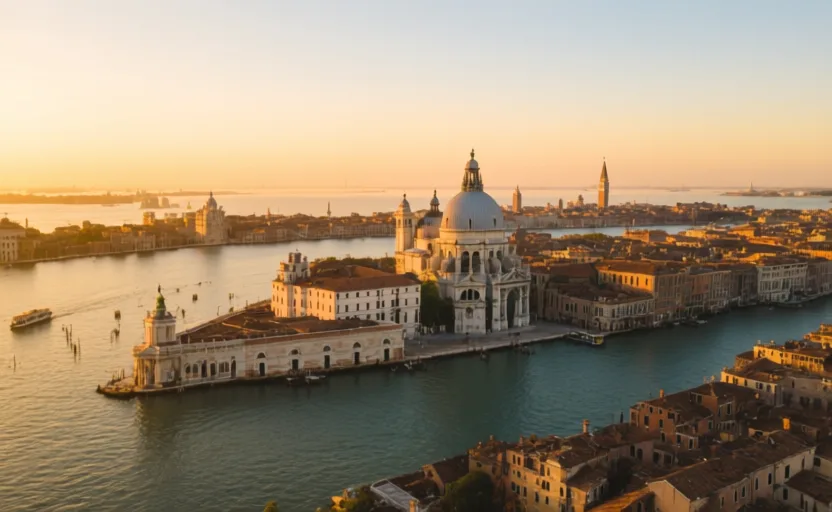
 Venice · AI city illustration · Artistic impression
City · Europe
Venice
Also known as Venezia, Venexia, La Serenissima
Saved in this browser — no account needed. Sign in later and it comes with you.
Read its story
Where it is
Venice is built in a shallow lagoon at the head of the Adriatic, behind a line of barrier islands that separate it from the open sea. The lagoon is a few metres deep at most and threaded with channels that are navigable only if you know them. The city itself stands on timber piles driven into the lagoon floor, with buildings on made ground rather than found ground. It has no defensive walls, because it never needed any: the water is the wall.
The land and water around it
The Venetian Lagoonlagoon
A shallow enclosed bay behind barrier islands, too shallow for a warship and too intricate to cross without local knowledge. It is also a living system: dredged shipping channels, reduced sediment supply and altered tidal exchange all change how it behaves.
The lidiisland
The barrier islands between lagoon and Adriatic, breached by three inlets. Those inlets are where the mobile flood barriers were installed, because they are the only places the sea gets in.
Its history, in short
Settlement in the lagoon grew during the disorder of the early medieval Adriatic, and the city that emerged built a trading state rather than a kingdom — a merchant elite, an elected doge with sharply limited personal power, and institutions designed above all to stop any one family taking over. Venice ran shipyards, convoys, colonies and trading posts across the eastern Mediterranean, treated commercial advantage as state policy, and financed and steered the Fourth Crusade into sacking Constantinople in 1204. Its structural advantage ended when Portuguese ships reached India around the Cape, giving Indian Ocean goods a route that bypassed the Mediterranean entirely. The republic itself ended in 1797. What threatens the city now is the lagoon: land that has subsided, a sea that has risen, and a resident population of the historic centre that has fallen for decades.
Timeline
Dates are shown on a timeline rather than as changing shapes on the map. The globe draws modern boundaries only, and tinting a modern outline to stand for a historical one would state something we cannot source.
Post-classical world
Traditionally 697
The first doge
Venetian tradition dates its first doge to the late seventh century. The early chronology comes from much later chronicles written when the republic had reason to claim antiquity.
Approximate dateUNESCO World Heritage CentreThe early ducal chronology rests on Venetian chronicles composed centuries afterwards, in a state with a strong interest in an ancient and continuous origin story.
1104
The Arsenale
A state shipyard is established that eventually produces vessels on something close to a production line — one of the largest industrial complexes in pre-industrial Europe, and the material basis of Venetian sea power.
Well attestedUNESCO World Heritage Centre1204
The sack of Constantinople
The Fourth Crusade, financed and redirected with Venetian involvement, takes and sacks Constantinople. Venice acquires territory, trading privileges and a great deal of loot. A republic and an empire are not opposites.
1348
Plague, and quarantine
The Black Death reaches the city. Venice and its Adriatic possessions develop the practice of holding arriving ships in isolation — quarantena, forty days — which is where the word comes from.
Well attestedUNESCO World Heritage Centre
Early modern & oceanic
1498
The Cape route reaches India
Portuguese ships arrive in India by sea. Venice's advantage as the western end of an overland-and-Levant route does not vanish at once, but it is now structural rather than temporary.
Well attestedUNESCO World Heritage Centre1797
The republic ends
Napoleon's forces arrive and the Venetian Republic is dissolved after roughly a thousand years.
Well attestedUNESCO World Heritage Centre
Contemporary
1966
The great flood
An exceptional acqua alta floods the city and Florence in the same days, prompting international conservation campaigns and a much sharper public awareness of the lagoon's fragility.
Well attestedUNESCO World Heritage Centre2020 onward
Mobile barriers at the inlets
The MOSE system begins operating, closing the lagoon's three inlets against high tides. It buys time. It does not stop sea-level rise, and closing the lagoon has ecological effects of its own.
Well attestedUNESCO World Heritage Centre
Places that carry meaning
The Arsenale12th century onward
The state shipyard, enclosed by its own walls. Its scale and its standardised production are the reason a city of this size could sustain a fleet at all.
Piazza San Marco9th century onward
The lowest-lying part of the historic centre, which is why it is the first place to flood and the image that circulates whenever it does.
The Ghetto1516 onward
The quarter where Venice compelled Jews to live from 1516, gated and locked at night. The word 'ghetto' comes from this place — from the foundry, geto, that was there before — and travelled from it into general use.
Languages here
Places are usually multilingual. This lists what is actually spoken, not one language per border.
ItalianRomance family
The official and everyday language.
Standard Italian derives from Tuscan, not from the local speech, and became general here through schooling, administration and broadcasting rather than descent.
VenetianRomance family
The local language, still widely spoken in the region.
Not a dialect of Italian in the descent sense: Venetian and Tuscan are sibling developments from Latin. It was the language of the republic's administration and of its Mediterranean trade for centuries.
Learn the language here
- 1Understand which languages are spoken hereVenice is multilingual. Start with which languages are used, by whom, and for what — the phrase list only covers one of them.Written by Globe Quest
- 2Learn 11 phrasesCurated everyday phrases for Venice, with audio and a written form.Written by Globe Quest
- 3Say them out loudSpeaking practice with pronunciation feedback, one phrase at a time.Globe Quest material, your own additions
- 4Come back to themSpaced review, so what you learned this week is still there next month.Written by Globe Quest
- 5Read why the language is what it isThe quest for this place covers how its languages got here and who speaks them.Written by Globe Quest
Check yourself
What defensive advantage did the lagoon give?
Shallow, channelled water only local navigators could cross
Too shallow to attack across and too intricate without local knowledge.
Why does 'relative sea level' matter more than sea level alone?
Because the land can sink while the sea rises, and flooding depends on the gap
Subsidence and sea-level rise combine, so a place can flood faster than global averages suggest.
Worth arguing about
- Venice can hold back the tide but not keep its residents. Which problem would you rather your city solved first?
- A republic that sacked a Christian capital for commercial advantage. How should a city present that part of its own history?
What we have not established
These are open questions, listed rather than filled in. We would rather show a gap than a plausible guess.
How many people now live in the historic centre, and how fast is that falling?
The Venice comune publishes population statistics, and campaign groups publish a widely-reported running count using a different boundary. The trend is not in doubt; a single figure needs a stated boundary and date we have not fixed.
Sources
- UNESCO · Venice and its LagoonUNESCO World Heritage Centre · intergovernmental · checked 2026-09-08
- UNESCO · Historic Areas of IstanbulUNESCO World Heritage Centre · intergovernmental · checked 2026-09-08
- UNESCO · Monastery of the Hieronymites and Tower of Belém in LisbonUNESCO World Heritage Centre · intergovernmental · checked 2026-09-08
Reviewed by Globe Quest editorial on 2026-09-08.