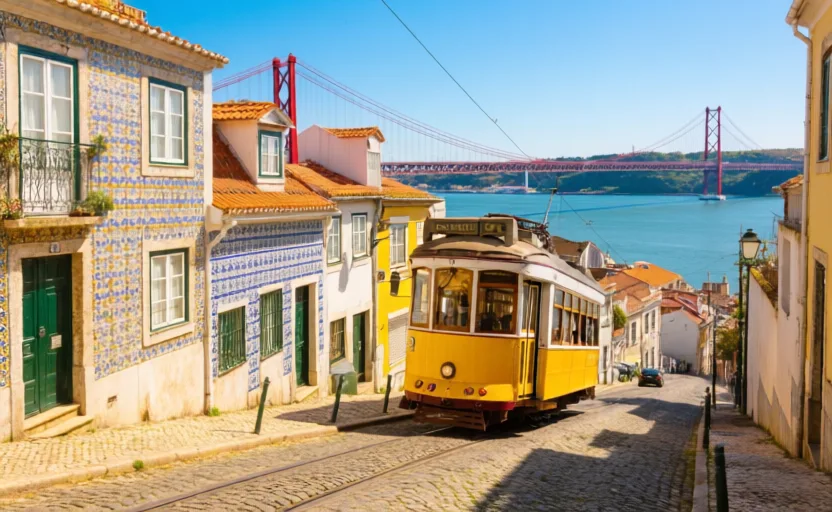
 Lisbon · AI city illustration · Artistic impression
City · Europe
Lisbon
Also known as Lisboa, Olisipo, al-Ushbuna
Saved in this browser — no account needed. Sign in later and it comes with you.
Read its story
Where it is
Lisbon stands on the north bank of the Tagus where the river widens into a broad basin — the Mar da Palha, the sea of straw — before narrowing to meet the Atlantic. That gives it deep sheltered water large enough to assemble and repair a fleet, only a few kilometres from open ocean. The city is built across steep hills above the water, which is why it has funiculars, and it sits near an active tectonic boundary, which is why it has been destroyed.
The land and water around it
A broad sheltered basin close to the open Atlantic — the combination that made Lisbon the right address for oceanic voyaging rather than Mediterranean coasting.
The hillsplateau
Steep ground rising from the water, which shaped the medieval street pattern that survived 1755 in the Alfama and made the flat rebuilt Baixa so conspicuous.
The Azores–Gibraltar fault zonemountains
The tectonic boundary offshore that generated the 1755 earthquake. Portugal's seismic risk is not incidental to its Atlantic position; it comes with it.
Its history, in short
A Phoenician and then Roman port, taken by Muslim forces in the eighth century and by Christian ones in 1147, Lisbon became the capital of a kingdom that turned its Atlantic position into a programme. Decades of incremental coastal voyaging down West Africa produced a sea route to India in 1498, and the wealth that followed built the monastery and tower at Belém. The same infrastructure carried the largest share of the Atlantic slave trade, principally to Brazil. In 1755 an earthquake, tsunami and fire destroyed much of the city; the rebuilt centre is an early example of deliberately anti-seismic urban design. Portugal's empire outlasted most others, ending in the 1970s.
Timeline
Dates are shown on a timeline rather than as changing shapes on the map. The globe draws modern boundaries only, and tinting a modern outline to stand for a historical one would state something we cannot source.
Post-classical world
1147
The siege of Lisbon
Christian forces, including crusaders diverted from the Second Crusade, take the city after four centuries of Muslim rule.
Well attestedUNESCO World Heritage Centre15th century
Down the coast, cape by cape
Decades of incremental voyaging along West Africa accumulate navigational knowledge — winds, currents, latitude — that eventually makes a long ocean arc possible instead of a coastal crawl. Dias rounds the southern tip in 1488.
Early modern & oceanic
1498
The sea route to India
Vasco da Gama reaches India. The trade that follows funds the monastery and tower at Belém, and removes the structural advantage of the Mediterranean intermediaries.
Well attestedUNESCO World Heritage Centre16th–19th centuries
The Atlantic trade
Portuguese ships carry the largest share of enslaved Africans across the Atlantic, principally to Brazil. Salvador da Bahia is the main arrival port; Gorée and the Gold Coast forts are among the memorial sites on the African side. Brazil abolishes slavery in 1888, last in the Americas.
1 November 1755
Earthquake, tsunami, fire
A major earthquake on All Saints' Day is followed by a tsunami in the Tagus and fires burning for days. Much of the centre is destroyed and tens of thousands die.
Well attestedUNESCO World Heritage Centre1758 onward
The Baixa Pombalina
The centre is rebuilt on a grid with an early anti-seismic timber cage inside the masonry, tested by marching troops around models. Officials also collected parish reports from across the country — often described as an early systematic disaster survey.
Well attestedUNESCO World Heritage Centre
Contemporary
25 April 1974
The Carnation Revolution
A military coup ends nearly five decades of dictatorship, and the colonial wars with it. Decolonisation follows rapidly, and hundreds of thousands of retornados arrive from the former colonies.
Well attestedUNESCO World Heritage Centre
Places that carry meaning
The Hieronymites Monastery and Tower of Belém16th century
Built at the point ships departed from, funded by the spice trade the departures produced. The Manueline decoration is full of maritime motifs — rope, coral, navigational instruments.
The Baixa Pombalina1758 onward
The rebuilt lower town: a grid of standardised blocks with the gaiola pombalina, a timber frame designed to flex. Among the earliest deliberately earthquake-resistant urban construction anywhere.
The AlfamaMedieval
The quarter that largely survived 1755, built on rock rather than the reclaimed ground of the Baixa. Its tangled streets are what the whole city looked like before.
Languages here
Places are usually multilingual. This lists what is actually spoken, not one language per border.
PortugueseRomance family
The national language.
European Portuguese differs noticeably from Brazilian Portuguese in pronunciation and usage; Brazil has far more speakers, which occasionally surprises people about which variety is the outlier.
Cape Verdean CreolePortuguese-lexifier creole family
Widely spoken in Lisbon's Cape Verdean community.
A language in its own right rather than a dialect of Portuguese. Lisbon's African communities, largely from the former colonies, make the city considerably more multilingual than the national figure suggests.
Learn the language here
- 1Understand which languages are spoken hereLisbon is multilingual. Start with which languages are used, by whom, and for what — the phrase list only covers one of them.Written by Globe Quest
- 2Learn 12 phrasesCurated everyday phrases for Lisbon, with audio and a written form.Written by Globe Quest
- 3Say them out loudSpeaking practice with pronunciation feedback, one phrase at a time.Globe Quest material, your own additions
- 4Come back to themSpaced review, so what you learned this week is still there next month.Written by Globe Quest
- 5Read why the language is what it isThe quest for this place covers how its languages got here and who speaks them.Written by Globe Quest
Check yourself
Why did the Tagus estuary suit oceanic voyaging?
Deep sheltered water for a fleet, a few kilometres from open Atlantic
Mediterranean ports are sheltered but must pass a strait to reach the ocean. This one does not.
What made the 1755 rebuilding significant beyond Portugal?
Deliberate anti-seismic construction, and a systematic survey of the disaster
The timber cage was engineered against future shaking, and officials collected parish reports nationwide.
Worth arguing about
- Lisbon rebuilt with earthquakes in mind after one destroyed it. What is your city built to survive, and what is it not?
- The monuments at Belém and the memorial sites at Gorée were funded by the same system. How should a city present both?
What we have not established
These are open questions, listed rather than filled in. We would rather show a gap than a plausible guess.
How many people died in the 1755 earthquake?
Contemporary estimates range from about ten thousand to over fifty thousand for Lisbon, and the city's pre-earthquake population is itself uncertain. Modern scholarship narrows the range without settling it.
Sources
- UNESCO · Monastery of the Hieronymites and Tower of Belém in LisbonUNESCO World Heritage Centre · intergovernmental · checked 2026-09-08
- UNESCO · Island of GoréeUNESCO World Heritage Centre · intergovernmental · checked 2026-09-08
- UNESCO · Historic Centre of Salvador de BahiaUNESCO World Heritage Centre · intergovernmental · checked 2026-09-08
Reviewed by Globe Quest editorial on 2026-09-08.