 Globe Quest
 Human Quest · LearningSign in
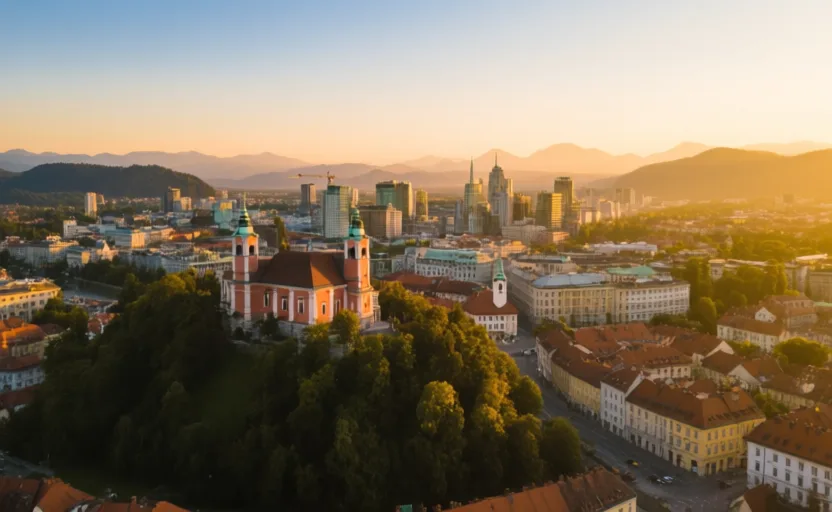 Ljubljana · AI city illustration · Artistic impression
City · Europe
Ljubljana
Saved in this browser — no account needed. Sign in later and it comes with you.
Where it is
Ljubljana fills a flat alluvial basin at about 295 metres, between the Alps to the north and the limestone Karst to the south. The Ljubljanica winds through the centre below Castle Hill, which rises to 366 metres, and joins the Sava and the Kamnik Bistrica at the lowest point of the city, 261 metres, on its eastern edge. South of the city lies the Ljubljana Marsh, the largest wetland in Slovenia, still prone to flooding. The setting puts the city on an old line of travel between the northern Adriatic and the Danube lands. Rain is heavy, about 1,400 millimetres a year, and fog on some 64 days.
The land and water around it
The Ljubljana Marshmarsh
The largest marsh in Slovenia lies south of the city. Pile-dwelling communities settled it around 2000 BC and left the oldest wooden wheel yet found. The Gruber Canal, built between 1772 and 1780 around Castle Hill, reduced the flood danger.
The Ljubljanica and Castle Hillriver
The river runs through the old centre, and the three medieval districts of Town, Old Square and New Square grew on its banks, joined by bridges. Castle Hill, 366 metres high, carries a castle built in the 12th century.
The basin between Alps and Karstplain
The alluvial plain dates from the Quaternary, while the mountains around it are Triassic or older. The ground is seismically active, and earthquakes devastated the city in 1511 and 1895.
Its history, in short
People lived in pile dwellings on the marsh around 2000 BC, and the area later passed from Illyrians and Celts to the Romans, who around 50 BC built a military camp that grew into Emona. Huns destroyed it in 452, and for centuries little is known of the place. The ancestors of the Slovenes arrived in the 6th century. A castle and a market grew up on the Ljubljanica in the 12th century, town privileges followed between 1220 and 1243, and in 1256 the capital of Carniola was moved here from Kamnik. Habsburg rule lasted until 1918, and German was the language of the Laibach of the Habsburg period. Earthquakes shaped the city twice: the quake of 1511 led to a Renaissance rebuilding behind a new wall, and that of 1895 brought a rebuilding in Vienna Secession style under the mayor Ivan Hribar. Between the wars the architect Jože Plečnik reshaped the centre for a city that was becoming a national capital, and in 1991 it became the capital of independent Slovenia.
Timeline
Dates are shown on a timeline rather than as changing shapes on the map. The globe draws modern boundaries only, and tinting a modern outline to stand for a historical one would state something we cannot source.
First cities & states
c. 2000 BC
Pile dwellers on the marsh
Lake-dwelling people live on the Ljubljana Marsh by hunting, fishing and early farming. Their remains are now part of a multi-country UNESCO listing.
Approximate dateWikipedia
Classical world
c. 50 BC
Roman camp, then Emona
The Romans build a military encampment that becomes a permanent settlement, home to around 5,000 to 6,000 people with painted brick houses and drainage.
Approximate dateWikipedia
Post-classical world
1220–1243
Town privileges
Ljubljana receives its town privileges at some point in this span, after market rights at Old Square around 1200.
Approximate dateWikipedia1256
Capital of Carniola
When Ulrich III of Spanheim becomes lord of Carniola, the provincial capital moves from Kamnik to Ljubljana.
Well attestedWikipedia
Early modern & oceanic
1511
The Idrija earthquake
The quake damages the city, which is rebuilt in Renaissance style with a new wall. After a fire at New Square in 1524 wooden buildings are banned.
Well attestedWikipedia
Industrial & imperial
1809–1813
Capital of the Illyrian Provinces
Under Napoleon the city, as Laybach, is the capital of the Illyrian Provinces, then returns to Austria and serves as administrative centre of the Kingdom of Illyria until 1849.
Well attestedWikipedia1895
The great earthquake
A magnitude 6.1 quake kills 21 people and destroys about a tenth of the city's 1,400 buildings. The rebuilding of 1896 to 1910 is called the revival of Ljubljana.
Well attestedWikipedia
Contemporary
1991
Capital of independent Slovenia
The city, capital of the Socialist Republic of Slovenia within Yugoslavia since the Second World War, becomes the capital of a sovereign state.
Well attestedWikipedia
Places that carry meaning
Ljubljana Castle12th century onward
The castle on Castle Hill housed the margraves and then the dukes of Carniola. A viewing tower was added in 1848, and a funicular linked it to the centre in 2006. The hill has been inhabited since around 1200 BC.
Plečnik's LjubljanaBetween the world wars
The architect Jože Plečnik gave the city two axes, a green promenade on land and one along the embankments and bridges of the Ljubljanica. The UNESCO listing describes the result as renewal that worked with existing buildings rather than clearing them.
Franciscan Church of the Annunciation1646–1660
The early-Baroque church faces Prešeren Square, the central square, and replaced a Gothic church. The 1895 earthquake cracked its ceiling, and the frescos were repainted afterwards by Matej Sternen.
Languages here
Places are usually multilingual. This lists what is actually spoken, not one language per border.
SloveneSlavic family
The national language and the first language of about 91% of residents.
By the 16th century about 70% of the town's 5,000 people spoke Slovene as their first language, and most of the rest German. The Slovene printing, school and library tradition of the capital began in that period.
GermanGermanic family
The historical language of administration under Habsburg rule.
Laibach remained the German name of the city until 1918 and is still used in German. The first documented form of that name, in 1144, is a little older than the earliest Slovenian record in 1146.
Bosnian and Serbo-CroatianSlavic family
The second and third most spoken languages in the city today.
They come mainly from people who moved to Slovenia from other parts of former Yugoslavia, who make up about 86% of the country's foreign-born population.
Learn the language here
- 1Understand which languages are spoken hereLjubljana is multilingual. Start with which languages are used, by whom, and for what — the phrase list only covers one of them.Written by Globe Quest
- 2Learn 11 phrasesCurated everyday phrases for Ljubljana, with audio and a written form.Written by Globe Quest
- 3Say them out loudSpeaking practice with pronunciation feedback, one phrase at a time.Globe Quest material, your own additions
- 4Come back to themSpaced review, so what you learned this week is still there next month.Written by Globe Quest
Check yourself
What was the Roman settlement on the site of Ljubljana called?
Emona
Emona was the Roman city here. Poetovio and Celeia were Roman towns elsewhere in modern Slovenia, at Ptuj and Celje.
What did the architect Plečnik do for the city between the world wars?
Gave it a green land axis and a water axis of promenades, bridges and squares
Plečnik worked in the interwar years, as the former provincial town became a national capital, and tied the old centre together with promenades along the land and the river.
Worth arguing about
- The city has been rebuilt after two earthquakes, in 1511 and 1895, each time in the style of its day. Should a city that rebuilds often be judged on what it kept or what it chose?
- Ljubljana is Slovene-speaking now but spent centuries as Laibach. What should be done with the names and traces of an earlier ruling language?
What we have not established
These are open questions, listed rather than filled in. We would rather show a gap than a plausible guess.
Where does the name Ljubljana come from?
The link between the Slovene and German forms of the name has long puzzled scholars. A 2007 argument derives it from a Slavic root meaning to love or like, but the origin is still not settled, and the earliest mention of the town is dated between 1112 and 1125 only by deduction.
Sources
- Wikipedia · LjubljanaWikipedia · encyclopedia · checked 2026-11-24
- Wikipedia · SloveniaWikipedia · encyclopedia · checked 2026-11-24
- UNESCO · The works of Jože Plečnik in Ljubljana – Human Centred Urban DesignUNESCO World Heritage Centre · intergovernmental · checked 2026-11-24
Reviewed by Globe Quest editorial on 2026-11-24. Drafted with AI assistance and checked against the sources above before publication.