 Globe Quest
 Human Quest · LearningSign in
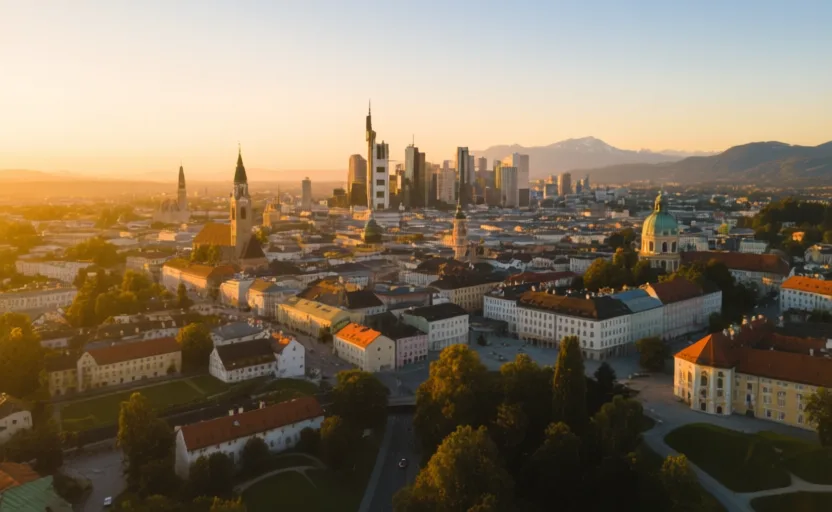 Graz · AI city illustration · Artistic impression
City · Europe
Graz
Saved in this browser — no account needed. Sign in later and it comes with you.
Where it is
The Mur flows through Graz in a basin that closes in on the north, east and west and opens only to the south. Plabutsch, at 754 metres, marks the western edge, and the Schöckl rises about 1,100 metres above the city to the north. The centre sits at 353 metres. Lying south-east of the Alps, the city is shielded from the westerly weather that crosses most of Central Europe and is influenced by the Mediterranean instead. It is sunnier, calmer and drier than Vienna or Salzburg, and plants that normally grow much farther south are found in the city. It lies about 150 kilometres south-west of Vienna and 50 kilometres from Maribor in Slovenia.
The land and water around it
The Mur valley and the Graz Basinvalley
Graz stands at the head of the open, fertile Mur valley, which made it a target for invaders and a place of passage. The basin is open only to the south, so the climate is warmer than the latitude suggests.
The Schlossbergmountains
A rocky hill above the old town, once crowned by the castle and fortress. It was the only fortification in the region that the Ottoman Turks never took, apart from the Riegersburg.
Styria’s green hillsforest
Graz is the largest city of Styria, a wooded province at the Alps’ eastern fringe. The word Mark in its name means a border land where peasants were trained to defend.
Its history, in short
The oldest traces of settlement on the site go back to the Copper Age, but nothing links them to the town, which began in the Middle Ages as a fortified place on a rock above the river. Its name probably comes from a Slavic word for a small castle, even though Bavarian settlers founded the town and later called it Bavarian Graz to tell it apart from an older Slovene one. The name first appears in records in 1128. The Babenberg dukes made it a trading centre in the twelfth century, and under the Habsburgs it gained privileges in 1281. From the fifteenth century it was the residence of the Inner Austrian line, who governed Styria, Carinthia, much of present-day Slovenia and bits of Italy from there. Italian architects shaped its Renaissance centre. The line inherited the imperial throne in 1619, and Ferdinand II moved the court to Vienna. Graz resisted the Ottomans and Napoleon from the Schlossberg, until the peace of 1809 required the fortress to be blown up. Today it is Austria’s second city and a university town, with four universities and about 63,000 students.
Timeline
Dates are shown on a timeline rather than as changing shapes on the map. The globe draws modern boundaries only, and tinting a modern outline to stand for a historical one would state something we cannot source.
Post-classical world
1128
The name first appears
The place is named in a document of 1128. An earlier mention, “Grez” in 1091, is questioned.
DisputedWikipediaHistorians disagree on whether the 1091 record refers to Graz, so 1128 is the first secure date.
1281
Habsburg privileges
King Rudolph I gives Graz special privileges, soon after the Habsburgs took over from the Babenbergs.
Well attestedWikipedia
Early modern & oceanic
1481–1532
Hungarians and Ottomans
Matthias Corvinus’s Hungarians attack in 1481, and the Ottomans threaten in 1529 and 1532. The Schlossberg holds.
Well attestedWikipedia1551
The provincial armoury
The collection of weapons kept at the provincial armoury begins to be preserved; it now holds over 30,000 items and is regarded as the largest such collection of late medieval and Renaissance weapons anywhere.
Well attestedWikipedia1585
University founded
Archduke Karl II founds the university. Kepler comes to teach in Graz in 1594 and leaves in 1600 when Protestants are banned.
Well attestedWikipedia
Industrial & imperial
1809
The fortress demolished
A small garrison beats off eight attacks, but after the defeat at Wagram the peace terms require the fortifications to be blown up. Citizens pay a ransom to save the clock tower and bell tower.
Well attestedWikipedia
Contemporary
2 April 1945
Massacre at Wetzelsdorf
During the heaviest Allied air raid on Graz, the Gestapo and Waffen-SS kill resistance fighters, Hungarian-Jewish forced labourers and prisoners of war at the SS barracks.
Well attestedWikipedia1999
World Heritage listing
The historic centre is inscribed, and in 2010 the listing grows to take in Eggenberg Palace, at the city’s western limit. Graz is European Capital of Culture in 2003.
Places that carry meaning
Altstadt and Eggenberg PalaceMiddle Ages to the 18th century
The historic centre and the baroque palace on the western edge are listed together as a crossroads of Germanic, Balkan and Mediterranean artistic currents shaped by the Habsburgs and aristocratic families.
The Landhaus16th century
A government headquarters for the provincial rulers, designed by Domenico dell’Allio, and a leading example of the Italian Renaissance architecture that shaped the city in that century.
Uhrturmspared in 1809
The civic clock tower, spared in 1809 when citizens paid a ransom, is now a leading symbol of the city.
Languages here
Places are usually multilingual. This lists what is actually spoken, not one language per border.
German (Styrian dialect)Germanic family
The official and everyday language.
Locals call the speech of Graz Steirisch. It belongs to the Austro-Bavarian dialects, a mix of Central Bavarian in western Styria and Southern Bavarian in the east.
SloveneSlavic family
The historic minority language, once a language of learning in the city.
Graz was a centre of Slovene culture from the university’s founding until the University of Ljubljana opened in 1919. The first Slovene Catholic book was printed here in 1574, and the oldest chair of Slovene was created in 1811, although Slovenes were always a tiny minority in the city itself.
Languages of newer residents
Spoken by the 30 per cent of residents who are not Austrian citizens.
Of the 307,912 people with their main residence in the city in 2026, 14 per cent hold EU citizenship and 16 per cent are non-EU nationals.
Learn the language here
- 1Understand which languages are spoken hereGraz is multilingual. Start with which languages are used, by whom, and for what — the phrase list only covers one of them.Written by Globe Quest
- 2Learn 11 phrasesCurated everyday phrases for Graz, with audio and a written form.Written by Globe Quest
- 3Say them out loudSpeaking practice with pronunciation feedback, one phrase at a time.Globe Quest material, your own additions
- 4Come back to themSpaced review, so what you learned this week is still there next month.Written by Globe Quest
Check yourself
What does the name Graz most likely come from?
A Slavic word for a small castle
The name probably derives from Slavic gradec, meaning small castle, although Bavarian settlers founded the town that carries it.
Why does the Schlossberg no longer have its fortress?
It was blown up under the peace of 1809 after Napoleon’s victory
The fortifications were demolished with explosives as the Peace of Schönbrunn required, but the clock tower and bell tower were saved by a ransom paid by citizens.
Worth arguing about
- Graz was a court city for the Inner Austrian Habsburgs and then lost the court to Vienna in 1619. What does a former capital keep, and what does it lose?
- A centre of Slovene learning and later a place of anti-Slovene feeling, Graz shows how a university can bring people together or divide them. Which was it, and for whom?
What we have not established
These are open questions, listed rather than filled in. We would rather show a gap than a plausible guess.
How many people live in Graz?
The count of about 308,000 covers only people with their main residence there. Counting those with a secondary residence raises the figure to about 345,000, and the wider urban area holds more than 660,000.
Sources
- Wikipedia · GrazWikipedia · encyclopedia · checked 2026-11-24
- Wikipedia · AustriaWikipedia · encyclopedia · checked 2026-11-24
- UNESCO · City of Graz – Historic Centre and Schloss EggenbergUNESCO World Heritage Centre · intergovernmental · checked 2026-11-24
Reviewed by Globe Quest editorial on 2026-11-24. Drafted with AI assistance and checked against the sources above before publication.