 Globe Quest
 Human Quest · LearningSign in
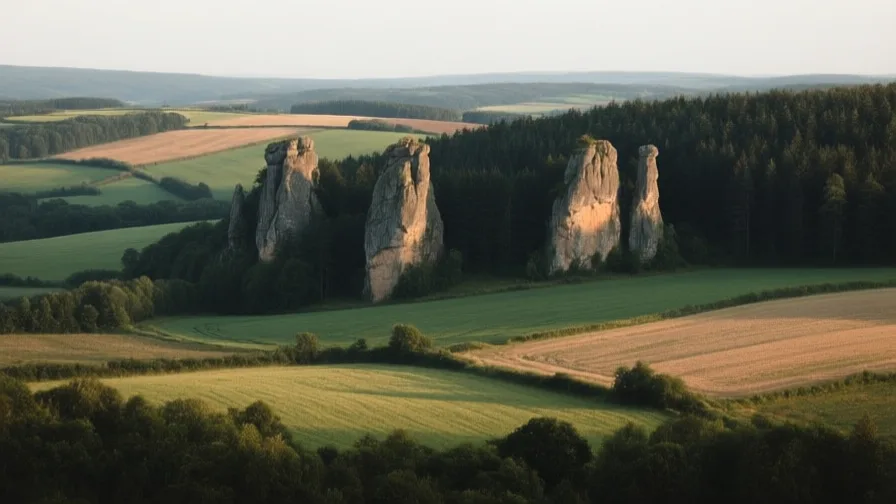 Czechia · AI landscape illustration · Artistic impression
Country · Europe
Czechia
Saved in this browser — no account needed. Sign in later and it comes with you.
Where it is
Czechia is a landlocked country of low hills and plateaus, ringed along its borders by modest mountains and lying on the geologically old Bohemian Massif. Bohemia in the west is a basin whose water gathers into the Elbe and the Vltava, Moravia in the east is hillier and drained by the Morava, and a small part of Silesia in the north-east holds the source of the Oder. Water therefore leaves the country towards three seas, the North Sea, the Baltic and the Black Sea. The highest point, Sněžka in the Giant Mountains, is 1,603 metres. The climate lies between oceanic and continental, with warm summers and cold, cloudy winters.
The land and water around it
The Bohemian basin and the Vltavariver
Bohemia is a basin drained by the Elbe and its main tributary, the Vltava, the country's longest river, which joins the Elbe at Mělník. The Elbe leaves Czechia on its way to the North Sea.
The border mountainsmountains
The Bohemian Forest, the Ore Mountains, the Sudetes with the Giant Mountains, and the Beskids ring the country. Sněžka at 1,603 metres is the highest, and its summit averages minus 0.4 degrees Celsius, while the South Moravian lowlands average about 10.
Ponds and reservoirslake
Few natural lakes exist. Most water bodies are man-made, from the Rožmberk Pond, part of a system of fishponds built in the 16th century around Třeboň, to reservoirs built in the 1950s such as Lipno and Orlík.
Its history, in short
The Czech lands have been settled since the Paleolithic, and the Venus figurine of Dolní Věstonice, made some 29,000 to 25,000 years before the Common Era, is the oldest known ceramic figurine. Celtic Boii gave Bohemia its name, Germanic tribes followed them, and Slavs arrived in the 6th century. The first states were Samo's realm in the 7th century and Great Moravia in the 9th, where the missionaries Cyril and Methodius helped create the Glagolitic alphabet. The Přemyslid dynasty built the Duchy of Bohemia, which became an imperial estate in 1002 and a kingdom in 1198 or 1212, according to which grant is counted. The Hussite movement challenged Rome in the 15th century, the Habsburgs inherited the crown in 1526, and defeat at White Mountain consolidated their rule. Industry grew in the 19th century, and in 1918 Czechoslovakia emerged from the wreck of Austria-Hungary. It was occupied in 1938 and 1939, became communist in 1948 and was invaded in 1968. The Velvet Revolution of November 1989 restored democracy, and on 31 December 1992 the country split peacefully into Czech and Slovak republics.
Timeline
Dates are shown on a timeline rather than as changing shapes on the map. The globe draws modern boundaries only, and tinting a modern outline to stand for a historical one would state something we cannot source.
Early human world
c. 29,000–25,000 BC
The Venus of Dolní Věstonice
A ceramic figurine from south Moravia, considered the oldest known ceramic figure in the world, shows how important the region was in the Gravettian period.
Post-classical world
623–631
Samo's realm
According to the Chronicle of Fredegar, a Frankish merchant named Samo joins Slavic tribes against the Avars and becomes their ruler. The realm defends itself against the Franks at Wogastisburg in 631 and breaks up after his death.
Approximate dateWikipedia830s onward
Great Moravia
A Slavic realm probably forms in Moravia and western Slovakia. It sees the first Slavic literary culture in Old Church Slavonic and the creation of the Glagolitic alphabet.
Approximate dateWikipedia1212
Bohemia becomes a hereditary kingdom
Přemysl Ottokar I secures royal status for himself and his heirs through the Golden Bull of Sicily from Emperor Frederick II.
1419–1434
The Hussite Wars
The followers of Jan Hus defeat five crusades organised against them. For the next two centuries about 90 per cent of the population of Bohemia and Moravia are counted as Hussites.
Well attestedWikipedia
Early modern & oceanic
1526
Habsburg rule
After the Battle of Mohács the lands of the Bohemian Crown are gradually integrated into the Habsburg monarchy. A Protestant revolt a century later helps trigger the Thirty Years' War.
Well attestedWikipedia
Industrial & imperial
1918
Czechoslovakia founded
The republic, led by Tomáš Masaryk, holds only 27 per cent of the population of Austria-Hungary but nearly 80 per cent of its industry. Alone in Central and Eastern Europe, it stays a parliamentary democracy through the whole interwar period.
Well attestedWikipedia
Contemporary
1989
Velvet Revolution
Peaceful protests end communist rule. The Czech Republic and Slovakia become separate countries on 31 December 1992, and the Czech Republic joins NATO in 1999 and the European Union in 2004.
Well attestedWikipedia
Places that carry meaning
Dolní VěstoniceUpper Palaeolithic
A site in south Moravia that gave its name to the oldest known ceramic figurine. With Pavlov and Předmostí, it places south Moravia among Europe's richest areas for Ice Age archaeology.
MušovRoman era
Traces of a Roman winter camp built to house about 20,000 soldiers, in south Moravia, left by Rome's repeated wars with the Marcomanni.
Prague CastleFrom about 880
The residence of Bořivoj, the first known Přemyslid, from about 880. It laid the foundation for the city of Prague and has been a seat of rulers since.
The Moldauhafen in HamburgTreaty of Versailles to 2028
A 30,000 square metre plot in the Hamburg docks leased to Czechoslovakia so that goods travelling down the Elbe could be transferred to sea-going ships. It reverts to Germany in 2028.
Languages here
Places are usually multilingual. This lists what is actually spoken, not one language per border.
CzechSlavic family
The language of the state and of the great majority of residents.
A West Slavic language, spoken as the sole mother tongue by 92 to 98 per cent of the population, depending on the survey. That makes the country one of Europe's most linguistically uniform. Newcomers, including Ukrainians, Slovaks and Vietnamese, add to this.
SlovakSlavic family
A closely related language with many speakers.
Czech and Slovak are highly mutually intelligible, a legacy of the shared state until 1992. About 0.9 per cent of residents recorded Slovak nationality in the 2021 census.
GermanGermanic family
Historically the mother tongue of a large minority, now a foreign language.
Until 1945 German was the mother tongue of more than 30 per cent of the population. Today about half of students study it as their principal second foreign language, after English.
PolishSlavic family
The only minority language concentrated enough to have its own local infrastructure.
In the Cieszyn Silesia region in the north-east there are bilingual place names. The government recognises 14 national minorities and protects their languages.
Learn the language here
Check yourself
Into how many seas does water from Czechia flow?
Three, the North Sea, the Baltic and the Black Sea
The Elbe leads to the North Sea, the Oder to the Baltic and the Morava, through the Danube, to the Black Sea.
How did Czechoslovakia end?
A peaceful split into two states on 31 December 1992
After the Velvet Revolution, Slovak national aspirations strengthened and the federation was dissolved peacefully, creating the Czech Republic and Slovakia.
Worth arguing about
- Czechs are among the least religious people in the world, yet the Hussite Reformation was once a national cause. What changed?
- Until 1945 more than 30 per cent of people in the Czech lands spoke German. What does a country lose when a language community disappears?
What we have not established
These are open questions, listed rather than filled in. We would rather show a gap than a plausible guess.
What is the official language of Czechia?
Czech is the language of the state, but the constitution does not name an official language, and the 2021 census left nationality optional, with 31.6 per cent giving no answer, so the ethnic and linguistic shares rest on partial data.
Sources
- Wikipedia · Czech RepublicWikipedia · encyclopedia · checked 2026-11-24
- Wikipedia · History of the Czech landsWikipedia · encyclopedia · checked 2026-11-24
- Wikipedia · Geography of the Czech RepublicWikipedia · encyclopedia · checked 2026-11-24
Reviewed by Globe Quest editorial on 2026-11-24. Drafted with AI assistance and checked against the sources above before publication.