 Globe Quest
 Human Quest · LearningSign in
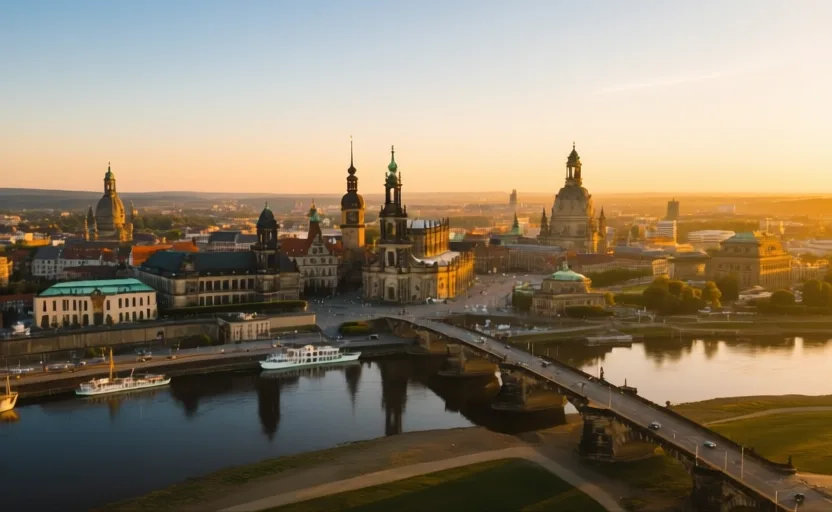 Dresden · AI city illustration · Artistic impression
City · Europe
Dresden
Saved in this browser — no account needed. Sign in later and it comes with you.
Where it is
Dresden fills a wide basin on both banks of the Elbe, with the eastern Ore Mountains to the south, a steep granite slope to the north and sandstone hills on the east side. The highest point in the city is the Triebenberg at 384 metres, while the river sits around 112. The climate is oceanic with continental influence, with a January average near freezing and a warm July. Because Ore Mountain streams feed the Elbe, floods are a constant concern, and large areas are kept free of buildings as floodplain. About 62 percent of the city is green space or forest, and meadows run through it for some 20 km.
The land and water around it
The Elbe and the Dresden Basinriver
The city occupies the basin on both banks of the river. The meadows of the Elbe valley form a green band about 20 km long through it, and the Dresden Elbe Valley was once a World Heritage cultural landscape.
The Dresden Heathforest
A 50 km² forest in the north-east of the city and one of its main recreation areas.
Saxon Switzerland and the Ore Mountainsmountains
Sandstone rock country lies south-east of the city and the Ore Mountains rise to the south. Mining in the Ore Mountains was one of the reasons for Dresden’s early growth and for the Margraviate of Meissen.
Its history, in short
The name comes from the Sorbian word Drežďany, probably meaning woods or lowland forest-dwellers, and the early town was a German trading settlement on the south bank, first named in a charter of 1206. A stone bridge of 1220 joined it to the Sorbian village on the north bank, which became Old Dresden. The city rose with the Wettin family. In 1547 the electoral title passed to the Albertine branch, which made Dresden its principal residence, rebuilt the castle in Renaissance style and in 1560 began the art collections that still define the city. Augustus the Strong converted to Catholicism in 1697, though the population stayed Lutheran. Dresden became capital of the Kingdom of Saxony in 1806, and the first railway, to Leipzig, followed in 1839. Its Baroque and Rococo centre earned the nickname the Jewel Box and Florence on the Elbe. The population reached 649,252 in 1933, and American and British bombing at the end of the Second World War killed about 25,000 people and destroyed much of the centre; by 1945 the population had fallen to 368,519. Under East Germany the cleared areas were rebuilt in socialist styles. Since 1990 many landmarks have been reconstructed, and the city has become a hub of microelectronics.
Timeline
Dates are shown on a timeline rather than as changing shapes on the map. The globe draws modern boundaries only, and tinting a modern outline to stand for a historical one would state something we cannot source.
Post-classical world
31 March 1206
First mention
A charter by Margrave Dietrich of Meissen, which records his judgment in a quarrel between two local rulers, the bishop of Meissen and the burgrave of Dohna, names the place. A charter of 1216 first calls it a town.
Well attestedWikipedia1220
The stone bridge
A bridge over the Elbe is built where the Augustus Bridge stands today. It links the town to a Sorbian settlement on the north bank, later called Old Dresden.
Well attestedWikipedia
Early modern & oceanic
1547
Albertine electors
After the Schmalkaldic War the electoral dignity passes to the Albertine branch of the Wettins, who make Dresden their main residence.
Well attestedWikipedia1560
The electoral art collections
The electors found collections that become the Dresden State Art Collections.
Well attestedWikipedia
Industrial & imperial
1806
Capital of a kingdom
Napoleon creates the Kingdom of Saxony, with Dresden as capital. He wins the Battle of Dresden there on 27 August 1813.
Well attestedWikipedia1839
Railway to Leipzig
Dresden’s first railway opens, with a direct link to Leipzig. A technical school, the predecessor of the university, had been founded in 1828.
Well attestedWikipedia
Contemporary
1945
Bombing
Allied bombing near the end of the war destroys large parts of the centre and kills approximately 25,000 people, most of them civilians. The attack remains controversial.
Well attestedWikipedia1994–2005
The Frauenkirche rebuilt
The church, left as ruins for fifty years as a war memorial, is reconstructed with privately raised funds. A gold cross made in London tops it.
Well attestedWikipedia
Places that carry meaning
Frauenkirche18th century; rebuilt 1994–2005
The city’s best-known building, on the Neumarkt. Its reconstruction was the first step in rebuilding the whole square.
Royal Palace and Dresden CastleFrom 1485
The residence of the Saxon rulers, rebuilt in Renaissance style from 1548.
Semperoper1878
A historicist opera house that opened in its present form in 1878. It was destroyed in 1945, rebuilt in the East German period and reopened in 1985.
Hellerau1909
Germany’s first garden city, an experiment that combined housing, work and cultural facilities in a single planned settlement.
Languages here
Places are usually multilingual. This lists what is actually spoken, not one language per border.
GermanGermanic family
The official language, spoken in an Upper Saxon form.
The local name of the city in the Upper Saxon dialect is Dräsdn. At the end of 2025, 12.8 percent of registered residents, some 73,199 people, did not hold German citizenship.
SorbianSlavic family
The Slavic language behind the city’s name.
Dresden comes from the Sorbian Drežďany. The village on the north bank that the 1220 bridge connected was a Sorbian settlement called Drezdany.
Learn the language here
- 1Understand which languages are spoken hereDresden is multilingual. Start with which languages are used, by whom, and for what — the phrase list only covers one of them.Written by Globe Quest
- 2Learn 11 phrasesCurated everyday phrases for Dresden, with audio and a written form.Written by Globe Quest
- 3Say them out loudSpeaking practice with pronunciation feedback, one phrase at a time.Globe Quest material, your own additions
- 4Come back to themSpaced review, so what you learned this week is still there next month.Written by Globe Quest
Check yourself
Where does the name Dresden come from?
The Sorbian Drežďany, meaning woods or lowland forest-dwellers
The area was settled by Sorbs before German traders arrived. The stone bridge of 1220 linked the German town to a Sorbian village on the north bank.
What happened to the ruins of the Frauenkirche after the war?
They stayed as a war memorial for about fifty years, then the church was rebuilt in 1994–2005
The East German authorities left the ruins standing, and reconstruction began only after reunification, paid for largely by private donations.
Worth arguing about
- Dresden rebuilt its Baroque centre, building by building, after leaving it as ruins for decades. Is a reconstruction a way of remembering or a way of forgetting?
- Part of the city has always been kept free of building because of the Elbe. How should a city choose between space for the river and space for people?
What we have not established
These are open questions, listed rather than filled in. We would rather show a gap than a plausible guess.
How many people live in Dresden?
Official estimates based on the 2022 census give 562,764 at the end of 2025, while the municipal register lists 571,510 people with a main residence there. They use different bases, so both are valid and they do not match.
Sources
- Wikipedia · DresdenWikipedia · encyclopedia · checked 2026-11-24
Reviewed by Globe Quest editorial on 2026-11-24. Drafted with AI assistance and checked against the sources above before publication.