 Globe Quest
 Human Quest · LearningSign in
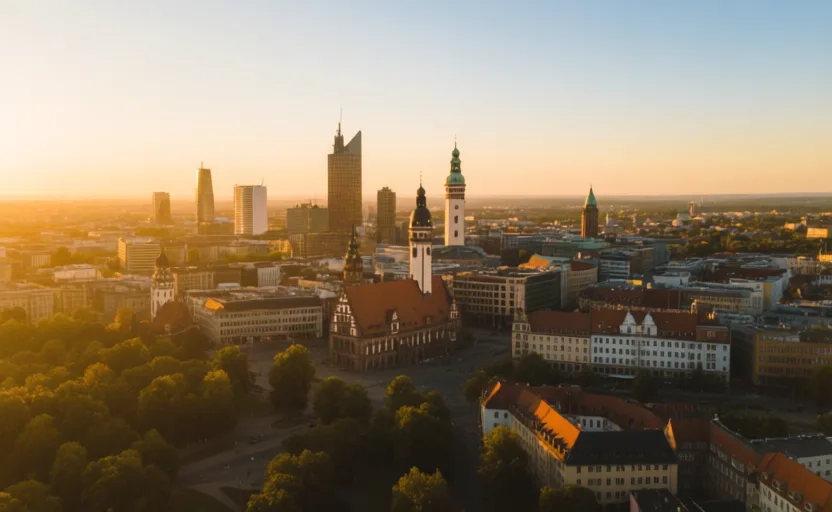 Leipzig · AI city illustration · Artistic impression
City · Europe
Leipzig
Saved in this browser — no account needed. Sign in later and it comes with you.
Where it is
Seen from above, the city is a tangle of waterways in a flat landscape. It lies in the Leipzig Bay, the southernmost lobe of the North German Plain, about 150 km south-west of Berlin. Three rivers meet here, the White Elster with its tributaries the Pleiße and the Parthe, and together they form a delta-like web that Leipzigers call the Gewässerknoten. The ground is swampy and wooded along the water, with some limestone to the north, and the countryside around is relatively treeless. Two old roads crossed on this plain, the east–west Via Regia and the north–south Via Imperii. The climate is oceanic with continental influence: cold winters averaging about 1 °C and warm summers.
The land and water around it
The White Elster and its confluenceriver
The river rises in the Czech Republic and runs on to the Saale south of Halle. The Pleiße and Parthe join it in the city, forming an inland delta-like landscape of channels.
The Auwaldforest
A riparian forest on the swampy ground along the rivers, lying mostly within the city limits. Flat land with traces of moraine and drumlins lies around it.
The former lignite pitslake
Open-pit mines worked in the region during the 20th century. Many have since been flooded and converted into lakes.
Its history, in short
Leipzig was never a royal seat or a bishop’s town, and its history is that of merchants. The first document, from 1015, calls it urbs Libzi, and its name probably comes from the Slavic word for linden trees. It received city and market privileges in 1165, and the trade fair is dated to 1190 and is the oldest surviving fair in the world. A university followed in 1409. In the 18th century the city took on a bookish and musical character, with Bach as cantor from 1723 and the Gewandhaus orchestra from 1743, and it was the centre of German publishing until 1945. Napoleon lost the Battle of Leipzig in 1813, the largest battle in Europe before 1914. The city then became a rail hub, with the first long-distance line in Germany to Dresden in 1839, and the cradle of the German labour movement. The population peaked above 700,000 around 1930 and shrank to 437,000 by 1998 after reunification, but the city has grown quickly since. The demonstrations that began at St Nicholas Church in 1989 helped bring down communist rule.
Timeline
Dates are shown on a timeline rather than as changing shapes on the map. The globe draws modern boundaries only, and tinting a modern outline to stand for a historical one would state something we cannot source.
Post-classical world
1015
First mention
Bishop Thietmar of Merseburg’s chronicle names the place urbs Libzi.
Well attestedWikipedia1165
City and market rights
Otto the Rich grants the town its charter. The fair, dated to 1190, is the longest-running trade fair still held anywhere.
Well attestedWikipedia1409
University founded
One of the oldest universities in German-speaking lands is established here.
Early modern & oceanic
1723–1750
Bach in Leipzig
Johann Sebastian Bach spends the longest phase of his career as Thomaskantor and director of music for the city’s churches, writing among other works the St John and St Matthew Passions.
Industrial & imperial
16–19 October 1813
Battle of the Nations
Austria, Prussia, Russia and Sweden defeat Napoleon, ending his presence in Germany. The monument that marks the centenary was finished in 1913.
7 April 1839
First long-distance railway
The line to Dresden opens, the first long-distance railway in Germany. It makes Leipzig a hub of Central European rail traffic.
23 May 1863
First workers’ party
Ferdinand Lassalle founds the General German Workers’ Association, the first German labour party. About 600 workers travel to the founding by the new railway.
Contemporary
1989
Demonstrations from St Nicholas
Protests that start at St Nicholas Church help to bring down communism in Europe.
Well attestedWikipedia
Places that carry meaning
St Thomas’s Church13th century onward
Where Bach worked as cantor and where the Thomanerchor, a boys’ choir founded in 1212, sings.
St Nicholas Church1989
Starting point of the demonstrations that played a major part in the fall of communism in Europe.
Leipzig Hauptbahnhof1902–1915
Europe’s largest railway station by floor area. It has two grand entrance halls, the eastern hall for the Saxon royal railways and the western one for the Prussian state railways, a reminder of the two states that shared it.
Monument to the Battle of the Nations1913
A 91-metre monument on the spot where the fiercest fighting of 1813 took place.
Languages here
Places are usually multilingual. This lists what is actually spoken, not one language per border.
GermanGermanic family
The official language, used in public life and by the great majority of residents.
The city’s immigrant share is low by German standards: in 2012 only 5.6 percent of residents were foreigners, against a national 7.7 percent. By 2016 people with an immigrant background were 13.3 percent.
Sorbian and PolishSlavic family
Slavic languages with a long local presence.
The city’s name comes from a Slavic word, and the equivalent in Sorbian and Polish is Lipsk. Polish and Sorbian preaching societies were established in Leipzig in 1706 and 1716, and in 1831–32 the city was a route for Polish insurgents fleeing west.
Greek
Spoken by a mercantile community of the 18th century.
When Goethe studied in the city from 1764 to 1768, Leipzig had the largest Greek community outside Greece.
Learn the language here
- 1Understand which languages are spoken hereLeipzig is multilingual. Start with which languages are used, by whom, and for what — the phrase list only covers one of them.Written by Globe Quest
- 2Learn 11 phrasesCurated everyday phrases for Leipzig, with audio and a written form.Written by Globe Quest
- 3Say them out loudSpeaking practice with pronunciation feedback, one phrase at a time.Globe Quest material, your own additions
- 4Come back to themSpaced review, so what you learned this week is still there next month.Written by Globe Quest
Check yourself
Which two medieval roads crossed at Leipzig?
The Via Regia and the Via Imperii
The Via Regia ran east to west and the Via Imperii north to south, so the market on their crossing became a fair city.
What opened on 7 April 1839?
The first long-distance railway in Germany, from Leipzig to Dresden
The Leipzig–Dresden line made the city a rail hub. The university dates from 1409 and the Gewandhaus orchestra from 1743.
Worth arguing about
- Leipzig lost a third of its people after 1990 and has since become Germany’s fastest-growing big city. What turns a shrinking city around?
- A city of merchants with no court or cathedral became a centre for books, music and politics. Why do trading towns produce so many ideas?
What we have not established
These are open questions, listed rather than filled in. We would rather show a gap than a plausible guess.
How many people live in Leipzig?
The figure of 633,592 at the end of 2025 sits beside an earlier rounded 620,000, and the city has grown quickly since 2015, so the total depends on the date. The historical peak of over 700,000 around 1930 was within different boundaries.
Sources
- Wikipedia · LeipzigWikipedia · encyclopedia · checked 2026-11-24
- Wikipedia · History of LeipzigWikipedia · encyclopedia · checked 2026-11-24
Reviewed by Globe Quest editorial on 2026-11-24. Drafted with AI assistance and checked against the sources above before publication.