 Globe Quest
 Human Quest · LearningSign in
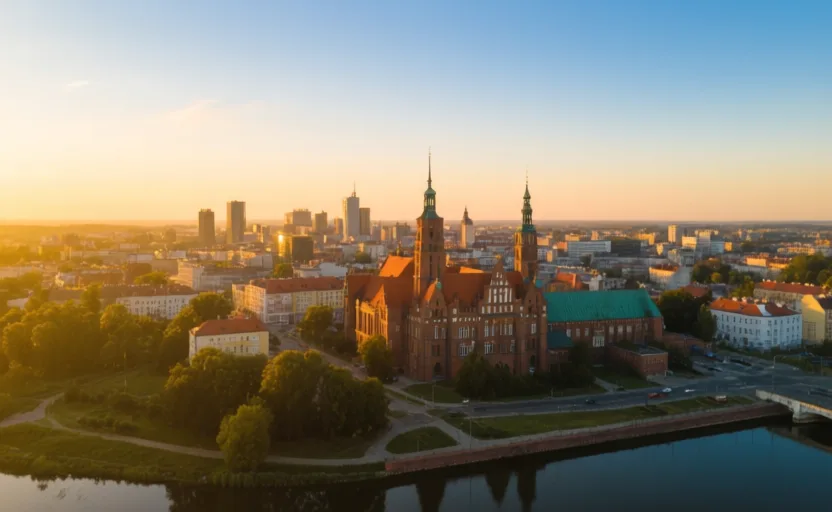 Szczecin · AI city illustration · Artistic impression
City · Europe
Szczecin
Saved in this browser — no account needed. Sign in later and it comes with you.
Where it is
Szczecin straddles the lower Oder, a short way south of the lagoon and bay through which the river reaches the Baltic. The city spreads along the southwestern shore of Dąbie Lake and across both branches of the river, with islands of low ground between them, and it is ringed by forest and heath that continue into Germany. That position, a river port with a sea outlet behind a lagoon, explains most of its history. The climate is oceanic: winters are colder than on the open coast, summers are warm but tempered by the Baltic, and annual rainfall is modest, around 540 millimetres.
The land and water around it
The lower Oderriver
The river splits into western and eastern branches here, leaving islands of low ground in between. Szczecin grew where the Oder could be forded and where ships could still come inland, and grain from Pomerania, Brandenburg and Greater Poland was sent down the Oder and its tributary the Warta to be loaded in the port.
Dąbie Lakelake
The city runs along the lake’s southwestern shore. Water divides it into districts on either bank and on the islands between, which is why the right-bank district, Prawobrzeże, is administered as a separate part of the city.
The lagoon and the Bay of Pomeranialagoon
Ships bound for the sea leave Szczecin through the lagoon and the bay to its north, so the city is a seaport that sits well inland. That arrangement made it useful to Sweden, Prussia and Poland in turn, and later made it an outlet for Silesian coal.
Its history, in short
The place began as a Slavic stronghold on the Oder at the site of the later ducal castle. Once the neighbouring port of Wolin declined in the 12th century, Szczecin became one of the main harbours on the southern Baltic. Polish rulers, German empires and Danish kings all claimed overlordship in turn, while a local dynasty, the Griffins, kept the ducal seat here until it died out in 1637. After the Thirty Years’ War the city became the capital of Swedish Pomerania and a fortress, and in 1720 it passed to Prussia. As Stettin it grew from a few thousand people in the early 1700s to over two hundred thousand by 1905, and Haussmann-style boulevards were laid out in the 1880s. The Second World War left the centre partly destroyed and the population sharply reduced. From 1946 the German inhabitants were expelled and the city was resettled by Poles, mostly from central Poland, and by others displaced by the war. As Polish Szczecin it became a shipbuilding and coal-export port, and in 1980 it was the place where protesters signed the first agreement with the communist authorities, an agreement that opened the way to Solidarity.
Timeline
Dates are shown on a timeline rather than as changing shapes on the map. The globe draws modern boundaries only, and tinting a modern outline to stand for a historical one would state something we cannot source.
Post-classical world
8th century
A Slavic stronghold on the Oder
West Slavic people build a fortified settlement on the site that later holds the ducal castle, beside a ford of the river. Over the following centuries it is strengthened and extended toward the riverbank.
1121–1122
Bolesław III takes the city
A winter campaign by the Polish duke Bolesław III brings Szczecin and Pomerania under his overlordship. Duke Wartislaw I stays on as local ruler and pays tribute, and Bishop Otto of Bamberg is invited to convert the population, with his first mission following in 1124.
1243
Magdeburg rights
Duke Barnim grants the city Magdeburg law, after a charter of 1237 had separated the German merchants from the Slavic community around St Nicholas’s Church. The city becomes a trading town of the Hanseatic world, dealing in grain, salt and herring.
Well attestedWikipedia
Early modern & oceanic
1648
Capital of Swedish Pomerania
Sweden had occupied the city after the Treaty of Stettin in 1630, and the Peace of Westphalia confirmed its hold. Szczecin is made a major fortress and is besieged several times; in 1677 it falls to a Danish, Brandenburger and Lüneburger army.
1720
Passed to Prussia
Sweden, beaten in the Great Northern War, gives up the city to Prussia under Frederick William I. Plague had cut the population from 6,000 to 4,000 between 1709 and 1711.
Well attestedWikipedia
Industrial & imperial
1880s
Remodelled on a Paris plan
The city is re-planned with wide tree-lined avenues and roundabouts, to a plan drawn up by Georges-Eugène Haussmann, the man behind the rebuilding of Paris. This street pattern is still visible and is still used in new districts.
Approximate dateWikipedia
Contemporary
1946–1950
Expulsion and resettlement
The pre-war population had fallen to 57,215 by October 1945. From February 1946 the German inhabitants were systematically expelled, and by 1950 none remained. Settlers, about 70 per cent of them from central Poland, together with Ukrainians, Poles returning from Harbin and Greek civil-war refugees, formed the new population.
Well attestedWikipedia1980
The Szczecin agreement
Protests in 1970 are followed by a second wave in 1980, and that year the first agreement between protesters and the communist regime is signed in the city. It paves the way to the creation of Solidarity.
Well attestedWikipedia
Places that carry meaning
The Ducal Castle8th century onward
The castle stands where the Slavic stronghold was. It was the seat of the Pomeranian dukes, the last of whom, Bogislaw XIV, was buried here in 1654, and Duke Philip II assembled a collection of ancient and early modern coins in it in the early 1600s.
St Jacob’s ChurchConsecrated 1187
Founded by a merchant from Bamberg named Beringer, it was the centre of the German traders who settled in the city in the late 12th century. Its date shows that German commerce in Szczecin predates the city’s Magdeburg charter by more than half a century.
The boulevard city plan1880s
Broad avenues with trees and often tram lines down the middle, joined by roundabouts, give central Szczecin a layout that recalls Paris. After 1945 the communist authorities chose to conserve Gothic and Renaissance buildings as the city’s Polish-looking heritage, while much of the rebuilt centre went up in the socialist-realist style.
Languages here
Places are usually multilingual. This lists what is actually spoken, not one language per border.
PolishSlavic family
The language of nearly all residents since 1945.
Polish is the predominant language of Poland, with 97 per cent of respondents giving it as their mother tongue. Most of Szczecin’s Polish speakers descend from the settlers who arrived after 1945, mainly from central Poland.
GermanGermanic family
The everyday language of the city until 1945.
The city appeared as Stettin in German, the counterpart of the Polish name. By the 1630s the city had become completely German-speaking, and 93 per cent of its population was Protestant in 1890. The German population was expelled after the war, so the language no longer has a community here.
UkrainianSlavic family
The language of the largest recent immigrant community.
After 2014 Szczecin received many Ukrainians. About 26,000 were officially registered in July 2017, with unofficial estimates up to 50,000, more than a tenth of the city’s inhabitants.
Learn the language here
- 1Understand which languages are spoken hereSzczecin is multilingual. Start with which languages are used, by whom, and for what — the phrase list only covers one of them.Written by Globe Quest
- 2Learn 12 phrasesCurated everyday phrases for Szczecin, with audio and a written form.Written by Globe Quest
- 3Say them out loudSpeaking practice with pronunciation feedback, one phrase at a time.Globe Quest material, your own additions
- 4Come back to themSpaced review, so what you learned this week is still there next month.Written by Globe Quest
Check yourself
Which state held Szczecin as the capital of its part of Pomerania from 1648 until 1720?
Sweden
Sweden occupied the city in 1630 and the Peace of Westphalia confirmed it as the capital of Swedish Pomerania. It passed to Prussia in 1720 after the Great Northern War.
What happened to the city’s population between 1939 and 1950?
It collapsed and was replaced by Polish and other settlers after the Germans were expelled
The pre-war population of more than 268,000 fell to 57,215 by October 1945, and the remaining Germans were expelled from 1946. The new population was drawn from across Poland and from people displaced by the war.
Worth arguing about
- Szczecin has had Slavic, German, Swedish and Polish rulers, and was resettled almost entirely in the 1940s. What does a city inherit when nearly all of its people change, and what do the new residents have to build for themselves?
- The city is laid out on a Paris model but sits on a river split by islands and low ground. How far does an imported plan fit the ground it is laid on?
What we have not established
These are open questions, listed rather than filled in. We would rather show a gap than a plausible guess.
Where does the name Szczecin come from?
The name is Proto-Slavic, and the first record, as Stetin, dates from 1112 to 1118. A standard dictionary of Polish place names lists eleven different theories, including a word for a hill peak, the teasel plant and a personal name, and none has won out.
Sources
- Wikipedia · SzczecinWikipedia · encyclopedia · checked 2026-11-24
- Wikipedia · History of SzczecinWikipedia · encyclopedia · checked 2026-11-24
- Wikipedia · PolandWikipedia · encyclopedia · checked 2026-11-24
Reviewed by Globe Quest editorial on 2026-11-24. Drafted with AI assistance and checked against the sources above before publication.