 Globe Quest
 Human Quest · LearningSign in
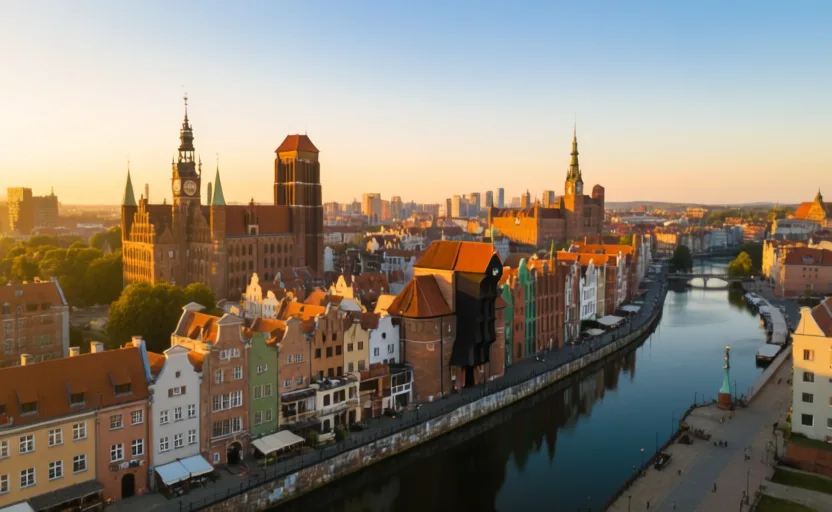 Gdansk · AI city illustration · Artistic impression
City · Europe
Gdansk
Also known as Danzig, Gdańsk
Saved in this browser — no account needed. Sign in later and it comes with you.
Where it is
Gdańsk is built where the Motława meets the Vistula, near the head of the Gulf of Gdańsk on the Baltic. The city is split between two levels. The low Dolny Taras by the coast covers part of the Vistula Fens, while the Górny Taras above it is uneven upland belonging to the Kashubian Lake District. Neighbouring Sopot and Gdynia run along the same shore, forming the Tricity. The climate mixes oceanic and continental traits: winters are cloudy and near freezing in January, summers mild with showers, and seasonal extremes are softer than inland, with only about 507 millimetres of rain a year.
The land and water around it
The Vistula delta and the Motławadelta
The city sits at the mouth of both rivers, which shaped its geography and economy. The name itself is thought to come from Gdania, the old name of the Motława, and the Vistula brought the grain trade that made the port rich.
The two terracesplateau
A low coastal terrace over the Vistula Fens, and above it an upland terrace that is part of the Kashubian Lake District. After a flood in 2001 that killed four people, the city built more than fifty reservoirs.
The amber coastcoast
Most of the world's amber deposits lie along this stretch of the Baltic, and the Amber Road is among the oldest traces of trade in the area. Amber processing remains part of the local economy.
Its history, in short
The place first appears in writing in 997, in a biography of Saint Adalbert, as a town ruled by Bolesław I the Brave, though archaeology suggests timber building here by the 10th century. It grew on the Baltic trade routes under Piast and then Samborid rulers. In 1308 the Teutonic Knights, called in against Brandenburg, seized it and killed many inhabitants. In 1454 the city turned against the Order and rejoined the Kingdom of Poland, receiving wide privileges. Through the early modern period it was Poland's main seaport and its largest city, mostly German-speaking and Protestant, and it kept considerable autonomy. Prussia annexed it in 1793; it was a Napoleonic free city from 1807 to 1814 and then a Prussian and German city until 1919. The League of Nations made it the Free City of Danzig, and the war began here on 1 September 1939 at Westerplatte. After 1945 the German population left or was expelled, and Polish settlers rebuilt it. Solidarity, the movement that helped end communist rule, was born here.
Timeline
Dates are shown on a timeline rather than as changing shapes on the map. The globe draws modern boundaries only, and tinting a modern outline to stand for a historical one would state something we cannot source.
Post-classical world
997
First written mention
A biography of Saint Adalbert records his visit to a town called Gyddanyzc under Bolesław I the Brave. The exact site of this early settlement is not firmly established, and archaeology points to timber building in the 10th century.
1308
The Teutonic takeover
After a siege by Brandenburg, Polish forces appeal to the Teutonic Knights, who relieve the stronghold, seize the town and kill many of its people. Estimates of the dead run to roughly a thousand townspeople, out of a population of 2,000 to 3,000.
Early modern & oceanic
1454
Return to the Polish crown
The Prussian Confederation, which the city had helped found in 1440, appeals to King Casimir IV. The war with the Order lasts until 1466, and Gdańsk wins the right to its own laws and taxes.
1793
Annexed by Prussia
The Second Partition gives the city to Prussia. The population largely opposed it, the mayor resigned, and some families, including the Schopenhauers, left.
Industrial & imperial
1920–1939
The Free City of Danzig
Created under the Treaty of Versailles and overseen by the League of Nations, with its own constitution and parliament. Poland controlled foreign affairs, had a customs union and a garrison on Westerplatte.
1 September 1939
The war begins at Westerplatte
The German attack on the Polish depot at Westerplatte is one of the first events of the Second World War. Westerplatte's defenders surrendered after seven days.
Contemporary
1945
Resettlement
The city, heavily damaged, comes under Polish administration on 30 March 1945. Some 124,000 Germans and 8,000 Poles lived there in June; Germans were then expelled and Poles from across the country and the former east replaced them.
1980s
Solidarity
The independent trade union and movement is born in the city and helps bring about the end of communism in Europe. Its leader, Lech Wałęsa, becomes President of Poland in 1990.
Well attestedWikipedia
Places that carry meaning
The Main Town and Town HallMedieval onward
The oldest traces of medieval settlement lie under the Town Hall of the Main Town. Parts of the old city were rebuilt in the 1950s and 1960s, in a way that played down German influence and stressed Flemish, Dutch, Italian and French ones.
St. Mary's ChurchMedieval
One of the largest brick churches in the world, a landmark of the historic centre, which is listed as a national monument.
Westerplatte1939
The military depot where the German assault of 1 September 1939 began, one of the first clashes of the Second World War.
European Solidarity CentreOpened 2014
A museum and library devoted to the history of Solidarity, in the city where the movement began.
Languages here
Places are usually multilingual. This lists what is actually spoken, not one language per border.
PolishSlavic family
The language of the city today.
Poles from other parts of the country, from expelled eastern regions and from nearby villages replaced the German-speaking population from 1945.
GermanGermanic family
The dominant language of the city before 1945.
Around 1600 over 90 per cent of residents were German-speaking Protestants, and in the 1923 census 95 per cent in the Free City were German-speaking, with 3.5 per cent speaking Polish or Kashubian.
KashubianSlavic family
The regional language of the area around the city.
In Kashubian the city is called Gduńsk. About 100,000 people use the language daily in Kashubia and Pomerania, and it is Poland's one recognised regional language.
Learn the language here
- 1Understand which languages are spoken hereGdansk is multilingual. Start with which languages are used, by whom, and for what — the phrase list only covers one of them.Written by Globe Quest
- 2Learn 11 phrasesCurated everyday phrases for Gdansk, with audio and a written form.Written by Globe Quest
- 3Say them out loudSpeaking practice with pronunciation feedback, one phrase at a time.Globe Quest material, your own additions
- 4Come back to themSpaced review, so what you learned this week is still there next month.Written by Globe Quest
Check yourself
Why was Danzig a Free City from 1920 to 1939?
Germans formed the majority, so it was not given to Poland, but Poland kept rights there
The Allies promised Poland access to the sea, but because German speakers made up most of the city, it was placed under the League of Nations instead, with Polish rights over the port, a post office and a garrison.
What happened in 1454?
The city rejoined the Kingdom of Poland and won broad privileges
After the Prussian Confederation rose against the Order, King Casimir IV took the territory back, and Gdańsk gained the right to enact its own laws and set taxes.
Worth arguing about
- Postwar planners rebuilt the old town to look less German. Can a rebuild choose which parts of a city's past to keep?
- The city was Polish, Teutonic, Prussian, free and German in turn. Which name, Gdańsk or Danzig, should a visitor use, and why does it matter?
What we have not established
These are open questions, listed rather than filled in. We would rather show a gap than a plausible guess.
Where was the settlement of 997?
The 10th-century biography names a town that is generally identified with Gdańsk, but the exact location of that early settlement has not been securely established, and the founding is variously dated to the 980s and to timber felled in 930.
Sources
- Wikipedia · GdańskWikipedia · encyclopedia · checked 2026-11-24
- Wikipedia · History of GdańskWikipedia · encyclopedia · checked 2026-11-24
- Wikipedia · PolandWikipedia · encyclopedia · checked 2026-11-24
Reviewed by Globe Quest editorial on 2026-11-24. Drafted with AI assistance and checked against the sources above before publication.