 Globe Quest
 Human Quest · LearningSign in
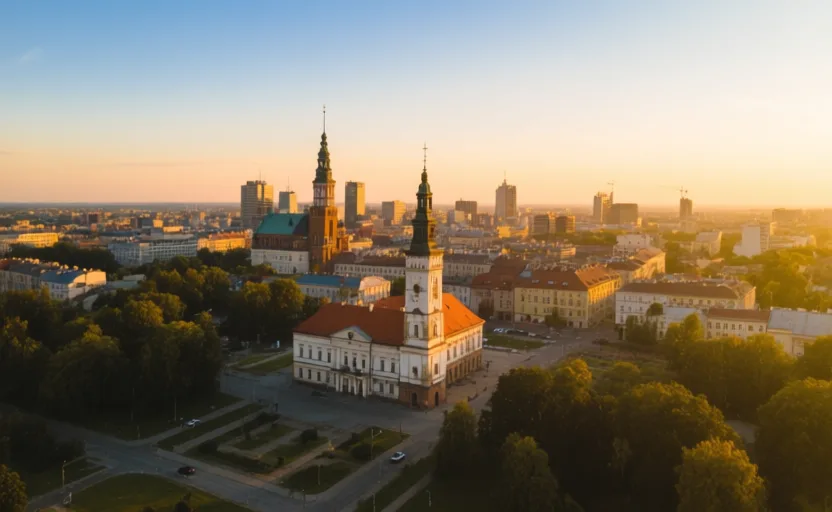 Katowice · AI city illustration · Artistic impression
City · Europe
Katowice
Saved in this browser — no account needed. Sign in later and it comes with you.
Where it is
Katowice stands on the Silesian Highlands in the Upper Silesian Coal Basin, about 50 kilometres north of the Silesian Beskids, with a lowest point of 245 metres, making it the highest-lying large city in Poland. The watershed between the Oder and the Vistula runs through it, with the Kłodnica and Rawa rivers draining to either side. Gentle south-westerly winds come through the Moravian Gate. What defines the place is not the surface but what lies under it: coal and metal ores that turned a group of villages into the core of Poland's largest conurbation, which has about 2.7 million people.
The land and water around it
The Silesian Highlandsplateau
A gently rolling upland, at roughly 245 to 300 metres, where the median elevation of the city is about 266 metres. The ground is flat enough that mine drainage was a huge engineering problem at nearby Tarnowskie Góry, where water inflow was up to three times that at other major European metal mines.
The Oder–Vistula divideriver
The boundary between the catchments of the Oder and the Vistula crosses the city. The Kłodnica, a tributary of the Oder, and the Rawa, a tributary of the Vistula, are its largest rivers, and the city sits on a hinge between the two great Polish river systems.
The coal basinplain
Rich coal reserves, found in the mid-18th century, and metal ores shaped the settlement pattern. Red-brick workers' estates, chimneys, plants and quarries make up the typical cityscape, and each mining district grew its own commercial strip.
Its history, in short
Unlike most big Polish cities, Katowice never began as a medieval town with a market and walls. It grew from villages, the oldest of them Dąb, mentioned in 1299, and the name Katowice first appears in 1598. Silesia passed from the Piasts to the Bohemian Crown, then the Habsburgs, and in 1742 to Prussia. The change came with industry. A railway reached the town in 1847, linking it to Berlin, Vienna, Kraków and Warsaw, and coal and steel made Kattowitz a city in 1865. After the First World War a plebiscite and a Silesian uprising settled the borders, and in 1922 the city joined Poland as the capital of an autonomous Silesian Voivodeship. Germany burned its synagogue in 1939 and expelled most Poles and Jews by 1941. Under communism it was renamed Stalinogród from 1953 to 1956. Coal mines have closed since, and the economy has shifted to services, education and culture.
Timeline
Dates are shown on a timeline rather than as changing shapes on the map. The globe draws modern boundaries only, and tinting a modern outline to stand for a historical one would state something we cannot source.
Post-classical world
1299
Dąb, the oldest village
The village that later became part of the city is first mentioned in a document of Duke Casimir of Bytom. The name Katowice itself first appears in 1598.
Well attestedWikipedia
Early modern & oceanic
1742
Prussian Silesia
Prussia seizes most of Silesia in the First Silesian War. Two more wars leave the area depopulated and its economy in ruins.
Well attestedWikipedia
Industrial & imperial
1847
The railway
The Breslau–Myslowitz line is completed in 1846, and the first train reaches Katowice station on 6 August 1847. Connections to Berlin, Kraków, Vienna and Warsaw follow within a year.
Well attestedWikipedia11 September 1865
City status
King Wilhelm I grants city rights to Kattowitz. In 1884, 36 Zionist delegates meet here and form the Hovevei Zion movement.
1921–1922
The plebiscite and the border
In the 1921 plebiscite, over 85 per cent of the city voted to stay in Germany, while the surrounding rural district voted 56 per cent for Poland. After rumours that the border would favour Germany, the Third Silesian Uprising broke out, and Katowice joined Poland in 1922 with a measure of autonomy.
1939–1945
German occupation
The Great Katowice Synagogue is burned on 4 September 1939. Polish street names are replaced, public use of Polish is banned, and by mid-1941 most Polish and Jewish residents have been expelled. The Red Army captures the city in January 1945.
Contemporary
1953–1956
Stalinogród
On the day of Stalin's death the communist government decrees a new name for the city. Residents never accepted it, and in 1956 the name Katowice was restored.
2018
A climate conference in a coal city
Katowice hosts COP24, the United Nations climate conference, as it pivots from heavy industry to services and the arts.
Well attestedWikipedia
Places that carry meaning
NikiszowiecFormer mining town
A former mining settlement built around a mine, gentrified in recent years and now known for its brick architecture and art galleries.
Cathedral of Christ the King1927–1955
A classicist cathedral and the largest in Poland, seat of the Roman Catholic archdiocese of Katowice.
Tarnowskie Góry mine16th to 19th century
Near Katowice, a lead, silver and zinc mine with 50 kilometres of main drainage tunnels, listed by UNESCO for its water-management system, an early example of public water supply driven by steam pumps.
Languages here
Places are usually multilingual. This lists what is actually spoken, not one language per border.
PolishSlavic family
The national and everyday language; 93.87 per cent of residents declared Polish nationality in 2021.
In 1867 the town's population was about 50 per cent Polish, and in the Prussian era Polish reading rooms and societies kept the language going. In the census respondents can name two nationalities, which is why shares can add up to more than 100 per cent.
GermanGermanic family
The language of administration under Prussia and during the Second World War.
The town was renamed Kattowitz and flourished under Prussian rule. In 1939 the German occupiers banned Polish in public and renamed the streets in German.
UkrainianSlavic family
The language of a small religious congregation and part of the city's mixed population.
One Jehovah's Witness congregation holds services in Ukrainian and another in English, alongside the Polish-language ones. In the 1950s Greek refugees from the civil war also settled in the city.
Learn the language here
- 1Understand which languages are spoken hereKatowice is multilingual. Start with which languages are used, by whom, and for what — the phrase list only covers one of them.Written by Globe Quest
- 2Learn 12 phrasesCurated everyday phrases for Katowice, with audio and a written form.Written by Globe Quest
- 3Say them out loudSpeaking practice with pronunciation feedback, one phrase at a time.Globe Quest material, your own additions
- 4Come back to themSpaced review, so what you learned this week is still there next month.Written by Globe Quest
Check yourself
Why does Katowice lack a medieval old town?
It was never founded as a medieval market town and grew from villages and industry
Katowice grew out of villages as coal and steel arrived, so its layout reflects annexed towns and workers' estates, not a Magdeburg-law grid with a market square.
What was Katowice called from 1953 to 1956?
Stalinogród
The communist government renamed the city on the day Stalin died. People never accepted the name, and the old one returned in 1956.
Worth arguing about
- The 1921 plebiscite gave the city a large majority for Germany and the countryside one for Poland. Whose choice should decide where a border runs?
- A city built entirely on coal now hosts climate talks and bills itself as a city of music. Can a place reinvent itself without hiding where it came from?
What we have not established
These are open questions, listed rather than filled in. We would rather show a gap than a plausible guess.
How many people live in Katowice?
The figures depend on how residents are counted. The official population was 286,960 in 2021, a resident estimate puts it near 315,000, and the statistical office gave 292,774 for the end of 2020. The wider metropolitan area is given as 2.5 million and the conurbation as about 2.7 million.
Sources
- Wikipedia · KatowiceWikipedia · encyclopedia · checked 2026-11-24
- Wikipedia · History of KatowiceWikipedia · encyclopedia · checked 2026-11-24
- UNESCO · Tarnowskie Góry Lead-Silver-Zinc Mine and its Underground Water Management SystemUNESCO World Heritage Centre · intergovernmental · checked 2026-11-24
Reviewed by Globe Quest editorial on 2026-11-24. Drafted with AI assistance and checked against the sources above before publication.