 Globe Quest
 Human Quest · LearningSign in
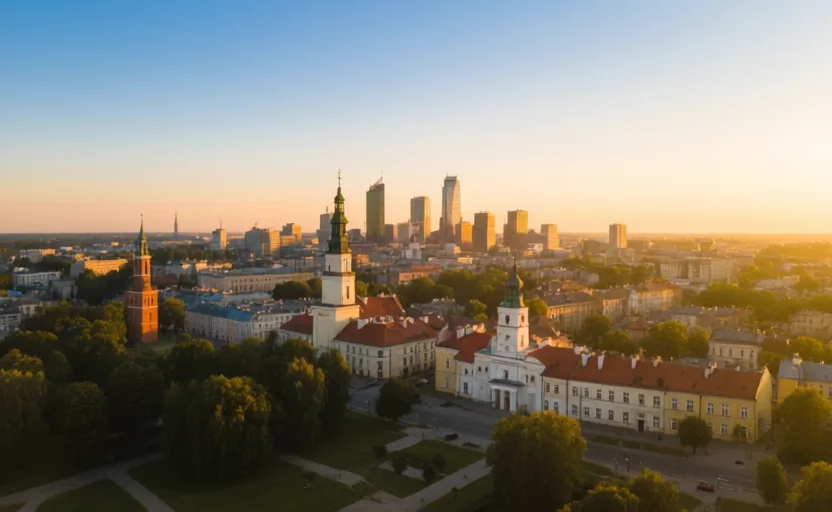 Łódź · AI city illustration · Artistic impression
City · Europe
Łódź
Saved in this browser — no account needed. Sign in later and it comes with you.
Where it is
Łódź lies in the middle of Poland, about 120 kilometres south-west of Warsaw, on flat ground in the lowlands of the Central European Plain. The land never rises more than 300 metres and the local hills stay within 50 metres of the surrounding ground. The soil is mostly sand, with clay and small areas of wetland peat, and forest cover is thin. The town grew on the small Łódka, now canalised, and the many small rivers around it were enough to power the early mills. The climate is humid continental.
The land and water around it
The Central European Plainplain
Łódź is on this lowland, with a flat landscape and highlands not exceeding 50 metres above their surroundings. It is the heart of the country, and the town never had defensive walls.
The small riversriver
The streams, including the Łódka, were enough to power fulling mills, bleaching works and other textile machinery in the 19th century. Their abundance is the reason given for the textile industry developing here.
Sandy soil and wetlandmarsh
The ground is 62 per cent sand, 24 per cent clay, 8 per cent silt and 6 per cent organic wetland deposits. For centuries it was thinly settled among woodlands and marshes, mainly farmland until the 19th century.
Its history, in short
For centuries Łódź was a small settlement among woods and marshes, owned by the bishops of Włocławek. It got town rights in 1423 but had fewer than 200 people at the end of the 18th century. Its transformation was planned from above: in 1820 the government of Congress Poland picked it for industrial development, laid out a new centre and an octagonal square, and offered tax exemptions that drew German weavers and craftsmen. Textiles then made it among the most crowded industrial cities anywhere, growing from 13,000 people in 1840 to over 500,000 by 1913, with Poles, Germans and Jews living side by side and sharply divided by wealth. Under German occupation it was renamed Litzmannstadt and its Jews were walled into a ghetto. In 1945 it served as Poland's temporary seat of government. After 1989 the textile industry collapsed, and only in the 2010s did the neglected centre begin to be revived.
Timeline
Dates are shown on a timeline rather than as changing shapes on the map. The globe draws modern boundaries only, and tinting a modern outline to stand for a historical one would state something we cannot source.
Post-classical world
1332
First written record
Władysław the Hunchback, Duke of Łęczyca, hands the village of Łodzia over to the bishops of Włocławek in a document that lists its inhabitants' rights to graze land and to log.
1423
Town rights
King Władysław II Jagiełło grants town rights under Magdeburg Law, though the town stays small, with no more than about 1,000 people, and never has walls.
Industrial & imperial
1820s
A planned industrial town
The Congress Kingdom designates Łódź for centrally planned industry. A new centre with an octagonal square (now Liberty Square) is built in 1821–23, then cotton-mill colonies and the north–south Piotrkowska Street in 1824–28.
1840–1913
Textile boom
The population climbs from 13,000 to over 500,000, with a large share of migrants who are Jews and Germans. Just before the First World War it is crowded to about 13,280 inhabitants per square kilometre, among the densest and most polluted industrial cities anywhere.
Well attestedWikipedia1931
Muzeum Sztuki
The museum is founded and becomes the first in Europe devoted to collecting and showing modern art, a sign of the city's interwar avant-garde.
Well attestedWikipedia1940
Litzmannstadt
Incorporated into the Reichsgau Wartheland in November 1939, the city is renamed on 11 April 1940 after a German general. Polish and Jewish establishments are closed, and Jews are forced into a walled ghetto before deportation to camps.
Well attestedWikipedia
Contemporary
January 1945
Temporary capital
Soviet forces liberate the city on 19 January. With Warsaw in ruins, Łódź informally takes over as the seat of government and administration until the capital is rebuilt. The University of Łódź opens in May and the National Film School in 1948.
Well attestedWikipediaAfter 1989
The end of the textile city
The industry collapses and the population falls from a peak of around 854,000 in 1988. Łódź was Poland's second city until 2007, then lost ground to Kraków and later Wrocław.
Well attestedWikipedia
Places that carry meaning
Piotrkowska StreetFrom 1824–1828
The long main street laid out as the spine of the planned industrial town, revitalised in the 2000s with shops and restaurants. Mansions, red-brick factories and tenements once stood side by side along its length.
Liberty Square1821–1823
The octagonal square at the heart of the new town centre planned by Rajmund Rembieliński, south of the old marketplace.
The Litzmannstadt Ghetto area1940–1944
The walled zone where the city's large Jewish minority was confined before deportation to concentration and extermination camps.
St. Matthew's ChurchHistoric church
The only active Lutheran church left in the city, a reminder of the German-speaking Protestant weavers and workers who once made up a sizable part of the city. It also serves as a concert hall.
Languages here
Places are usually multilingual. This lists what is actually spoken, not one language per border.
PolishSlavic family
The national and everyday language.
Under German occupation the Polish-language press was banned and Polish establishments were closed. Today Łódź is one of the more secular Polish cities, with mass attendance estimated at 17 per cent in 2023.
GermanGermanic family
The language of weavers and factory owners in the industrial city.
In 1839 about 78 per cent of the town's 6,648 people were German. Newcomers were drawn by tax exemptions and the planned textile industry, and the Protestant community that grew from these migrants still made up 9.2 per cent of the population in 1931.
Learn the language here
- 1Understand which languages are spoken hereŁódź is multilingual. Start with which languages are used, by whom, and for what — the phrase list only covers one of them.Written by Globe Quest
- 2Learn 12 phrasesCurated everyday phrases for Łódź, with audio and a written form.Written by Globe Quest
- 3Say them out loudSpeaking practice with pronunciation feedback, one phrase at a time.Globe Quest material, your own additions
- 4Come back to themSpaced review, so what you learned this week is still there next month.Written by Globe Quest
Check yourself
Why was Łódź called the Polish Manchester?
Its textile industry grew from small town to huge mill city in the 19th century
Government planning from 1820, German weavers, and the power of small streams turned a town of under 200 people at the end of the 18th century into a city of over half a million by 1913.
Why did Łódź act as Poland's capital in 1945?
Warsaw was in ruins and the government needed somewhere to work
After the destruction of Warsaw, most of the government and administration sat in Łódź until the capital was reconstructed.
Worth arguing about
- Łódź's rise was planned by a state and fed by migrants, then it fell when its single industry went. What should a city built for one purpose do when the purpose goes?
- The old mills and mansions now attract visitors. Is industrial heritage worth preserving when it remembers hardship as much as wealth?
What we have not established
These are open questions, listed rather than filled in. We would rather show a gap than a plausible guess.
Where does the name Łódź come from?
There is no consensus. The Polish word means boat, which is linked with the old village of Łodzia and the Łódka river, but the name may also come from a word for willow or from the personal name Włodzisław.
Sources
- Wikipedia · ŁódźWikipedia · encyclopedia · checked 2026-11-24
- Wikipedia · History of ŁódźWikipedia · encyclopedia · checked 2026-11-24
Reviewed by Globe Quest editorial on 2026-11-24. Drafted with AI assistance and checked against the sources above before publication.