 Globe Quest
 Human Quest · LearningSign in
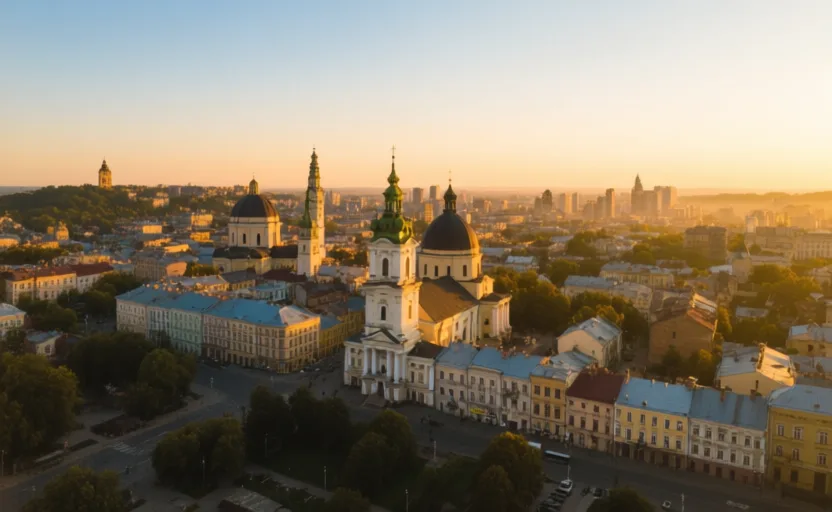 Lviv · AI city illustration · Artistic impression
City · Europe
Lviv
Also known as Lemberg, Lwów, Львів
Saved in this browser — no account needed. Sign in later and it comes with you.
Where it is
Lviv is built where the Roztochia Upland ends, in a basin at an average of 296 metres above sea level. It is about 70 kilometres east of the Polish border and 160 kilometres north of the eastern Carpathians. The old town grew on the low ground at the foot of the High Castle hill, which at 409 metres is the highest point in the city, and beside the small Poltva River, which was covered over in the early 20th century and now runs under the main avenue and the opera house. The climate is humid continental, with a January mean of about −3 °C and a July mean of 18 °C, and rain peaks in summer. A position between the Black Sea and the Baltic, and between Kyiv and Kraków, shaped everything the city became.
The land and water around it
The High Castle hillmountains
A hill of 409 metres, the highest point in Lviv, with a view over the historic centre. The oldest settlement and the first fortified stronghold were on its slopes, and the old walled town was laid out below it.
The Poltva Riverriver
A small stream that bounded the medieval town on the west and carried goods in the 13th century. In the early 20th century it was covered where it crosses the city, and it now flows beneath Liberty Avenue and the opera house.
The Roztochia Uplandplateau
The city lies on the edge of this upland, 160 kilometres north of the eastern Carpathians. Its position on the Black Sea–Baltic and Kyiv–Kraków routes, and its distance from routes of Tatar raids, let it overtake older centres such as Halych.
Its history, in short
Lviv was rebuilt after the Mongol invasion of 1240 by King Daniel of Galicia, who named it for his son Lev, and it first appears in written sources in 1259. Sitting on trade routes between the Black Sea and the Baltic, and between Kyiv and Kraków, it drew Ruthenians, Germans, Jews, Tatars, Karaites and Armenians. It was the capital of the Galicia–Volhynia principality, then in 1349 passed to Poland, and in 1356 Casimir III gave it Magdeburg rights, handing self-government to a council of wealthy citizens. German-speaking burghers became the majority in the 15th century and were later Polonised. After the First Partition of Poland in 1772 it became Lemberg, capital of Austrian Galicia, and grew from about 30,000 people to over 200,000 by 1913. In 1918 Poles and Ukrainians fought over it, and it became part of interwar Poland, a major academic centre. The Soviets annexed it in 1939, and in the war and the postwar population transfers it lost an estimated 80 to 90 percent of its prewar population. Since 1991 it has been part of independent Ukraine and has been hit repeatedly by Russian missile and air attacks since 2022.
Timeline
Dates are shown on a timeline rather than as changing shapes on the map. The globe draws modern boundaries only, and tinting a modern outline to stand for a historical one would state something we cannot source.
Post-classical world
1259
First written mention
After the Mongol invasion, the stronghold is rebuilt under Daniel of Galicia and named for his son Lev. The earliest source naming the town dates from 1259, and another from 1261 says its fortifications were pulled down at the Tatars’ demand.
Approximate dateWikipedia17 June 1356
Magdeburg rights
Casimir III of Poland moves the city to a new site and grants it Magdeburg law, so that a council elected by wealthy citizens decides city matters. This begins a period of accelerated development.
Early modern & oceanic
1772
Capital of Austrian Galicia
After the First Partition of Poland the city is annexed by the Habsburgs and, as Lemberg, becomes capital of the Kingdom of Galicia and Lodomeria. It grows from about 30,000 people to 196,000 by 1910, with rising poverty.
Well attestedWikipedia
Industrial & imperial
1–22 November 1918
Polish–Ukrainian fighting over the city
After Austria-Hungary collapses, Ukrainian forces take control of the city on the night of 31 October to 1 November and proclaim the West Ukrainian People’s Republic with Lviv as capital. Polish residents rise against them, and regular Polish forces reach the city on 19 November and force the Ukrainians out by 22 November. About 340 civilians are killed in the looting and burning of Jewish and Ukrainian quarters that follows.
Ukrainian accounts see the city as part of a new Ukrainian state; Polish accounts see a city with a Polish majority that was seized. Both nations treated Lviv as part of their new states.
September 1939
Soviet annexation
German forces encircle the city by 14 September, the Soviets invade Poland on 17 September, and Lwów capitulates to the Red Army on 22 September. It becomes capital of the new Lviv Oblast.
Well attestedWikipedia
Contemporary
1944–1946
Population exchange
Between 100,000 and 140,000 Poles are resettled from the city, many to Wrocław, and in February 1946 it becomes part of the Ukrainian SSR. The Holocaust, expulsions and migration from elsewhere leave Lviv with an estimated 80 to 90 percent fewer of its prewar residents.
1991
Independent Ukraine
With the Soviet Union’s dissolution Lviv stays in newly independent Ukraine. It strongly supports Viktor Yushchenko in 2004 and plays a key role in the Orange Revolution.
Well attestedWikipedia2022 onward
Missile and air attacks
Since Russia’s invasion of 2022, the city has been hit by repeated missile and aerial attacks on military and infrastructure targets, which have also killed civilians and damaged homes. Its historic centre is on UNESCO’s list of sites in danger.
Well attestedWikipedia
Places that carry meaning
The historic centre13th to 20th century
A World Heritage property in which buildings of Orthodox, Armenian and Catholic churches, a synagogue and even a mosque show the separate communities that once lived side by side. Its architecture fuses Eastern European tradition with Italian and German influences.
St George’s ensembleBaroque
A complex on a plateau south-west of the old city that was the heart of the Halychyna Church Metropolis, with mainly Baroque buildings.
Lviv UniversityFrom 1608
One of the oldest universities in Central Europe, founded as a Jesuit school in 1608. In interwar Poland the city was the country’s second academic centre and home to the Lwów School of Mathematics.
Languages here
Places are usually multilingual. This lists what is actually spoken, not one language per border.
UkrainianSlavic family
The language of nearly all residents today.
An estimated 80 percent spoke it in 2000, and a mid-2023 survey found 96 percent using it at home. Its use rose from the 1970s as Russian declined from the 1980s.
PolishSlavic family
The language of the city for centuries, now spoken by a small minority.
Polish was the language of the dominant burghers after the 15th century and of Lwów between the wars, when Poles formed the majority. Postwar transfers moved many Poles out, and those who stayed became a small minority.
RussianSlavic family
A minority language, strongest in the Soviet decades.
Immigrants from Russia and eastern Ukraine made ethnic Russians almost a third of the city in the 1950s. A 2023 survey found only 3 percent speaking Russian at home.
Learn the language here
- 1Understand which languages are spoken hereLviv is multilingual. Start with which languages are used, by whom, and for what — the phrase list only covers one of them.Written by Globe Quest
- 2Learn 12 phrasesCurated everyday phrases for Lviv, with audio and a written form.Written by Globe Quest
- 3Say them out loudSpeaking practice with pronunciation feedback, one phrase at a time.Globe Quest material, your own additions
- 4Come back to themSpaced review, so what you learned this week is still there next month.Written by Globe Quest
Check yourself
Who is Lviv named after?
Lev, son of King Daniel of Galicia
Daniel renamed the rebuilt town in honour of his son Lev, so the name means Leo’s city, which is also the root of the Latin Leopolis.
Why does the 1944 to 1946 period matter so much to Lviv’s identity?
Population exchanges and the Holocaust removed most of its prewar residents
Expulsions of Poles, the Holocaust and migration from elsewhere left Lviv with only a fraction of its prewar population and changed its ethnic composition.
Worth arguing about
- Lviv was Lwów, Lemberg and Lviv in turn and each name belonged to a different state. Whose name should a city’s heritage be told in?
- Both Poles and Ukrainians claimed the city in 1918 as part of their new state. What is a fair way to remember a place two nations each call theirs?
What we have not established
These are open questions, listed rather than filled in. We would rather show a gap than a plausible guess.
How much of Lviv’s population was lost between 1939 and 1946?
Estimates range from 80 to 90 percent of the prewar population, and the number of Poles resettled is given as 100,000 to 140,000. The pre- and post-war counts cover different boundaries and the Holocaust, expulsions and later migration overlap, so no single figure is reliable.
Sources
- Wikipedia · LvivWikipedia · encyclopedia · checked 2026-11-24
- Wikipedia · History of LvivWikipedia · encyclopedia · checked 2026-11-24
- UNESCO · L'viv – the Ensemble of the Historic CentreUNESCO World Heritage Centre · intergovernmental · checked 2026-11-24
Reviewed by Globe Quest editorial on 2026-11-24. Drafted with AI assistance and checked against the sources above before publication.