 Globe Quest
 Human Quest · LearningSign in
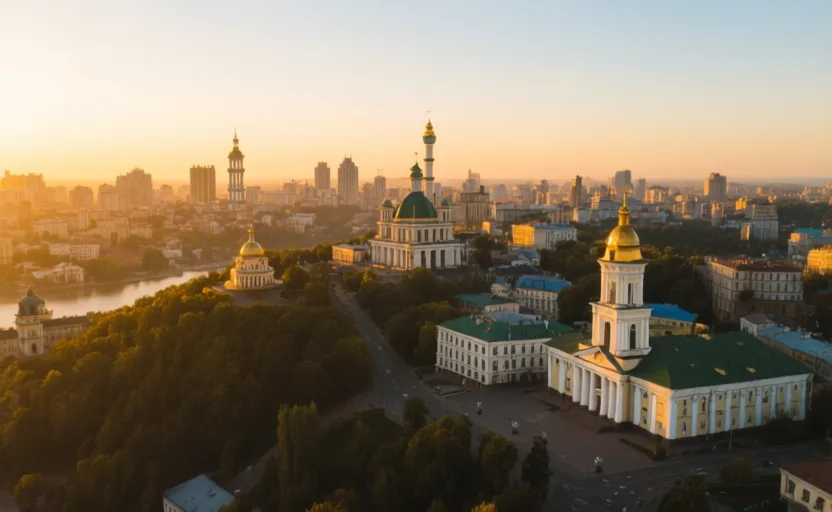 Kyiv · AI city illustration · Artistic impression
City · Europe
Kyiv
Also known as Kiev, Київ
Saved in this browser — no account needed. Sign in later and it comes with you.
Where it is
The Dnieper runs south through Kyiv, and the city has always been two cities in terms of ground. The older, higher western bank rises into wooded hills cut by ravines, and the relief explains district names: Podil means “lower”, Pechersk “caves”, and an uzviz is a steep descent. The eastern Left Bank is low, flat and was settled only in the 20th century, partly on sand pumped up and held back by dams. The river branches into islands and harbours inside the city, close to where the Desna joins it and between two reservoirs. Winters are cold, with snow lying from mid-November to the end of March and a record low of −32.9 °C in 1951.
The land and water around it
The Dnieperriver
A navigable river that splits the city into the Right Bank and Left Bank, with islands, harbours and 16 developed beaches inside the boundary. Locks on the reservoirs control shipping, and winter freeze-over still limits it.
The Kyiv Hillsplateau
The historic core is part of the Dnieper Upland on the west bank, with steep wooded slopes and ravines. The Lavra stands on a plateau overlooking the river, and the relief gave districts their names.
The Left Bank lowlandplain
The Dnieper Lowland on the eastern bank, built up only in the 20th century. Large areas were raised with deposited sand and are protected by dams, and the northern outskirts meet the Polesian Lowland.
Its history, in short
Kyiv’s own account of its origin is a legend of four siblings, Kyi, Shchek, Khoryv and Lybid, and scholars still argue about when a town really appeared. What is clear is the position: on the trade road between Scandinavia and Constantinople, taken from the Khazars’ orbit by Varangians in the later 9th century, and from there the capital of Kyivan Rus’. By around 1000 it had some 45,000 people, and Yaroslav the Wise built St Sophia’s. The city was ruined in 1240 by the Mongols, ruled in turn by Lithuania, Poland and, from 1667, Russia, and became a centre of Orthodox learning with the Kyiv-Mohyla Academy in 1632. Industry and the railway made it a commercial city in the late 19th century, and after 1917 it was the capital of successive Ukrainian states and changed hands sixteen times in under two years. It became capital of the Ukrainian SSR in 1934 and was heavily damaged in the Second World War, when about 34,000 Jews were murdered at Babi Yar. Independence was proclaimed here in 1991, and the city was the main stage of the 2004 Orange Revolution and the 2013 to 2014 Euromaidan.
Timeline
Dates are shown on a timeline rather than as changing shapes on the map. The globe draws modern boundaries only, and tinting a modern outline to stand for a historical one would state something we cannot source.
Classical world
482 or later
When was Kyiv founded?
The traditional date of 482 led the city to celebrate its 1,500th anniversary in 1982. Archaeology points to the sixth or seventh century, and tree-ring dating of log houses in Podil finds nothing before 887.
The traditional and official Soviet-era dating gives 482; archaeologists and dendrochronologists place the town’s beginning between the 6th century and the late 9th century.
Post-classical world
882
Capital of Rus’
According to the Primary Chronicle, Prince Oleg takes Kyiv from Askold and Dir and makes it his capital. The same chronicle says its people had paid tribute to the Khazars.
1240
The Mongol siege
The city is left in ruins and loses most of its influence for centuries, having been one of the largest cities in the world before that.
Well attestedWikipedia
Early modern & oceanic
1632
Kyiv-Mohyla Academy
The Orthodox Metropolitan Peter Mogila founds an academy to preserve Ukrainian culture and the Orthodox faith. It becomes the foremost educational centre, with multilingual training.
Well attestedWikipedia
Industrial & imperial
1918–1920
Sixteen changes of hands
The city is the capital of successive Ukrainian states and is caught up in the First World War, the Russian Civil War and the Polish–Soviet War. It changes hands sixteen times between the end of 1918 and August 1920.
Well attestedWikipedia29–30 September 1941
Babi Yar
Nearly 34,000 Kyivan Jews are massacred at Babi Yar by the German army and SS, with Ukrainian auxiliary police and local collaborators. At least 33,771 is given in the Einsatzgruppen’s own reports.
Contemporary
24 August 1991
Declaration of independence
The Ukrainian parliament proclaims independence in the city, and Kyiv remains the country’s largest and wealthiest city.
Well attestedWikipediaFebruary 2022 onward
The invasion and its aftermath
Russian forces attempt to seize Kyiv at the start of the 2022 invasion but are repelled on its outskirts, and the city itself escapes major damage. From April 2022, when Russian troops pulled back from the area, it has been hit by frequent air strikes.
Well attestedWikipedia
Places that carry meaning
Saint Sophia CathedralEarly 11th century
Built under Yaroslav the Wise with local builders and Byzantine masters as the main church of the Kyivan Rus’ capital. It keeps its original interior with 11th-century mosaics and frescoes, and the monastic buildings around it are 17th and 18th-century Ukrainian Baroque.
Kyiv-Pechersk Lavra11th century onward
A monastery founded by Anthony and Theodosius on the plateau above the right bank of the Dnieper, with churches above and below ground dating from the 11th to the 19th century, and a cave labyrinth more than 600 metres long. It was a spiritual and cultural centre that contributed to education, art and medicine.
PodilMedieval onward
The lowland trading quarter by the river. Under Lithuanian rule it held the core of the city, and archaeological finds point to commercial activity here as early as the seventh or eighth century.
Languages here
Places are usually multilingual. This lists what is actually spoken, not one language per border.
UkrainianSlavic family
The official language of the state and the native language of most residents.
About 75 percent of Kyiv answered Ukrainian as their native language in the 2001 census. In a 2006 survey only 23 percent said they used it at home, while 24 percent switched between Ukrainian and Russian.
RussianSlavic family
Widely used in everyday life, especially at home.
Around 25 percent gave Russian as their native language in 2001, and 52 percent said they used it at home in 2006. In 1897 about 56 percent of Kyivans spoke it as their main language after a century of Russification.
Yiddish and Polish
Historic languages of large communities.
In 1874 about 11 percent of the city spoke Yiddish and 6 percent Polish. Polish was the language of Kyiv’s schools in the 1830s, and the Jewish population, over 81,000 before the First World War, was reduced by the Babi Yar massacre.
Learn the language here
- 1Understand which languages are spoken hereKyiv is multilingual. Start with which languages are used, by whom, and for what — the phrase list only covers one of them.Written by Globe Quest
- 2Learn 12 phrasesCurated everyday phrases for Kyiv, with audio and a written form.Written by Globe Quest
- 3Say them out loudSpeaking practice with pronunciation feedback, one phrase at a time.Globe Quest material, your own additions
- 4Come back to themSpaced review, so what you learned this week is still there next month.Written by Globe Quest
Check yourself
Why is Kyiv’s founding date disputed?
The traditional date of 482 conflicts with archaeology and tree-ring dating of later settlement
Tradition says 482, but archaeology suggests the sixth or seventh century and dendrochronology finds nothing before 887, so scholars still disagree.
Where do the names Podil and Pechersk come from?
From the city’s relief, meaning “lower” and “caves”
The hilly west bank gave districts names that describe the ground: Podil is the lower town and Pechersk is the district of caves.
Worth arguing about
- Kyiv has been capital of several states and fell to many rulers in a few decades. What does a city keep when its government changes this often?
- Surveys show that most Kyivans call Ukrainian their native language while many used Russian at home. What does it mean to ask someone for their language?
What we have not established
These are open questions, listed rather than filled in. We would rather show a gap than a plausible guess.
When was Kyiv founded?
No document records a founding, and the legendary account, the 482 tradition, archaeology and tree-ring dating give dates from the fifth to the ninth century. The question stays open.
How many people live in Kyiv?
The population is given as 2,952,301 in January 2022 and 2,847,200 in 2013, and an estimate based on bakery sales in 2007 put the real daily population at 3.5 million or more. Registered residents, commuters and war-time displacement make any current figure uncertain.
Sources
- Wikipedia · KyivWikipedia · encyclopedia · checked 2026-11-24
- Wikipedia · History of KyivWikipedia · encyclopedia · checked 2026-11-24
- Wikipedia · UkraineWikipedia · encyclopedia · checked 2026-11-24
- UNESCO · Kyiv: Saint-Sophia Cathedral and Related Monastic Buildings, Kyiv-Pechersk LavraUNESCO World Heritage Centre · intergovernmental · checked 2026-11-24
Reviewed by Globe Quest editorial on 2026-11-24. Drafted with AI assistance and checked against the sources above before publication.