 Globe Quest
 Human Quest · LearningSign in
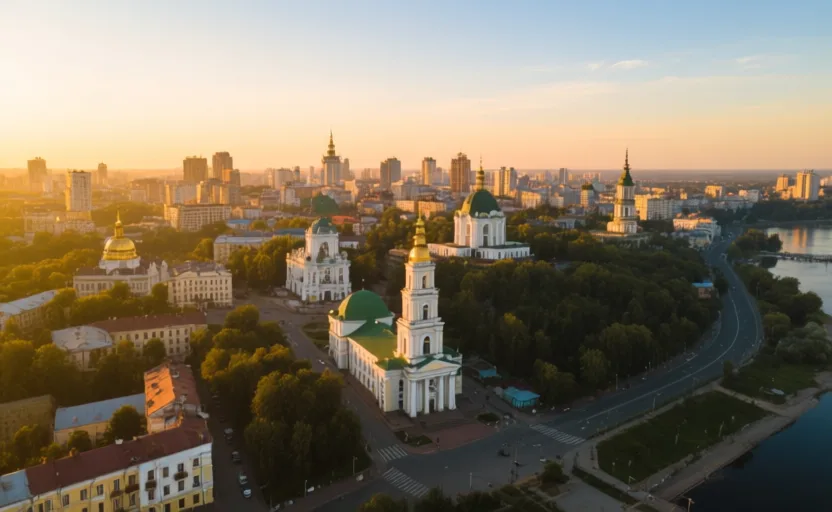 Kharkiv · AI city illustration · Artistic impression
City · Europe
Kharkiv
Saved in this browser — no account needed. Sign in later and it comes with you.
Where it is
Four rivers meet in Kharkiv, the Kharkiv, Lopan, Udy and Nemyshlia, and together they flow on into the Siverskyi Donets. The city fills their wide valley, which runs north-west to south-east between the Mid-Russian Upland and the Donets Lowland. Ground levels differ by more than a hundred metres, from about 94 metres in the lowest district to 202 metres at the highest, and the city divides into four lower and four higher districts. A system of concrete and metal dams keeps the water level in the rivers under control. The climate is humid continental: winters are long, cold and snowy, summers warm or hot, and about 519 millimetres of rain a year, mostly in June and July.
The land and water around it
The Kharkiv river valleyvalley
A broad valley formed by four interconnected rivers, lying between the Mid-Russian Upland and the Donets Lowland. The city is divided into higher and lower districts, with a difference of more than 100 metres between them.
The Lopan and Kharkiv riversriver
The founding settlers of 1654 chose the banks of these two rivers. The city’s name probably comes from the Kharkiv river, whose name is attested before the fortress, while the legend of a founder called Kharko is a folk etymology.
Sloboda Ukraineplain
Kharkiv is the main city of this historic region in north-eastern Ukraine, also called Slobozhanshchyna, where settlers moved in the 17th century during turmoil on the right bank of the Dnieper.
Its history, in short
Kharkiv began in 1654 as a Cossack fortress, when settlers rebuilt an abandoned settlement on the banks of the Lopan and Kharkiv rivers. They reluctantly accepted the authority of a Russian voivode, and it became the main city of Sloboda Ukraine, seat of its own governorate from 1765. Its university opened in 1805, and by the late 19th century Kharkiv was a major commercial and industrial centre of the Russian Empire. The Bolsheviks made it the capital of the Ukrainian Soviet Socialist Republic from December 1919 until January 1934, a period when migrants from the countryside and looser rules on Ukrainian culture made Ukrainian the largest recorded nationality, though Russian stayed the dominant spoken language. Constructivist buildings date from those years. In the Second World War it was fought over repeatedly, changed hands several times in 1941 to 1943, and its Jewish population, of about 130,000 before the war, was systematically destroyed under German occupation. Tank factories evacuated to the Urals returned afterwards and made the city a core of the Soviet military-industrial complex. In 2014 separatists tried and failed to seize the city, and since February 2022 it has been under Russian shelling and missile and drone attack.
Timeline
Dates are shown on a timeline rather than as changing shapes on the map. The globe draws modern boundaries only, and tinting a modern outline to stand for a historical one would state something we cannot source.
Early modern & oceanic
1654
A Cossack fortress
Settlers arrive at the banks of the Lopan and Kharkiv and rebuild and fortify an abandoned settlement. Within two years a Russian voivode from Moscow begins building an ostrog.
Well attestedWikipedia1765
Seat of Sloboda Ukraine
After periods of rule from Kyiv in 1708 and Belgorod in 1727, Kharkiv becomes the seat of its own governorate for Sloboda Ukraine.
Well attestedWikipedia
Industrial & imperial
1805
Kharkiv University
A university opens in the Palace of the Governorate-General. Its later graduates include the poet Ivan Franko, who received a doctorate from it in 1906.
Well attestedWikipediaDecember 1919 – January 1934
Capital of Soviet Ukraine
Kharkiv is the capital of the Ukrainian SSR, which joins the Soviet Union in 1922. Prestige projects in the officially approved Constructivist style are completed in the 1920s and 1930s.
Well attestedWikipediaOctober 1941 – August 1943
Battles and occupation
Germany captures the city on 24 October 1941. A Red Army offensive fails in May 1942, the city is retaken on 16 February 1943, lost again on 15 March and finally liberated on 23 August 1943.
Well attestedWikipedia
Contemporary
1 December 1991
Independence referendum
Of the 76 percent of Kharkiv Oblast voters who turn out, 86 percent approve separate Ukrainian statehood.
Well attestedWikipediaMarch–April 2014
Demonstrations and an aborted seizure
Both pro-Russian and pro-Ukrainian demonstrations take place, along with an attempt by Russian-backed separatists to seize the city and regional administration, which fails.
Well attestedWikipediaFebruary 2022 onward
Russian invasion and shelling
Russian forces reach the outskirts after the full-scale invasion of February 2022 but are forced back towards the border after several weeks of fighting. Shelling, drone and missile attacks continue, and one account reports that by February 2026 a quarter of the city had been destroyed.
Approximate dateWikipediaA published account for February 2026; the extent of destruction is reported rather than independently measured.
Places that carry meaning
Derzhprom, Freedom Square20th century
One of the city’s principal landmarks, standing in Freedom Square. The city also has Art Nouveau and Constructivist architecture, much of it from the years when Kharkiv was the Soviet Ukrainian capital.
Annunciation Cathedral1888
Among the tallest Orthodox churches anywhere, finished on 2 October 1888. The Dormition Cathedral, put up in the 1680s and rebuilt in the 1820s and 1830s, is the city’s other main church.
Kharkiv Tractor FactorySoviet period
An industrial landmark in the south-east of the city. Reports from late February 2022 said it was set on fire by shelling.
A report from the agricultural outlet Agroportal and video said to show fires on 25 and 27 February 2022.
Languages here
Places are usually multilingual. This lists what is actually spoken, not one language per border.
RussianSlavic family
The majority spoken language of the city.
In an April to May 2023 survey 78 percent said they spoke Russian at home. After the 2022 invasion many residents say they have tried to switch to Ukrainian.
UkrainianSlavic family
The state language, spoken at home by a minority but growing in public use.
In the 1920s, with the capital moved here and Ukrainian culture encouraged, Ukrainians became the largest recorded nationality. In 2023 only 16 percent said they spoke Ukrainian at home.
Learn the language here
- 1Understand which languages are spoken hereKharkiv is multilingual. Start with which languages are used, by whom, and for what — the phrase list only covers one of them.Written by Globe Quest
- 2Learn 12 phrasesCurated everyday phrases for Kharkiv, with audio and a written form.Written by Globe Quest
- 3Say them out loudSpeaking practice with pronunciation feedback, one phrase at a time.Globe Quest material, your own additions
- 4Come back to themSpaced review, so what you learned this week is still there next month.Written by Globe Quest
Check yourself
When was Kharkiv the capital of Soviet Ukraine?
From December 1919 to January 1934
The Bolsheviks gave the Ukrainian SSR its capital here, and it moved to Kyiv in 1934.
Which rivers meet in Kharkiv?
The Kharkiv, Lopan, Udy and Nemyshlia
Four rivers interconnect in the city and flow into the Siverskyi Donets, which is why dams were built to control water levels.
Worth arguing about
- Kharkiv was Ukraine’s capital in the 1920s and an industrial centre for the Soviet army. How does a city live with that heritage once its industry becomes a target?
- Many residents have been changing the language they speak since 2022. Is a language choice a private matter or a public one in wartime?
What we have not established
These are open questions, listed rather than filled in. We would rather show a gap than a plausible guess.
How much of Kharkiv has been destroyed since 2022?
Only one account in the sources, for February 2026, gives a share (a quarter of the city), and it is described as reported. Damage keeps changing, and no independent survey is cited.
Sources
- Wikipedia · KharkivWikipedia · encyclopedia · checked 2026-11-24
Reviewed by Globe Quest editorial on 2026-11-24. Drafted with AI assistance and checked against the sources above before publication.