 Globe Quest
 Human Quest · LearningSign in
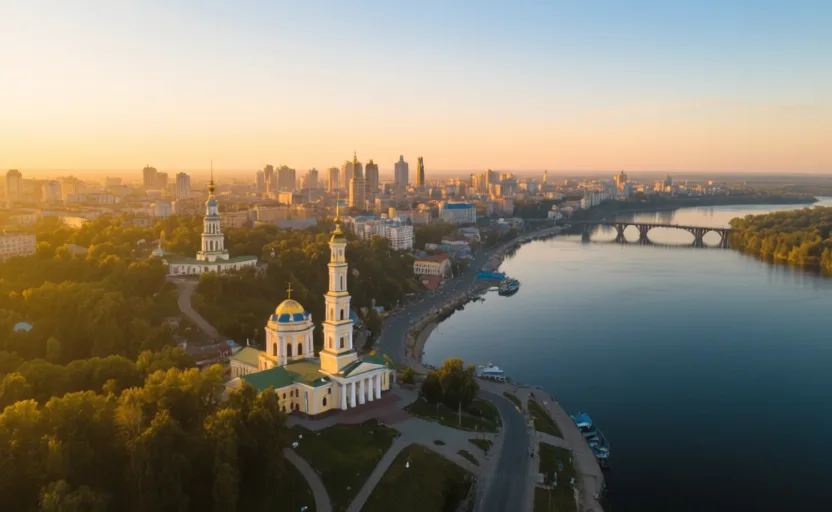 Dnipro · AI city illustration · Artistic impression
City · Europe
Dnipro
Saved in this browser — no account needed. Sign in later and it comes with you.
Where it is
Dnipro stands where the Samara River joins the Dnieper, in the bend of a great meander where the Dnieper turns away from its south-easterly course and heads south, and then south-west, towards the Black Sea. The turn is forced by the Azov Upland to the south-east. The centre lies on the right bank, part of the Dnieper Upland, with the old town on a hill, while the left bank belongs to the Dnieper Lowland. The climate is humid continental, with cold snowy winters, hot summers and two wetter shoulder seasons, and a steppe dryness in which evaporation is high. Industry on both banks has left heavy air and water pollution.
The land and water around it
The Dnieper meanderriver
The city is built on both banks of the Dnieper in the loop of a major bend. The river changes direction here because of the Azov Upland, and the old town stands on the hill that this turn creates.
The Samara confluenceriver
The Samara River enters the Dnieper at the city. The bend and confluence gave the Cossack and imperial towns a crossing point on the lower Dnieper, and the river later passes Kherson before reaching the sea.
The Dnieper Upland and Lowlandplateau
The right-bank centre is part of the upland, where snow is heavier, while the left bank is part of the lowland. The city developed first only on the right bank.
Its history, in short
Cossacks were living here by 1524 at the latest, and a Cossack town, Novyi Kodak, stood here by 1645. The Russian Empire’s Yekaterinoslav, “glory of Catherine”, was planned beside it in the 1770s and 1780s as an administrative centre, and Soviet scholars later changed its founding year for political reasons. From the late 19th century, foreign capital and a mixed international workforce exploited the iron ore of Kryvbas and the coal of Donbas, and more than a third of the city was Jewish until the German occupation. Renamed Dnipropetrovsk in 1926, it became a centre of heavy industry and, after the Second World War, of nuclear, arms and space industries, which made it a closed city. Party leaders from this “rocket city” held outsized weight in Kyiv and Moscow. Voters overwhelmingly backed independence in 1991. After the 2014 Euromaidan the city shifted from pro-Russian parties towards those favouring the European Union, and decommunisation brought the name Dnipro in 2016. Since the 2022 invasion it has served as a logistics hub for humanitarian aid and a place of arrival for people escaping the fighting.
Timeline
Dates are shown on a timeline rather than as changing shapes on the map. The globe draws modern boundaries only, and tinting a modern outline to stand for a historical one would state something we cannot source.
Early modern & oceanic
From at least 1524
Cossack settlement
Archaeological finds suggest the site was already home to Cossack communities in 1524. The Cossack town of Novyi Kodak is recorded for the years from 1645 to 1784.
Approximate dateWikipedia1776 or 1787
When was Yekaterinoslav founded?
The first written mention of a town called Yekaterinoslav is in a report of 23 April 1776, and Catherine II’s visit and the Transfiguration Cathedral date from 1787. In 1976 the founding date was moved back from 1787 to 1776.
DisputedWikipediaIn 1976 Soviet authorities moved the date to 1776 so the bicentenary would coincide with the 70th birthday of Leonid Brezhnev, a native of the region; the 1787 date is the earlier tradition.
Industrial & imperial
1926
Dnipropetrovsk
The city is renamed after the Ukrainian Communist Party leader Grigory Petrovsky and becomes a focus of Stalin’s drive for rapid heavy industrialisation.
Well attestedWikipedia26 August 1941 – 25 October 1943
German occupation and the Holocaust
The city is under German occupation, administered within Reichskommissariat Ukraine. Estimates of the remaining Jewish population range from 30,000 to 55,000; it was reduced to 702, and on 13 and 14 October 1941 the Germans killed 15,000 people.
Well attestedWikipedia
Contemporary
1944–1945
A closed city
Moscow decides in July 1944 to build a large military machine-building plant here, and German prisoners of war start constructing it in December 1945. Dnipropetrovsk’s later nuclear, arms and space industries make it a closed city.
Well attestedWikipedia1 December 1991
Independence referendum
In the national referendum, 90.36 percent of the city’s voters approve the declaration of independence the parliament had made on 24 August.
Well attestedWikipedia2016
Renamed Dnipro
After the 2014 Euromaidan the city shifted allegiance towards the European Union. Under the decommunisation laws it is renamed Dnipro, after the river.
Well attestedWikipediaFebruary 2022 onward
A hub for the displaced
After the full-scale Russian invasion of 24 February 2022, Dnipro turns into a logistics centre for humanitarian aid and a place where people escaping the fighting on several fronts arrive.
Well attestedWikipedia
Places that carry meaning
Transfiguration Cathedral and Soborna SquareCompleted 1835
The central point from which the city developed radially, in the neoclassical style. The cathedral’s foundation is credited to an order of Catherine II in 1787.
Akademik Yavornytskyi Prospekt18th century onward
A long, wide boulevard running east to west through the centre and linking the city’s two main architectural ensembles. Stalinist monumental classicism dominates the centre today.
St Nicholas Church19th century
The oldest church in Dnipro, a national monument standing on land that had belonged to the Cossack settlement of Novi Kodaky.
Languages here
Places are usually multilingual. This lists what is actually spoken, not one language per border.
RussianSlavic family
The most-used language at home.
In 2017, 63 percent of residents said they spoke Russian at home, and in a spring 2023 survey 66 percent did. In 1959, 82.6 percent of school pupils were taught in Russian-language schools.
UkrainianSlavic family
The state language, used at home by a growing minority.
In 2017, 9 percent said they spoke Ukrainian at home and 25 percent spoke Ukrainian and Russian equally. By 2023 the share speaking Ukrainian at home had risen to 27 percent. The Ukrainian share of the population grew from 16 percent in 1923 to 48 percent in 1933.
Learn the language here
- 1Understand which languages are spoken hereDnipro is multilingual. Start with which languages are used, by whom, and for what — the phrase list only covers one of them.Written by Globe Quest
- 2Learn 12 phrasesCurated everyday phrases for Dnipro, with audio and a written form.Written by Globe Quest
- 3Say them out loudSpeaking practice with pronunciation feedback, one phrase at a time.Globe Quest material, your own additions
- 4Come back to themSpaced review, so what you learned this week is still there next month.Written by Globe Quest
Check yourself
Why was Dnipropetrovsk a closed city in Soviet times?
Its nuclear, arms and space industries were strategically important
After the war the city developed nuclear, arms and space industries, which led the Soviet authorities to restrict access.
Why was Dnipropetrovsk renamed Dnipro in 2016?
A decommunisation law removed names honouring Soviet figures
The city had been named for the communist leader Petrovsky in 1926, and after Euromaidan the decommunisation laws led to the river’s name being used instead.
Worth arguing about
- The date of Dnipro’s founding was moved in 1976 for a politician’s birthday. How should a city keep a founding date that was set for politics?
- A closed city of rockets and heavy industry is now a refuge for displaced people. What does a city owe to those who arrive in it?
What we have not established
These are open questions, listed rather than filled in. We would rather show a gap than a plausible guess.
How many Jews of Dnipropetrovsk survived the German occupation?
Estimates of the remaining Jewish population when the Germans arrived range from 30,000 to 55,000, so the loss cannot be given as a single figure, though the number left afterwards is given as 702.
Sources
- Wikipedia · DniproWikipedia · encyclopedia · checked 2026-11-24
Reviewed by Globe Quest editorial on 2026-11-24. Drafted with AI assistance and checked against the sources above before publication.