 Globe Quest
 Human Quest · LearningSign in
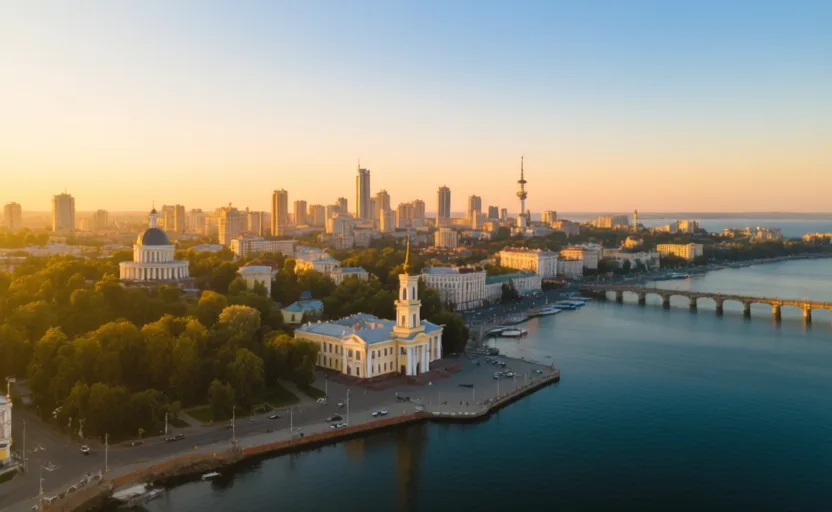 Odesa · AI city illustration · Artistic impression
City · Europe
Odesa
Saved in this browser — no account needed. Sign in later and it comes with you.
Where it is
Odesa stands on terraced hills above a small harbour on the north-western shore of the Black Sea, along the south-western side of the Gulf of Odesa. Behind it is the flat Black Sea Lowland, a steppe with no mountains or large hills for many kilometres. The city’s height runs from about 4 metres at the shore to 65 metres, and two deep ravines cut through the plateau at right angles to the sea. Three estuaries lie nearby, the mouth of the Dniester is about 31 kilometres to the south and the river supplies the city’s water, and the Moldovan border is some 40 kilometres west. Winters are mild by Ukrainian standards, rarely below −10 °C, and the sea almost never freezes, which is the point of a warm-water port.
The land and water around it
The Gulf of Odesagulf
A shallow indentation on the north-western Black Sea coast that gave Catherine II her warm-water port. The sea averages above 20 °C from June to September and falls to around 6 °C from January to March.
The Black Sea Lowlandsteppe
A flat plain that slopes gently towards the sea, part of the East European Plain. The coastal steppe was the long-standing trade route to the interior of East Central Europe that a Black Sea port could tap.
The estuaries and ravinesestuary
Three large estuaries, the Kuialnyk, Khadzhibey and Sukhyi, lie near the city, and two ravines cut across the plateau. The street grid of the historic centre was laid out to follow the direction of those ravines.
Its history, in short
Greek traders had a large settlement here by the mid-6th century BCE, and in the Middle Ages the coast passed between nomads, the Golden Horde, Lithuania and the Ottomans, who held the fortress of Khadjibey from 1529. The modern city is a deliberate act of the Russian Empire. After the Russo-Turkish war of 1787 to 1792, Catherine II decreed a navy harbour and trading place in 1794, and in 1795 the town was renamed Odessa. Its governors, Italian architects and a free-port regime from 1819 attracted Russians, Jews, Ukrainians, Poles, Germans, Greeks and many others, and in the 19th century Odesa was the fourth-largest city in the Russian Empire. The same diversity brought tension, with violent events beginning in 1821. In 1905 a workers’ uprising and the mutiny of the battleship Potemkin made the city famous. Romanian and German forces besieged it for 73 days in 1941 before it fell; The city had a large Jewish population up to the early 1940s, and most of Odesa’s Jews who remained emigrated between the 1970s and the 1990s. Since 2022 its port and historic centre have been bombed during the Russian invasion, and in January 2023 UNESCO placed the centre on the World Heritage in Danger list.
Timeline
Dates are shown on a timeline rather than as changing shapes on the map. The globe draws modern boundaries only, and tinting a modern outline to stand for a historical one would state something we cannot source.
Classical world
By the mid-6th century BCE
A Greek settlement
A large Greek settlement exists here, and some scholars think it was a trade station set up by the Greek city of Histria. Whether the bay is the ancient “Port of the Histrians” is still unsettled.
Approximate dateWikipedia
Post-classical world
1415
A Lithuanian port
The first chronicle mention of the Slavic port settlement of Kotsiubijiv, then part of the Grand Duchy of Lithuania, records a ship sent from here to Constantinople.
Well attestedWikipedia
Early modern & oceanic
1529
Ottoman Hacibey
The port and its surroundings pass to the Ottoman Empire as Hacibey or Khadjibey. In the mid-18th century the Ottomans rebuild the fortress, calling it Yeni Dünya, “New World”.
Well attestedWikipedia1794–1795
Founded by Catherine II
Catherine II decrees a navy harbour and trading place, and in 1795 the town is renamed Odessa. A first census in 1797 counts 3,455 people.
Industrial & imperial
1819 to 1858 or 1859
A free port
Odesa is a free port, and the trade draws diverse communities and fast growth. The end date is given as 1858 in one source and 1859 in another.
1905
The workers’ uprising
A workers’ uprising backed by the crew of the battleship Potemkin takes place. Eisenstein’s film shows hundreds killed on the great staircase; the real killings happened in nearby streets.
Well attestedWikipedia5 August – 16 October 1941
The siege of Odesa
Romanian and German troops attack in August and the siege lasts 73 days. The city falls to the Axis on 16 October and comes under Romanian administration.
Well attestedWikipedia
Contemporary
2 May 2014
The Odesa clashes
Clashes between pro-Ukrainian and pro-Russian protesters kill 42 people, four during the protests and at least 32 after a trade-union building is set on fire during an exchange of Molotov cocktails.
Well attestedWikipedia
Places that carry meaning
The historic centreFrom 1794
A grid of wide tree-lined streets set along the plateau’s edge, with low-rise buildings by mostly Italian architects. UNESCO inscribed it in January 2023 and put it on the list of sites in danger because of bombing in the invasion.
Prymorsky Boulevard and the Potemkin Steps19th century
The boulevard runs along the edge of the plateau and the stairs come down to the port. They are among the city’s main landmarks, and a statue of the Duc de Richelieu stands at the top.
Odesa Opera and Ballet Theatre1887
A neo-baroque house by Fellner and Helmer, built after the first opera house burned in 1873, and widely ranked among the world’s finest.
Languages here
Places are usually multilingual. This lists what is actually spoken, not one language per border.
RussianSlavic family
The everyday language of most residents.
A 2021 municipal survey found 96 percent speaking some Russian at home, and a spring 2023 survey found 80 percent. The city has long had its own accented dialect of Russian.
UkrainianSlavic family
The official language, growing in home use.
The share speaking some Ukrainian at home rose from 6 percent in 2015 to 29 percent in 2021. A 2023 survey in the wider oblast put Ukrainian at 42 percent at home against 54 percent for Russian.
Learn the language here
- 1Understand which languages are spoken hereOdesa is multilingual. Start with which languages are used, by whom, and for what — the phrase list only covers one of them.Written by Globe Quest
- 2Learn 12 phrasesCurated everyday phrases for Odesa, with audio and a written form.Written by Globe Quest
- 3Say them out loudSpeaking practice with pronunciation feedback, one phrase at a time.Globe Quest material, your own additions
- 4Come back to themSpaced review, so what you learned this week is still there next month.Written by Globe Quest
Check yourself
Who founded modern Odesa, and why?
Catherine II, to build a warm-water port
After the 1787 to 1792 war with the Ottomans, Catherine II ordered a navy harbour and trading place on the site of the Ottoman fortress.
What is true of the Odesa Steps massacre shown in Eisenstein’s film?
The killing in 1905 took place in nearby streets, not on the steps
The steps became famous through the film, but the actual 1905 killings took place in the streets nearby.
Worth arguing about
- Odesa was founded as a planned port and became one of the most mixed cities in the empire. Does a city planned from above end up more open or more fragile than one that grew slowly?
- Most residents speak Russian at home while using Ukrainian more each year. How should a city treat the language it speaks and the language it wants?
What we have not established
These are open questions, listed rather than filled in. We would rather show a gap than a plausible guess.
When did Odesa’s free-port status end?
The Wikipedia history gives 1858 and the UNESCO description gives 1859 for the end of the period that began in 1819. Both are listed and neither is confirmed.
Sources
- Wikipedia · OdesaWikipedia · encyclopedia · checked 2026-11-24
- UNESCO · The Historic Centre of OdesaUNESCO World Heritage Centre · intergovernmental · checked 2026-11-24
Reviewed by Globe Quest editorial on 2026-11-24. Drafted with AI assistance and checked against the sources above before publication.