 Globe Quest
 Human Quest · LearningSign in
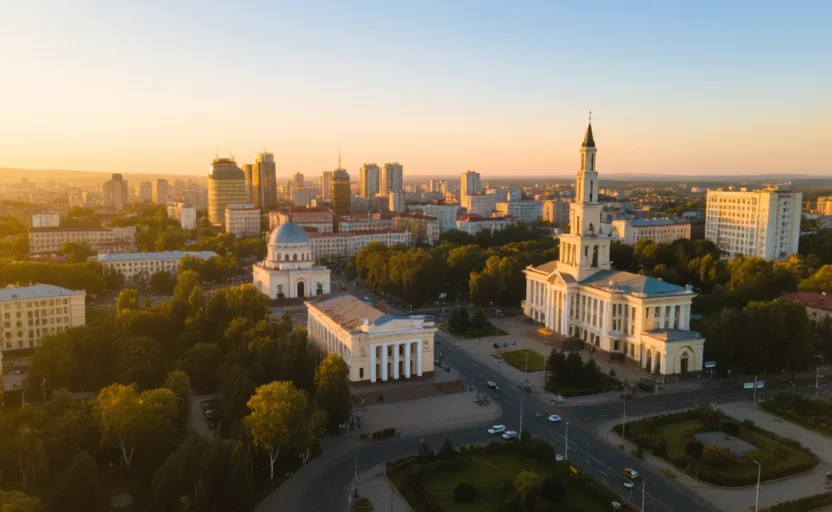 Chișinău · AI city illustration · Artistic impression
City · Europe
Chișinău
Saved in this browser — no account needed. Sign in later and it comes with you.
Where it is
Chișinău lies near the middle of Moldova on the Bîc, a small tributary of the Dniester, on a gently rolling, very fertile landscape. The city proper covers about 120 square kilometres, the wider municipality 635, and it sits almost equidistant from the Romanian border, 58 kilometres to the west, and the Ukrainian one, 54 kilometres to the east. The climate is hot-summer continental: summers reach the high 20s Celsius by day and can top 35 °C, the winters are cold and windy, and most of the year's rain falls in summer in short, heavy storms.
The land and water around it
The Bîcriver
A small stream that flows through the city on its way to the Dniester. One explanation of the name links the city to a small spring, from an old Romanian word for a source of water, at a corner of today's Pușkin and Albișoara streets, though the name's origin is unclear.
The fertile plainplain
The city sits in the middle of a relatively level landscape with very rich ground, which is why it grew as the market and administrative centre for a farming and wine-growing country.
A continental climateclimate
Winters are cold and windy, with minimums often below freezing but rarely below −10 °C, while summers are hot. Most of the year's precipitation arrives in summer, in infrequent but heavy storms.
Its history, in short
The city began in 1436 as a monastery village in the Principality of Moldavia and was still only a town of about 7,000 people at the start of the 19th century. Its history changed in 1812, when Russia took the eastern half of Moldavia and made Chișinău the capital of the new province of Bessarabia. A planned imperial town of long straight streets, a cathedral and a triumphal arch followed in the 1830s and 1840s, and by 1897 almost half of its people, over 50,000, were Jewish. A pogrom in April 1903 killed dozens of its Jewish residents. After the Russian Revolution, Bessarabia joined Romania, and Chișinău grew into the second largest city of the kingdom by 1919. In 1940 the Soviet Union annexed the region and made the city capital of a new Soviet republic, and within months the city was struck by a major earthquake, then by the war, in which it was almost completely destroyed. Rebuilt on Soviet plans, it is a city of wide avenues and large blocks of flats, and since 1991 it has been the capital of independent Moldova, with the streets renamed from a Communist theme to a national one.
Timeline
Dates are shown on a timeline rather than as changing shapes on the map. The globe draws modern boundaries only, and tinting a modern outline to stand for a historical one would state something we cannot source.
Post-classical world
1436
A monastery village
The settlement is founded in the Principality of Moldavia, which later became a vassal of the Ottoman Empire while keeping its autonomy. By the early 1800s it had only 7,000 inhabitants.
Industrial & imperial
1812
Capital of Bessarabia
The Ottomans cede the eastern half of Moldavia to the Russian Empire, and Chișinău becomes the capital of the new province. By 1834 a plan had given it broad roads, divided between the irregular old town and a newer centre near the station.
Well attestedWikipedia19–20 April 1903
The Kishinev pogrom
An anti-Jewish riot lasts three days and kills 47 Jews, wounds 92 severely and a further 500 lightly, and destroys several hundred houses and businesses. Many believe anti-Jewish articles in the area's only official newspaper helped to stir it up.
Well attestedWikipedia1918
Capital of a republic, then of a province of Romania
Chișinău is for the first time the capital of an independent state, the short-lived Moldavian Democratic Republic, before Bessarabia joins the Kingdom of Romania. Between 1918 and 1940 the centre was renovated and the Stephen the Great monument was put up.
1940
Soviet annexation and an earthquake
On 28 June, as a result of the Molotov–Ribbentrop Pact, the Soviet Union annexes Bessarabia from Romania, and Chișinău becomes the capital of the Moldavian Soviet Socialist Republic. More than 400 people were executed in the city that July, and on 10 November a devastating earthquake struck.
July 1941
War and mass murder
German and Romanian armies capture the city, after heavy bombardment. The mostly Jewish population suffered mass shootings, with an estimated 10,000 Jews murdered during the first occupation. Soviet troops re-entered the city on 24 August 1944.
Approximate dateWikipedia
Contemporary
1947–1949
The Shchusev plan
The architect Alexey Shchusev and a team draw up a plan for gradually rebuilding the city, and the 1950s bring rapid population growth and large housing projects in Stalinist and then Khrushchev-era style.
Well attestedWikipedia1991
Capital of independent Moldova
Independence from the Soviet Union brings a large-scale renaming of streets and places from Communist themes to national ones. The first foreign embassy, Romania's, opened on 20 January 1992.
Places that carry meaning
Nativity Cathedral and the Triumphal Arch1830–1840
The cathedral and its bell tower were built between 1830 and 1836, and the arch was finished in 1840. The belfry was demolished in Soviet times and rebuilt in 1997.
Bernardazzi's buildings19th century
Alexander Bernardazzi, an architect of Swiss, Italian and Russian background, drew up many of the city's buildings. They include City Hall and two churches, Saint Theodore and Saint Panteleimon.
The Cricova limestone and cellarsQuarried for the city
Much of Chișinău is built from limestone quarried at Cricova. The galleries left behind became a famous wine cellar, in a country whose winemaking goes back to at least 3000 BCE.
Soviet housing blocks1950s onward
Large blocks of flats arranged in considerable districts, built under the slogan “good, cheaper, and built faster”, define the style that dominates the city today.
Languages here
Places are usually multilingual. This lists what is actually spoken, not one language per border.
RomanianRomance family
The official language, which many residents still call “Moldovan”.
In the 2024 census, 47.9 per cent of the city's residents gave their mother tongue as Romanian and 28.8 per cent as “Moldovan”, together 76.7 per cent. In the capital the proportion declaring Romanian rather than Moldovan is higher than in the country as a whole.
RussianSlavic family
The language of a large minority and still widely used in daily life.
Russian is the mother tongue of 19.5 per cent of Chișinău's residents and the usually spoken language of 23.2 per cent. It was the language of the imperial administration and of the Soviet period, and it is a recognised minority language of Moldova. Russian-language media still call the city Kishinev or Kishineu.
UkrainianSlavic family
A minority language, spoken by 2.2 per cent as a mother tongue.
Ukrainian speakers are the next largest group, followed by very small numbers of Gagauz and Bulgarian speakers. After the 2022 invasion of Ukraine, more than 100,000 Ukrainian refugees were being hosted in Moldova, many of them in the capital.
Learn the language here
- 1Understand which languages are spoken hereChișinău is multilingual. Start with which languages are used, by whom, and for what — the phrase list only covers one of them.Written by Globe Quest
- 2Learn 12 phrasesCurated everyday phrases for Chișinău, with audio and a written form.Written by Globe Quest
- 3Say them out loudSpeaking practice with pronunciation feedback, one phrase at a time.Globe Quest material, your own additions
- 4Come back to themSpaced review, so what you learned this week is still there next month.Written by Globe Quest
Check yourself
What made Chișinău important after 1812?
It became the capital of the Russian province of Bessarabia
Before 1812 it was a small town of about 7,000. The Russian Empire gave it a planned townscape as capital of Bessarabia.
Which disaster struck Chișinău on 10 November 1940?
A devastating earthquake
The earthquake came only months after the Soviet annexation and was followed by the heavy damage of the Second World War, so much of the city had to be rebuilt.
Worth arguing about
- The city has been rebuilt by Moldavian princes, Russian tsars, the Romanian kingdom and Soviet planners. What traces of each should it keep?
- Streets in Chișinău were renamed after 1991 from a Communist theme to a national one. Who should decide what a street is named, and how often?
What we have not established
These are open questions, listed rather than filled in. We would rather show a gap than a plausible guess.
How strong was the 1940 earthquake?
Accounts give the magnitude as 7.3, 7.4 or 7.7, with the epicentre in eastern Romania, and the sources do not agree on a single figure.
How many people died in the 1903 pogrom?
The usual figure is 47 Jewish dead, but some sources say 49 people were killed. The number of wounded and the damage to property are also approximate.
Sources
- Wikipedia · ChișinăuWikipedia · encyclopedia · checked 2026-11-24
- Wikipedia · History of ChișinăuWikipedia · encyclopedia · checked 2026-11-24
- Wikipedia · MoldovaWikipedia · encyclopedia · checked 2026-11-24
Reviewed by Globe Quest editorial on 2026-11-24. Drafted with AI assistance and checked against the sources above before publication.