 Globe Quest
 Human Quest · LearningSign in
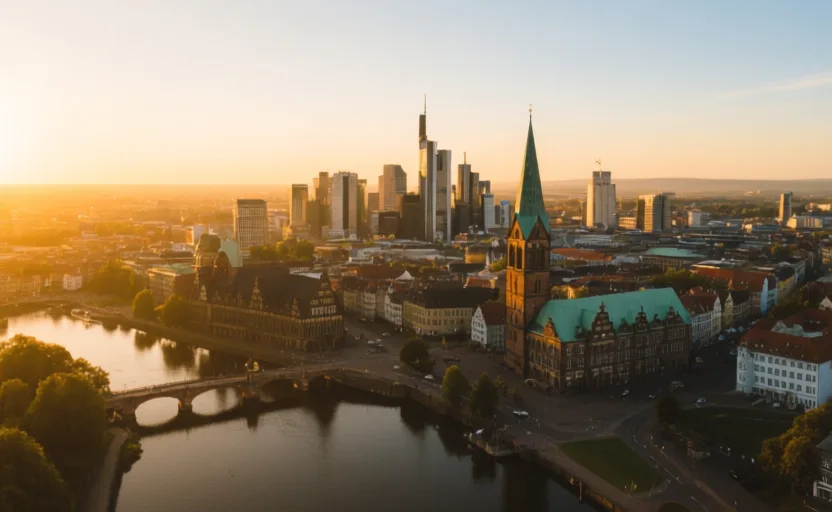 Bremen · AI city illustration · Artistic impression
City · Europe
Bremen
Saved in this browser — no account needed. Sign in later and it comes with you.
Where it is
Bremen is a river port that is not on the sea. It lies on both banks of the Weser, about 60 kilometres upstream of the North Sea at Bremerhaven, in country so level that the highest natural point in the whole city is only 32.5 metres above sea level, the lowest high point of any German state. The old centre stands on a dune beside the river, ten metres or so up. Marshland spreads on the left bank, and the whole city is encircled by Lower Saxony. Westerly winds off the Atlantic give a mild, cloudy oceanic climate, with winters that are grey even by German standards.
The land and water around it
The Weserriver
The longest river that runs entirely within Germany. Bremen sits 60 kilometres from the sea where the Middle Weser turns into the Lower Weser, and the river has been made navigable for ocean-going vessels from the port downstream.
The Weser duneplain
The old city is built on a low dune that reaches 10.5 metres at the cathedral. Around it the land is flat and low, and the marsh and floodplain are never far.
The marshes and dikesmarsh
The land on the left bank, drained by the Ochtum, is the Weser Marshes. Dutch settlers began draining the wetlands and raising the dikes that still mark the countryside in the twelfth century.
Its history, in short
Bremen became a bishopric in 787, and in 888 the king granted it rights to hold markets, mint coins and set customs. Stone walls and a stone cathedral followed in the eleventh century, paid for by North Sea trade. In 1186 the Gelnhausen Privilege gave the city wide legal and tax freedom, the base of its later claim to be a free imperial city, which the emperor confirmed in 1646. Its merchants and guilds belonged to the Hanseatic League. The Weser silted up, so in 1827 Bremen bought land at the river mouth and founded Bremerhaven as an outer harbour. With railways, that made it the main German port for emigrants to the Americas, and an importer of coffee, tobacco, cotton and rice. The shipping line Norddeutscher Lloyd, founded in 1857, grew into one of the world's largest. In the Second World War roughly two thirds of the built city was lost, and Bremen later became one of the founding states of West Germany.
Timeline
Dates are shown on a timeline rather than as changing shapes on the map. The globe draws modern boundaries only, and tinting a modern outline to stand for a historical one would state something we cannot source.
Post-classical world
787
A bishopric
Willehad becomes the first Bishop of Bremen, after the Franks under Charlemagne defeat Saxon resistance and order conversion by decree.
Well attestedWikipedia1186
The Gelnhausen Privilege
Frederick Barbarossa's grant of legal and fiscal autonomy is confirmed by the Archbishop. A serf who lived in the city for a year and a day became free. The city later cited this as the basis of its imperial freedom.
Well attestedWikipedia1404
The Roland
A stone statue of Roland is raised on the marketplace to stand for the rights and privileges of a free and imperial city. The Old Town Hall follows in the early fifteenth century.
Well attestedUNESCO World Heritage Centre
Early modern & oceanic
1646
Free imperial city
Emperor Ferdinand III confirms Bremen's imperial immediacy in the Diploma of Linz, while Swedish forces hold the lands around it. A later ruler, George I Louis, recognises it as free in 1720.
Industrial & imperial
1810 or 1811
Annexed by France
Napoleon annexes Bremen to enforce the closure of the Continent to British trade, and it becomes the capital of a French department. After the French withdraw in 1813, Johann Smidt secures its independence at the Congress of Vienna.
1827
Bremerhaven
Mayor Smidt buys a strip of land at the mouth of the Weser from Hanover to found a harbour that the silting river cannot block.
Well attestedWikipedia1857
Norddeutscher Lloyd
The shipping company is founded in Bremen. It becomes one of the leading lines in the world, and is now part of Hapag-Lloyd.
Well attestedWikipedia
Places that carry meaning
Town Hall and Roland1404 to the early 20th century
A Gothic hall of the early fifteenth century, reworked in the Weser Renaissance style in the early seventeenth, with a New Town Hall added in 1909 to 1913. UNESCO inscribes it as evidence of the civic autonomy and market rights of the Holy Roman Empire.
The colonial elephant1931
A ten-metre brick elephant, finished in 1931 as a colonial memorial. It has been turned into an anti-colonial monument, with a memorial beside it for those killed in the German genocide in what is now Namibia.
Bremen Cathedral11th century onward
The stone cathedral of St Peter's, begun in 1042, marks the wealth that North Sea trade brought. The city's claim to control it was disputed in 1629, when an imperial edict ordered it returned to a Catholic prince-archbishop and the city refused.
Languages here
Places are usually multilingual. This lists what is actually spoken, not one language per border.
GermanGermanic family
The official and everyday language.
German is the official and mainly spoken language across Germany.
Low GermanGermanic family
A protected regional language.
Only Hamburg and Dortmund are bigger inside the Low German dialect area. Germany recognises Low German as a regional language under European protection.
Turkish, Polish, Bulgarian and Arabic
Languages of migrant communities of different periods.
Workers from Turkey and southern Europe settled in the 1950s and 1960s, followed after the early 2000s by arrivals from Poland and Bulgaria, and after 2015 by refugees from Syria and elsewhere. Almost a third of residents are of non-German origin.
Learn the language here
- 1Understand which languages are spoken hereBremen is multilingual. Start with which languages are used, by whom, and for what — the phrase list only covers one of them.Written by Globe Quest
- 2Learn 12 phrasesCurated everyday phrases for Bremen, with audio and a written form.Written by Globe Quest
- 3Say them out loudSpeaking practice with pronunciation feedback, one phrase at a time.Globe Quest material, your own additions
- 4Come back to themSpaced review, so what you learned this week is still there next month.Written by Globe Quest
Check yourself
Why was Bremerhaven founded in 1827?
Bremen's river harbour was silting up, 60 km from the sea
The Weser kept filling with silt, so the city bought land at the river mouth. Bremen and Bremerhaven are still together one state.
What does Bremen's Roland statue stand for?
The rights and privileges of a free and imperial city
The statue was put up in 1404 beside the town hall on the marketplace, and UNESCO values it with the hall as a monument to civic autonomy.
Worth arguing about
- Bremen has held itself apart from larger neighbours for more than a thousand years and is still its own state. What does a city gain, and pay, for that independence?
- A monument to colonial ambition has been turned into a monument against colonialism. Is reinterpreting such a structure better than removing it?
What we have not established
These are open questions, listed rather than filled in. We would rather show a gap than a plausible guess.
In which year did France annex Bremen?
Accounts give 1810 and 1811. The dating may depend on whether the decree or its enforcement is counted, so the entry shows both.
Sources
- Wikipedia · BremenWikipedia · encyclopedia · checked 2026-11-24
- Wikipedia · History of BremenWikipedia · encyclopedia · checked 2026-11-24
- UNESCO · Town Hall and Roland on the Marketplace of BremenUNESCO World Heritage Centre · intergovernmental · checked 2026-11-24
- Wikipedia · GermanyWikipedia · encyclopedia · checked 2026-11-24
Reviewed by Globe Quest editorial on 2026-11-24. Drafted with AI assistance and checked against the sources above before publication.