 Globe Quest
 Human Quest · LearningSign in
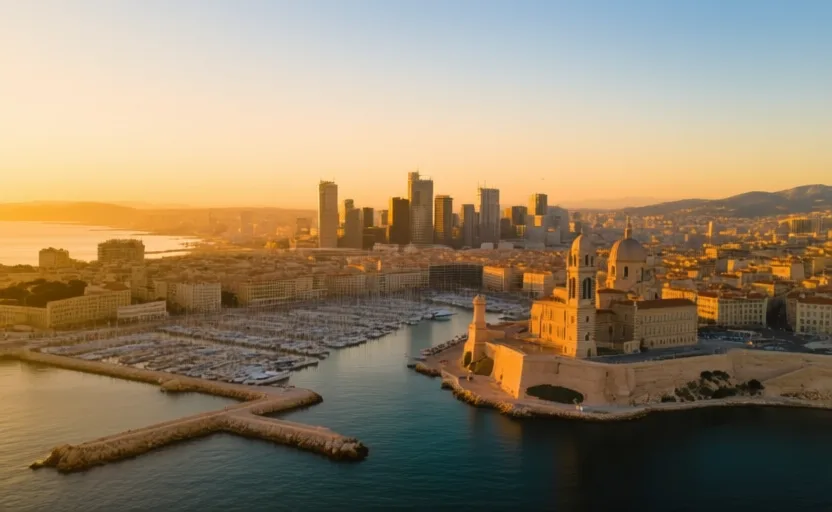 Marseille · AI city illustration · Artistic impression
City · Europe
Marseille
Saved in this browser — no account needed. Sign in later and it comes with you.
Where it is
A natural cove, the Lacydon, shelters the Old Port, and on the hills around it Marseille climbs towards the limestone coast. To the east the Calanques, rugged inlets like small fjords, run towards Cassis, and a national park reaches inside the city limits, the only one of its kind in a large French city. Out in the bay lie the Frioul islands, including the Château d’If. The climate is Mediterranean with a hot, dry summer, only about 532 millimetres of rain a year, and the highest sunshine total of any French city, around 2,900 hours. The mistral, a cold dry wind from the Rhône valley, scours the sky in winter and spring.
The land and water around it
The Lacydon cove and the Old Portharbour
A cove fed by a freshwater stream and guarded by two rocky promontories, according to the founding legend. Two forts, Saint-Nicolas and Saint-Jean, flank its entrance, and the main street, the Canebière, runs east from it.
The Calanquescoast
A rugged limestone coast of deep narrow inlets from the fishing village of Callelongue to Cassis. The south-east of Marseille lies inside Calanques National Park, and Palaeolithic paintings survive in the underwater Cosquer Cave near Morgiou.
The Frioul archipelagoisland
Four islands in the bay, one of which, If, carries the château made famous by the novel The Count of Monte Cristo.
Its history, in short
Greek settlers from Phocaea, on the Aegean coast of Asia Minor, founded Massalia around 600 BCE beside a sheltered cove, and it grew into the main Greek city of southern Gaul. Its traders carried wine, coral and salted fish up the Rhône and Durance rivers, and its navigator Pytheas sailed out into the Atlantic. It sided with Rome against Carthage, but backed the losing side in Caesar’s civil war and lost its independence after a siege in 49 BCE. It stayed a leading port through Visigothic rule, declined after a sack in 739, and joined the County of Provence in the 10th century. Plague in the 14th century and a sack by Aragon in 1423 hurt it, and René of Anjou strengthened its fortifications in the 15th. The great plague of 1720 killed much of the population, but numbers recovered, and volunteers from Marseille gave the Revolution’s song its name. In the 19th century industrial growth and empire made it the port linking France to Algeria, Morocco and Tunisia. German forces occupied it in November 1942, and since the 1990s the Euroméditerranée project has remade the waterfront. Each century has brought new communities, most recently Comorians, Maghrebis and Central and Eastern Europeans.
Timeline
Dates are shown on a timeline rather than as changing shapes on the map. The globe draws modern boundaries only, and tinting a modern outline to stand for a historical one would state something we cannot source.
Classical world
c. 600 BCE
Massalia founded
Colonists from Phocaea settle at the Lacydon. In the founding legend, the Greek Protis is chosen as husband by Gyptis, daughter of the local Ligurian chief, and the town grows on the hill north of the cove.
c. 330–320 BCE
Pytheas’ voyage
The mathematician and navigator Pytheas of Massalia sets out by ship into the Atlantic, having fixed the latitude of his city almost exactly and linked the tides to the phases of the moon.
Approximate dateWikipedia49 BCE
Siege of Massilia
Having taken the losing side in Caesar’s civil war, the city falls and loses its independence. Gallo-Roman culture begins.
Well attestedWikipedia
Post-classical world
Early modern & oceanic
1720
The Great Plague of Marseille
The city loses a large part of its population, but numbers recover by the middle of the century.
Well attestedWikipedia1792
La Marseillaise
The national anthem, born in Strasbourg, is sung in Paris by volunteers from Marseille, and the crowd names it after them.
Well attestedWikipedia
Industrial & imperial
November 1942
German occupation
The German Wehrmacht occupies the city, and it is heavily damaged in the war.
Well attestedWikipedia
Places that carry meaning
Notre-Dame de la GardeOverlooking the port
A Romano-Byzantine church known to Marseillais as la Bonne Mère, on a hill above the Old Port, and the city’s symbol.
Unité d’habitation20th century
A housing block by Le Corbusier, listed among the seventeen sites of his work. UNESCO calls it a major prototype of a housing model balancing the individual and the collective.
MuCEM and the quays21st century
The Museum of European and Mediterranean Civilisations, on the waterfront, is one of the museums that came out of the Euroméditerranée renewal project and that give Marseille more museums than any French city except Paris.
Languages here
Places are usually multilingual. This lists what is actually spoken, not one language per border.
FrenchRomance family
The everyday language of the city.
Marseille speech is a variant of French shaped by Provençal and known for its colloquial, melodious style. It also takes words from Arabic, Italian and other dialects.
Occitan (Provençal)Romance family
The historic regional language, called Marselha or Marsiho in its own spelling.
The name of the city, from Greek Massalía through Latin Massilia, passed into medieval Occitan as Marselha before reaching French.
Ancient GreekHellenic family
The language of the founders, which stayed in use long after Roman conquest.
Marseille remained a Greek-speaking place for a long time even after it came under Rome.
Languages of the port’s newcomers
Italian, Arabic and Berber, Armenian and Corsican among others, brought by successive waves of migrants.
In 2002 about a third of residents could trace roots to Italy, a quarter to the Maghreb, and the city has the second-largest Corsican and Armenian populations in France.
Learn the language here
- 1Understand which languages are spoken hereMarseille is multilingual. Start with which languages are used, by whom, and for what — the phrase list only covers one of them.Written by Globe Quest
- 2Learn 11 phrasesCurated everyday phrases for Marseille, with audio and a written form.Written by Globe Quest
- 3Say them out loudSpeaking practice with pronunciation feedback, one phrase at a time.Globe Quest material, your own additions
- 4Come back to themSpaced review, so what you learned this week is still there next month.Written by Globe Quest
Check yourself
Who founded Massalia, the city that became Marseille?
Greek colonists from Phocaea
Phocaea, on the Aegean coast of Asia Minor, sent settlers around 600 BCE, which makes Marseille the oldest city in France.
Why is Marseille the driest and sunniest major city in France?
Because of the mistral, a cold dry wind from the Rhône valley that clears the sky
The mistral brings clear skies and dry air, mostly in winter and spring, helping give the city about 2,900 hours of sun a year.
Worth arguing about
- A port that has absorbed Greeks, Italians, Armenians, Maghrebis and Comorians in turn. What does it take for a city to claim all of them as its own?
- Marseille has long been seen as a place apart from the rest of France, and often unfairly. Is that distance an asset or a stigma?
Sources
- Wikipedia · MarseilleWikipedia · encyclopedia · checked 2026-11-24
- Wikipedia · History of MarseilleWikipedia · encyclopedia · checked 2026-11-24
- UNESCO · The Architectural Work of Le Corbusier, an Outstanding Contribution to the Modern MovementUNESCO World Heritage Centre · intergovernmental · checked 2026-11-24
Reviewed by Globe Quest editorial on 2026-11-24. Drafted with AI assistance and checked against the sources above before publication.