 Globe Quest
 Human Quest · LearningSign in
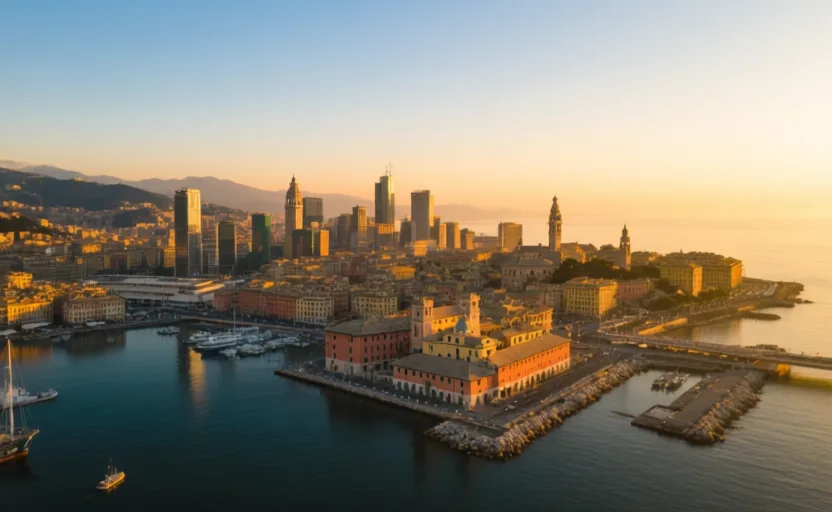 Genoa · AI city illustration · Artistic impression
City · Europe
Genoa
Also known as Genova
Saved in this browser — no account needed. Sign in later and it comes with you.
Where it is
Genoa is squeezed onto the inside curve of the Ligurian coast, where the Apennines drop almost straight to the sea. The municipality covers about 243 square kilometres but runs some 30 kilometres along the shore and only about 10 inland, up the Polcevera and Bisagno valleys. Flat ground is scarce, so the old town is a dense knot of lanes and the newer districts climb steep slopes. Mountains over 1,000 metres behind the city shelter it from the cold of the Po plain, and the sea keeps winters mild, but storms that stall against the ridge can drop heavy autumn rain on short, steep catchments.
The land and water around it
The Ligurian coastal archcoast
Genoa lies at the centre of the arc that the Ligurian coast draws around its gulf. One explanation of the name reads the arc as the bent “knee” of the Italian boot. The city's long, narrow shape follows this strip of land between the Ligurian Sea and the mountains.
The Bisagno and Polcevera valleysvalley
Two valleys carry the city inland from the coast, and the Bisagno stream crosses its eastern districts. Heavy convective rain in autumn, running down short slopes, has repeatedly flooded it: a serious flood in 1970, and again in 2010, 2011 and 2014, led to work from 2015 to rebuild and widen the covered stretch of the Bisagno.
The Apennine wallmountains
Ridges rising above 1,000 metres lie close behind the shore. They shield Genoa from the cold that settles on the far side of the range, in places such as Parma, so winters are mild, but they also leave the city exposed to northern winds in winter and storms from the southeast.
Its history, in short
A small Ligurian settlement on the Castello hill, Genoa was a minor Roman, then Byzantine and Lombard, town for centuries, slowly building up a merchant fleet. Its rise began with the First Crusade, when its galleys carried and supplied crusaders, and by the 13th century it was fighting Venice for the eastern trade. From the 11th century until 1797 it was the capital of a maritime republic, and in 1407 it created the Bank of Saint George, the oldest known state deposit bank in the world. The republic slid into decline from the 17th century as trade shifted away from the Mediterranean, and plague in 1656–57 killed as many as half of its people. Napoleon ended the old oligarchy in 1797, and after his fall the Congress of Vienna handed the city to the Kingdom of Sardinia against Genoese wishes. In the 19th century it reinvented itself as a steel and shipbuilding port, a role that shrank after the late 1980s. Today its harbour is the busiest in Italy.
Timeline
Dates are shown on a timeline rather than as changing shapes on the map. The globe draws modern boundaries only, and tinting a modern outline to stand for a historical one would state something we cannot source.
Classical world
5th century BCE
A hilltop oppidum
The first town is founded, probably by the Ligures, on the hill now called Castello. That hill lies within the medieval old town, so the oldest core of Genoa is still the heart of the modern centre.
209 BCE
Destroyed by Carthage
Genoa had allied itself with Rome during the Second Punic War, and the Carthaginians destroyed it in response. It was rebuilt and received municipal rights after the Carthaginian wars ended in 146 BCE.
Well attestedWikipedia
Post-classical world
1097
Galleys for the First Crusade
A town of about 10,000 sends twelve galleys, a ship and 1,200 soldiers east. During the siege of Antioch in 1098 the Genoese fleet blockaded the city, and the expansion of Genoese trade begins here.
Well attestedWikipedia1407
The Bank of Saint George
A deposit bank backed by the state, the earliest known of its kind. It lasted until its closure in 1805, and Columbus is recorded as leaving it a tenth of his American income.
Well attestedWikipedia
Early modern & oceanic
1576
The Rolli system
The Senate decrees that great private palaces may be used by turns to lodge visitors of the state. The scheme, together with the new streets laid out for those palaces, is what UNESCO later recognised.
Well attestedUNESCO World Heritage Centre1656–1657
Plague
An epidemic kills as many as half of the city's inhabitants, during the slow decline of the republic.
Approximate dateWikipedia14 June 1797
The republic falls
Under French pressure the old ruling families are overthrown and the Ligurian Republic is proclaimed under French military occupation. France annexed it in 1805.
Well attestedWikipedia
Industrial & imperial
1860
Garibaldi leaves from Quarto
Giuseppe Garibaldi embarks at Quarto with more than a thousand volunteers, starting the campaign in the south, a step towards a unified Italy that the Genoese republican tradition had pushed for.
Well attestedWikipedia
Places that carry meaning
Strade Nuove and the Palazzi dei RolliLate 16th and early 17th centuries
A group of Renaissance and Baroque palaces on new streets laid out north of the medieval maze, with the street design attributed to the architect Galeazzo Alessi. UNESCO describes them as the first European example of an urban scheme parcelled out by a public authority, tied to a system of public lodging in private homes.
The caruggiMedieval
The old town is one of the largest and most densely built historic centres in Europe, cut by narrow lanes that Genoese call caruggi. Its density follows from the lack of flat ground between the sea and the hills.
Castello hill5th century BCE onward
The hill where the first Ligurian town stood. The Roman settlement spread out from it onto the ground of Santa Maria di Castello and towards the San Lorenzo headland.
Languages here
Places are usually multilingual. This lists what is actually spoken, not one language per border.
ItalianRomance family
The national language, used in schools, administration and media.
Italy recognises twelve historical minority languages, but Italian is the common language of the city. The largest immigrant groups come from Ecuador, Albania, Morocco, Romania and Bangladesh, and immigrants made up 15.5 per cent of residents in 2025.
Genoese (Zeneize)Romance family
The local dialect, the most important variety of Ligurian.
Genoese is still commonly spoken in the city alongside Italian. It carries the memory of the republic: Genoese emigrants took it to the Americas, and the name “Xeneizes” survives as the nickname of the Boca Juniors football club in Buenos Aires.
Learn the language here
- 1Understand which languages are spoken hereGenoa is multilingual. Start with which languages are used, by whom, and for what — the phrase list only covers one of them.Written by Globe Quest
- 2Learn 12 phrasesCurated everyday phrases for Genoa, with audio and a written form.Written by Globe Quest
- 3Say them out loudSpeaking practice with pronunciation feedback, one phrase at a time.Globe Quest material, your own additions
- 4Come back to themSpaced review, so what you learned this week is still there next month.Written by Globe Quest
Check yourself
What was the Rolli system of 1576?
A public list of private palaces that housed official visitors
The Senate designated private palaces as lodgings for state visits, which is why the Strade Nuove are lined with grand houses built by wealthy families.
Why is Genoa long and narrow?
The Apennines come close to the sea, leaving only a coastal strip and short valleys
The city stretches about 30 kilometres along the shore but only roughly 10 kilometres inland, because the mountains leave little flat ground.
Worth arguing about
- Genoa's wealth came from trade and banking rather than land. How does that kind of power shape a city's streets and its relationship to its hinterland?
- A scheme that made private palaces serve state hospitality is now a World Heritage site. Should shared use of private buildings be part of how cities protect their heritage?
What we have not established
These are open questions, listed rather than filled in. We would rather show a gap than a plausible guess.
Where does the name Genoa come from?
Four explanations circulate: Latin for “knees”, the god Janus, the Latin for “door”, and an Etruscan word for “new city”. The earliest written form is Pliny's Latin Genua, and none of the derivations can be shown to be the original.
Sources
- Wikipedia · GenoaWikipedia · encyclopedia · checked 2026-11-24
- Wikipedia · History of GenoaWikipedia · encyclopedia · checked 2026-11-24
- Wikipedia · ItalyWikipedia · encyclopedia · checked 2026-11-24
- UNESCO · Genoa: Le Strade Nuove and the system of the Palazzi dei RolliUNESCO World Heritage Centre · intergovernmental · checked 2026-11-24
Reviewed by Globe Quest editorial on 2026-11-24. Drafted with AI assistance and checked against the sources above before publication.