 Globe Quest
 Human Quest · LearningSign in
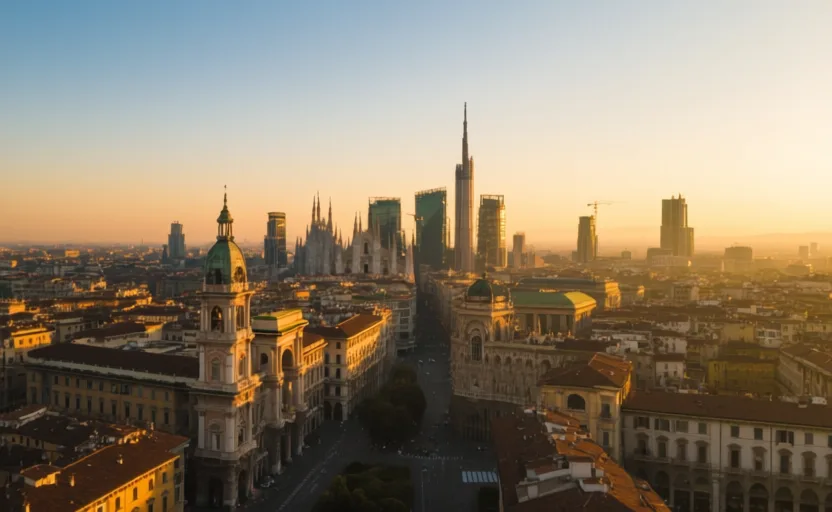 Milan · AI city illustration · Artistic impression
City · Europe
Milan
Also known as Milano, Mediolanum
Saved in this browser — no account needed. Sign in later and it comes with you.
Where it is
The name means a place in the middle of the plain, and the site proves it. Milan lies in the north-western Po Valley, flat country with a highest point of 122 metres, roughly halfway between the Po to the south and the lakes and Alpine foothills to the north, bounded by the Ticino on one side and the Adda on the other. Small rivers and streams once ran through the site, and a ring of canals, the Navigli, still shapes the concentric layout of the centre, though most are now covered. The climate is humid subtropical with hot, muggy summers and cold, foggy winters, and the mountains on three sides leave it with very little wind, which also lets winter air pollution linger.
The land and water around it
The Po Valleyplain
Milan sits in the north-western Po Valley and has no hill of its own except the artificial Monte Stella, 25 metres high and heaped from bombing debris and the last Spanish walls. That flat ground made it a natural meeting point for roads from every side.
The Navigliriver
An old system of interconnected navigable canals, now mostly covered, which gives the centre its concentric plan. The small rivers Olona, Lambro and Seveso and the Nirone and Pudiga streams lie behind the Celtic name.
The sheltered basinclimate
The Alps and Apennines screen the city from northern air, and the place is calmer than almost any other European city. The result is winter fog and, when temperature inversions persist, some of the continent’s worst air pollution.
Its history, in short
A Celtic tribe of the Insubres settled around a sanctuary here about 590 BCE, and the Romans took it in 222 BCE as Mediolanum, the chief city of Cisalpine Gaul. From 284 to 402 it was capital of the western half of the Roman Empire, until the Visigoths’ siege pushed the court to Ravenna. Attila, the Ostrogoths and the Lombards followed, and in the twelfth century a medieval commune fought its neighbours and Frederick Barbarossa, who destroyed much of the city in 1162. The Visconti and Sforza dukes made it a major Renaissance power until French, then Spanish and later Austrian rule. A rising in 1848, the Five Days, and the Austrian defeat in 1859 brought Lombardy into the new Italy. Union enhanced Milan’s economic lead, and from the nineteenth century onward it led the country’s industry and finance. After the war it became a city of rebuilt theatres, skyscrapers and nearly 1.75 million people at its 1973 peak, many of them migrants from the south.
Timeline
Dates are shown on a timeline rather than as changing shapes on the map. The globe draws modern boundaries only, and tinting a modern outline to stand for a historical one would state something we cannot source.
Classical world
c. 590 BCE
Medhelanon
A Celtic tribe of the Insubres settles around an ellipse-shaped sanctuary near today’s Piazza della Scala. Livy’s tradition names the founder as Bellovesus.
222 BCE
Mediolanum
The Romans under Gnaeus Cornelius Scipio Calvus capture the settlement and Latinise its name. It becomes the most important centre of Cisalpine Gaul.
Well attestedWikipedia284–402
Capital in the West
The city is the western capital of the Roman world. During the second half of the 4th century, Bishop Ambrose reshapes the centre and builds the basilicas at its gates.
Well attestedWikipedia
Post-classical world
1162
Barbarossa destroys the city
After the Milanese defeat neighbours such as Lodi and fight Pavia, Cremona and Como, those cities ask Frederick Barbarossa for help, and he destroys much of Milan.
Well attestedWikipedia
Early modern & oceanic
1495–1497
The Last Supper
Leonardo da Vinci paints The Last Supper in the refectory of Santa Maria delle Grazie, working in tempera on plaster, a technique that began to fail within decades.
Well attestedUNESCO World Heritage Centre1629–1631
The Great Plague
A plague kills an estimated 60,000 of 130,000 people, the memory of which Alessandro Manzoni preserved in The Betrothed.
Approximate dateWikipedia
Industrial & imperial
18 March 1848
The Five Days
Milan rebels against Austrian rule and forces Radetzky to withdraw temporarily. The Austrians return that summer, and Lombardy joins Piedmont–Sardinia after the battle of Solferino in 1859.
Well attestedWikipedia
Contemporary
1973
Population peak
After the war, rapid industrialisation, with over 400,000 migrants arriving from the rural south, brings the city to 1,743,427 inhabitants. About a third of residents then move to suburbs.
Well attestedWikipedia
Places that carry meaning
Santa Maria delle Grazie and The Last Supper1463; painting 1495–1497
A convent complex begun in 1463 and reworked by Bramante. On its refectory wall, Leonardo da Vinci painted the moment after Christ says one of the apostles will betray him, with the twelve in groups of three.
Milan Cathedral1386–1877
The largest church in Italy, outside the Vatican, and the most important Gothic building in the country, built over nearly five centuries near the site of a Celtic temple.
The basilicas of Ambrose4th century
Sant’Ambrogio, San Nazaro, San Simpliciano and Sant’Eustorgio were set at the city’s gates by Bishop Ambrose, whose Ambrosian Rite is still used by some five million Catholics.
Languages here
Places are usually multilingual. This lists what is actually spoken, not one language per border.
ItalianRomance family
The language of daily life and the state.
Postwar migrants arrived from the south of Italy in large numbers, and the national school system, television and mass media wore down regional dialects across the country.
CelticCeltic family
The language of the founders of Medhelanon.
The city’s original name was Celtic, built from the words for middle and plain, and the Romans adapted it into Mediolanum. About sixty Gallo-Roman places in France carried the same name.
Immigrant languages
Spoken by the 22.2% of residents who were born abroad.
The largest groups come from Egypt, the Philippines, China, Peru and Sri Lanka, joined by people from Eritrea, Morocco, Senegal, Nigeria, Albania, Romania and Ukraine. Greater Milan has the largest Orthodox community in Italy, and a Romanian congregation uses a Catholic church.
Learn the language here
- 1Understand which languages are spoken hereMilan is multilingual. Start with which languages are used, by whom, and for what — the phrase list only covers one of them.Written by Globe Quest
- 2Learn 11 phrasesCurated everyday phrases for Milan, with audio and a written form.Written by Globe Quest
- 3Say them out loudSpeaking practice with pronunciation feedback, one phrase at a time.Globe Quest material, your own additions
- 4Come back to themSpaced review, so what you learned this week is still there next month.Written by Globe Quest
Check yourself
What does the Celtic and Latin name of Milan mean?
A settlement in the middle of the plain
Medhelanon and Mediolanum both combine a word for middle with one for plain, and the site lies in the Po Valley between rivers and streams.
When was Milan the western capital of the Roman world?
Around 284 to 402
The imperial residence moved to Ravenna after the Visigoths besieged the city in 402, ending its period as the western capital.
Worth arguing about
- Milan’s population peaked in 1973 and about a third of residents then moved out. What does a city become when its workforce lives beyond its boundary?
- A city that has been rebuilt after sieges, plague and bombing keeps its original Celtic street plan. Which matters more in a city, its buildings or its layout?
What we have not established
These are open questions, listed rather than filled in. We would rather show a gap than a plausible guess.
How many people live in Milan?
The city proper held about 1.36 million people, while the Metropolitan City held about 3.2 million and the wider urban region more than 6 million. Which figure counts depends on whether the contiguous built-up area is included.
Sources
- Wikipedia · MilanWikipedia · encyclopedia · checked 2026-11-24
- Wikipedia · History of MilanWikipedia · encyclopedia · checked 2026-11-24
- Wikipedia · ItalyWikipedia · encyclopedia · checked 2026-11-24
- UNESCO · Church and Dominican Convent of Santa Maria delle Grazie with “The Last Supper” by Leonardo da VinciUNESCO World Heritage Centre · intergovernmental · checked 2026-11-24
Reviewed by Globe Quest editorial on 2026-11-24. Drafted with AI assistance and checked against the sources above before publication.