 Globe Quest
 Human Quest · LearningSign in
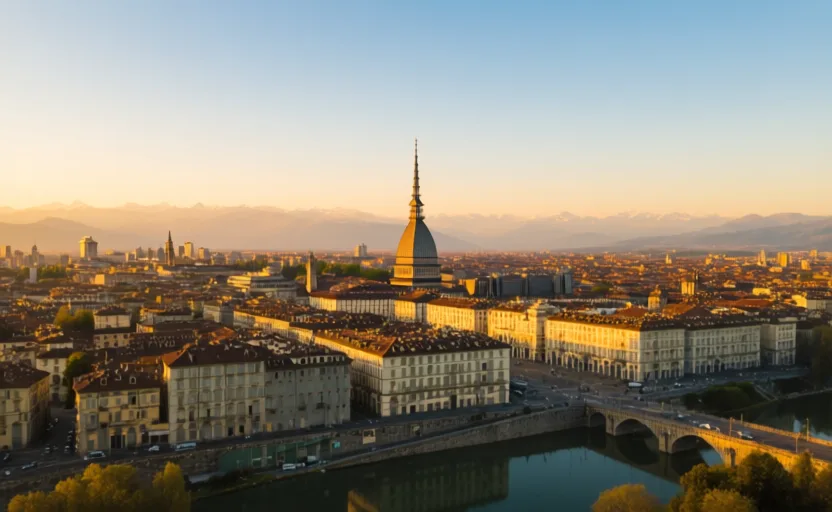 Turin · AI city illustration · Artistic impression
City · Europe
Turin
Also known as Torino
Saved in this browser — no account needed. Sign in later and it comes with you.
Where it is
Alpine ranges close the city in on its western and northern sides, and a high hill, continuing the Monferrato hills, bounds it on the east. Turin lies mostly on the west bank of the Po, where the river leaves the mountains, at the mouth of the Susa Valley, with three tributaries, the Dora Riparia, the Stura di Lanzo and the Sangone, running through it. Its position at the end of the Susa Valley keeps the thick fog that gathers on the plains mostly out of the city, and the föhn wind on the eastern flank of the Alps leaves the weather drier here than on the French side. The climate is humid subtropical, with records of 37.1 °C in 2003 and −21.8 °C in 1956.
The land and water around it
The Po and its tributariesriver
The Po runs past the city’s east side, with the Dora Riparia, Stura di Lanzo and Sangone joining it. The Dora’s name is a Celtic word for water, which the Romans took over as Duria Minor.
The Alpine arch and Susa Valleymountains
The western Alps curve around the city to the north and west, and the Susa Valley leads from them to the city, giving it a route to France. The Fréjus Tunnel, opened in 1871, turned this into an important link between Italy and France.
The Superga and Monferrato hillsmountains
A high hill on the east side is the natural continuation of the Monferrato hills. It frames the city on the side away from the Alps and shelters it from the river’s opposite bank.
Its history, in short
The Taurini, a Celto-Ligurian Alpine people, held the upper Po valley until Hannibal captured their chief town in 218 BCE, and the Romans later founded Augusta Taurinorum, whose street along the present Via Garibaldi and Porta Palatina remain. It was a small walled town of about 5,000 people. After Lombards and Franks, a countship grew under the Savoy family, and the city was annexed to the Duchy of Savoy by the end of the thirteenth century. In 1563 Emmanuel Philibert made it the ducal capital, and Baroque planning followed: Via Po, the Palazzo Reale, and a ring of royal residences. The French failed to take it in a 117-day siege in 1706, and the Savoy ruler became King of Sardinia, with Turin as the capital of a European kingdom. It led the Risorgimento and was the first capital of united Italy from 1861 to 1865. Fiat arrived in 1899, and postwar car factories drew hundreds of thousands of migrants from the south until the population peaked at nearly 1.2 million in 1971.
Timeline
Dates are shown on a timeline rather than as changing shapes on the map. The globe draws modern boundaries only, and tinting a modern outline to stand for a historical one would state something we cannot source.
Classical world
218 BCE
Hannibal and the Taurini
Hannibal, allied with the Taurini’s old enemies the Insubres, captures their chief town after a three-day siege.
Well attestedWikipediaafter 28 BCE
Julia Augusta Taurinorum
A Roman colony is believed to have been established under this name, replacing the earlier town. The date is a belief, not a record, and the town of the 1st century BCE had some 5,000 people.
Approximate dateWikipedia
Early modern & oceanic
1563
Capital of Savoy
Emmanuel Philibert, nicknamed Iron Head, moves the capital of the Duchy of Savoy to Turin. The first enlargement of the walls and Piazza San Carlo follow in the next century.
1706
Siege of Turin
The French besiege the city for 117 days and fail. Under the Treaty of Utrecht the Duke of Savoy becomes King of Sardinia, and Filippo Juvarra begins a major redesign of the city.
Well attestedWikipedia
Industrial & imperial
1861–1865
First capital of Italy
As the political and intellectual centre of the Risorgimento, Turin is capital of the new kingdom until 1865, when the capital moves to Florence and later Rome.
Well attestedWikipedia1899
Fiat
Fiat is founded in the city, followed by Lancia in 1906. A Universal Exposition in 1902 is regarded as the high point of Art Nouveau design.
Well attestedWikipedia1943
Bombing and strikes
The heaviest raid on 13 July 1943 kills 792 people. By the end of the war, bombing had killed 2,069 residents and damaged or destroyed 54% of the buildings. In March the city’s factories also start the first mass strikes in Fascist Italy.
Well attestedWikipedia
Contemporary
1950s–1971
The car city grows
The automotive industry draws hundreds of thousands of migrants from the rural south, so many that people called Turin the third biggest southern city of Italy, behind Naples and Palermo. Population reaches 1 million in 1960 and almost 1.2 million in 1971.
Well attestedWikipedia
Places that carry meaning
Residences of the Royal House of Savoyfrom 1562
Twenty-two palaces and villas, eleven in the centre and eleven in a ring around it, built to show the power of an absolute monarchy. The outer ring was called the Crown of Delights, and the Palazzo Reale was its command centre.
Porta PalatinaRoman, 1st century BCE onward
A surviving Roman gate on the north side of the centre, in a park beside the cathedral. Via Garibaldi traces the line of the Roman decumanus, and parts of the Roman theatre survive near the Manica Nuova.
Mole Antonelliana19th century
The city’s architectural symbol and the home of the National Museum of Cinema, built in the period after the Fréjus Tunnel when the city also gained the Egyptian Museum.
Languages here
Places are usually multilingual. This lists what is actually spoken, not one language per border.
ItalianRomance family
The language of government, work and school.
Waves of migrants from the rural south, hundreds of thousands in the postwar car boom, made Italian the common language of a city that had been Piedmontese-speaking.
PiedmonteseRomance family
The regional language, still heard in district names.
One of the city’s smallest districts is called Cit Turin, which means Little Turin in Piedmontese, so the language lives on in the names of the city’s own neighbourhoods.
Immigrant languages
Spoken by the 18.7% of residents who were born abroad.
The biggest groups were born in Romania, Morocco, Peru, Albania and Egypt.
Learn the language here
- 1Understand which languages are spoken hereTurin is multilingual. Start with which languages are used, by whom, and for what — the phrase list only covers one of them.Written by Globe Quest
- 2Learn 11 phrasesCurated everyday phrases for Turin, with audio and a written form.Written by Globe Quest
- 3Say them out loudSpeaking practice with pronunciation feedback, one phrase at a time.Globe Quest material, your own additions
- 4Come back to themSpaced review, so what you learned this week is still there next month.Written by Globe Quest
Check yourself
When was Turin the capital of Italy?
1861 to 1865
It was the first capital of the united kingdom, then the seat moved to Florence in 1865 and to Rome after the Papal States fell in 1870. Turin had been capital of the Duchy of Savoy since 1563.
What happened to the French siege of Turin in 1706?
It lasted 117 days and did not take the city
After it failed, the Treaty of Utrecht gave the Duke of Savoy Sicily, soon swapped for Sardinia, and the title King of Sardinia, so Turin became the capital of a kingdom.
Worth arguing about
- Turin was a capital of Savoy, then of a kingdom, then of a unified country for four years, and then became a factory town. What is left of a capital after it stops being one?
- Postwar Turin was called the third southern Italian city. What do cities owe the migrants who built their industries?
Sources
- Wikipedia · TurinWikipedia · encyclopedia · checked 2026-11-24
- UNESCO · Residences of the Royal House of SavoyUNESCO World Heritage Centre · intergovernmental · checked 2026-11-24
Reviewed by Globe Quest editorial on 2026-11-24. Drafted with AI assistance and checked against the sources above before publication.