 Globe Quest
 Human Quest · LearningSign in
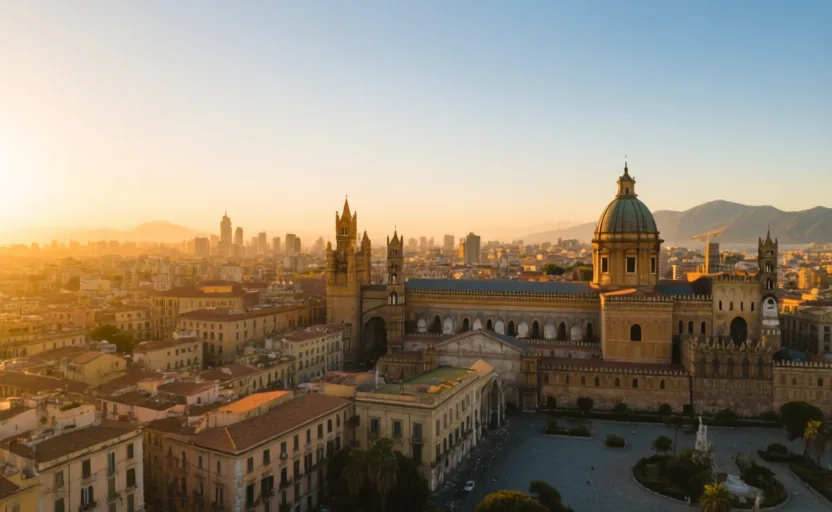 Palermo · AI city illustration · Artistic impression
City · Europe
Palermo
Also known as Balarm, Panormus
Saved in this browser — no account needed. Sign in later and it comes with you.
Where it is
A cirque of mountains wraps around Palermo, and the city fills the basin between them and a gulf on the Tyrrhenian Sea. The Arabs named that basin the Conca d’Oro, the Golden Basin, in the ninth century. Three small rivers, the Papireto, Kemonia and Oreto, drained it. The first two are now buried under streets that still follow their curves, and only the Oreto runs open. Monte Pellegrino stands apart in front of the sea, and the mountains behind made it historically hard to reach the interior of Sicily. The climate is hot-summer Mediterranean, with yearly air temperatures averaging 18 °C and about 2,530 hours of sunshine a year, and snow has fallen only about a dozen times since 1945.
The land and water around it
The Conca d’Orovalley
A basin ringed by mountains facing the Tyrrhenian Sea, named the Golden Basin by the Arabs. Seasonal torrents once made swampy plains in it, and some were reclaimed, as at Mondello.
Monte Pellegrinomountains
A promontory that stands on its own, separated from the other mountains by a plain, and facing the open sea. Goethe called its cliff the most beautiful promontory in the world, and Saint Rosalia’s remains were found in a cave on it.
The natural harbourharbour
The Phoenicians chose this harbour for their settlement and linked it to the mountains by two roads, which are today Via Cappuccini and Corso Pisani. The port and the quarters around it were largely destroyed in the Allied bombing of 1942–1943.
Its history, in short
Phoenicians built a small port on the natural harbour in the eighth century BCE, calling it Ziz, and it ranked among the three principal Phoenician colonies on Sicily, with Motya and Soluntum. Greek colonists called it Panormos, and it passed to Carthage and then to Rome, which held it for over a thousand years. Vandals, Ostrogoths and then Byzantines took it, until Muslim forces from Tunisia invaded Sicily in the 820s and made Balarm the island’s leading city, a rival in splendour to Córdoba and Cairo, as the story goes. The Normans took it in 1072 and made it the capital of the Kingdom of Sicily from 1130, a court where Muslim, Byzantine, Latin and Jewish traditions mixed. Frederick II’s court in the thirteenth century hosted the first Italian poetic school. Palermo lost capital status when Angevin rulers moved to Naples, and it later ruled Sicily under Spain, Savoy, Austria and the Bourbons. After a failed 1866 revolt against annexation, the city grew, then was bombed in 1942–1943, and rebuilt in the shadow of the Mafia and a building speculation known as the Sack of Palermo.
Timeline
Dates are shown on a timeline rather than as changing shapes on the map. The globe draws modern boundaries only, and tinting a modern outline to stand for a historical one would state something we cannot source.
Classical world
734 BCE
Phoenician Ziz
The city’s traditional founding date, as a Phoenician settlement called Ziz or Sis, meaning flower. Another account only gives the 8th century BCE, and two Greek colonies together called Panormos are also recorded.
Approximate dateWikipedia
Post-classical world
535
Siege of Panormus
The Byzantine general Belisarius besieges the city, the only Ostrogothic-held city in Sicily to refuse surrender, and eventually takes it.
Well attestedWikipedia831–1072
Balarm under the emirate
Muslim rule begins after Byzantine admiral Euphemius asked the Aghlabids for help in 827. Palermo replaces Syracuse as Sicily’s principal city, and its rulers allow the native population freedom of religion in return for a tax.
1072
The Normans
After a siege of four years, Palermo falls to Count Roger I of Sicily. His successors are crowned kings of Sicily from 1130.
1194
The Hohenstaufen
Henry VI, married to the last Norman heir, conquers Palermo and is crowned. His son Frederick II makes it a court that hosts scholars and artists and the first Italian school of poetry.
Well attestedWikipedia
Early modern & oceanic
1624
Saint Rosalia
After her remains are found on Monte Pellegrino and carried around the city three times, the plague is believed to have ended. The yearly Festino commemorates the miracle.
Approximate dateWikipedia
Industrial & imperial
12 January 1848
The first rising of 1848
A popular insurrection led by Giuseppe La Masa, the first in Europe that year, proclaims a parliament and constitution, with Ruggero Settimo as first president.
Well attestedWikipedia22 July 1943
Capture by the Allies
After heavy bombing in 1942 and 1943, Allied forces take the city during the invasion of Sicily. The harbour and nearby districts are effectively destroyed.
Well attestedWikipedia
Places that carry meaning
Arab-Norman PalermoNorman kingdom, 1130–1194
A group of nine monuments, among them the Royal Palace and Palatine Chapel, Zisa Palace, the cathedral, and the Admiral’s Bridge, together with the cathedrals of Cefalù and Monreale. They blend Western, Islamic and Byzantine design, with mosaics and carved ornament, and record the coexistence of Muslim, Byzantine, Latin, Jewish, Lombard and French people.
The Kalsa and old Arab quarters9th–11th centuries
The district called the Kalsa, the emirs’ seat on the sea, and the area around the great mosque are among the traces of Arab rule still readable in the street plan.
The street marketsLong-standing
Vucciria, Ballarò and Capo are colourful fruit, vegetable and fish markets in the middle of the old city.
Languages here
Places are usually multilingual. This lists what is actually spoken, not one language per border.
ItalianRomance family
The official language, spoken alongside the local dialect.
Palermitans speak Italian and the Palermitano dialect of the Sicilian language.
SicilianRomance family
The regional language, in its Palermitano variety.
Sicily has been ruled by Phoenician, Greek, Roman, Arab, Norman, Aragonese and other powers, and the Arabs are said to have left a lasting mark on Sicilian culture.
ArabicSemitic family
The language of the emirate, when the city was called Balharm.
The city kept contact with the Muslim world, and today its university draws many students from Islamic countries. About 5% of residents were born abroad, mostly in Bangladesh, Romania, Sri Lanka, Ghana and Tunisia.
Learn the language here
- 1Understand which languages are spoken herePalermo is multilingual. Start with which languages are used, by whom, and for what — the phrase list only covers one of them.Written by Globe Quest
- 2Learn 12 phrasesCurated everyday phrases for Palermo, with audio and a written form.Written by Globe Quest
- 3Say them out loudSpeaking practice with pronunciation feedback, one phrase at a time.Globe Quest material, your own additions
- 4Come back to themSpaced review, so what you learned this week is still there next month.Written by Globe Quest
- 5Practise with people: Arabic practice · DohaAn in-person practice circle. It is a prepared plan and needs a host before it runs.Run by members
Check yourself
Who named the basin around Palermo the Golden Basin?
The Arabs
Arab settlers called it the Conca d’Oro in the ninth century, when the city was their capital in Sicily and was known as Balarm.
What does the Arab-Norman group of monuments show?
A blend of Western, Islamic and Byzantine traditions under the Norman kingdom
In the 12th century Muslim, Byzantine, Latin, Jewish, Lombard and French people worked together, and the monuments show a deliberate blend of their techniques.
Worth arguing about
- Palermo’s Norman rulers kept Arab craftsmen and Byzantine mosaicists at work on one building. What does it take for such a mix to be a policy and not an accident?
- The Sack of Palermo destroyed old buildings and green space for cheap housing after the Mafia gained a share of local control. Who is accountable for a city damaged by its own growth?
What we have not established
These are open questions, listed rather than filled in. We would rather show a gap than a plausible guess.
How large was Palermo under Arab rule?
Arab writers’ figures are unreliable, and modern estimates for the 11th century range from about 60,000 to as many as 350,000 people. Comparisons with Old Cairo suggest between 100,000 and 250,000.
Sources
- Wikipedia · PalermoWikipedia · encyclopedia · checked 2026-11-24
- Wikipedia · History of PalermoWikipedia · encyclopedia · checked 2026-11-24
- UNESCO · Arab-Norman Palermo and the Cathedral Churches of Cefalú and MonrealeUNESCO World Heritage Centre · intergovernmental · checked 2026-11-24
Reviewed by Globe Quest editorial on 2026-11-24. Drafted with AI assistance and checked against the sources above before publication.