 Globe Quest
 Human Quest · LearningSign in
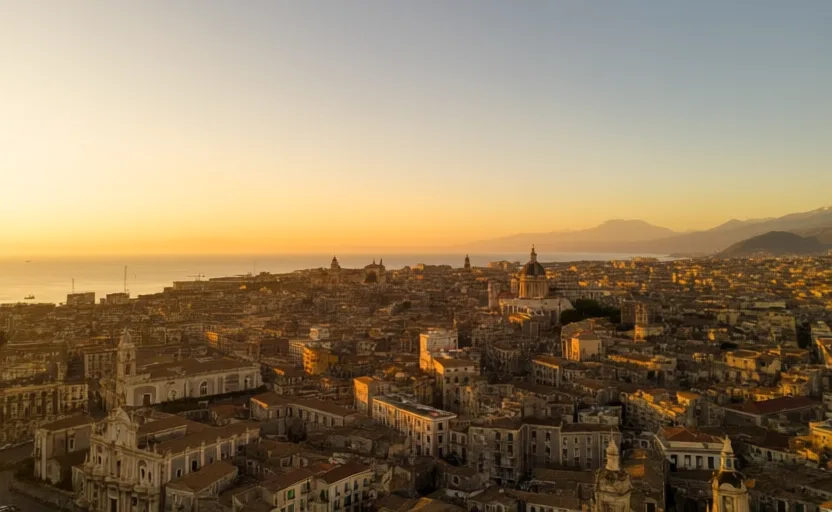 Catania · AI city illustration · Artistic impression
City · Europe
Catania
Saved in this browser — no account needed. Sign in later and it comes with you.
Where it is
Everything about Catania follows from the volcano above it. The city lies on Sicily's east coast, on the Ionian Sea, at the foot of Mount Etna, which has buried or shaken it again and again. The ash that falls on the slopes makes the soil good for vines. Rain arrives between October and March, about 500 millimetres in an average year but with swings from under 250 to over 1,200, and the summers are among the hottest in Italy. Etna also shelters the city from northern winds, which keeps snow almost unknown.
The land and water around it
Mount Etnavolcano
An active volcano that dominates the city's skyline. The Greek geographer Strabo is cited as noting that its eruptions both ruined parts of the city and enriched the soil with ash. Lava overwhelmed much of the city in 121 BCE, and in 1669 the walls turned most of the flow into the harbour. The 1928 eruption sent a large flow that destroyed a population centre for the first time in over two hundred years.
The buried riversriver
Two streams, the Amenano and the Longane or Lognina, run beneath the city. The Amenano reaches the surface at a single point south of Piazza Duomo, so the water is almost invisible in the street plan.
The Ionian coastcoast
The port at the foot of the slope was the main export point for the grain of the fertile plains behind it. Its position, facing the Ionian Sea on the east coast of Sicily, has kept it a key harbour through wars from the Punic period to the Sicilian Vespers.
Its history, in short
Greek settlers from nearby Naxos took over a Sicel village here in the 8th century BCE and turned it into the colony of Katane, with an acropolis on the defensible hill of Monte Vergine. Rome took it in 263 BCE, and it grew prosperous as a port that exported the grain of the plains behind it. The ruling powers that followed were Vandals, Ostrogoths, Byzantines, an Islamic emirate for two centuries, then Normans, Germans, Angevins and Aragonese, and in the 14th century the city was a seat of parliament and royal court. Sicily's first university was founded here in 1434. Catastrophe has marked the story more than conquest: a great lava flow in 121 BCE, a catastrophic earthquake in 1169, the Etna eruption of 1669 and above all the earthquake of 1693, which nearly levelled the town. It was rebuilt on its old site in the late Baroque style. In the 19th and early 20th century it industrialised and was called the Manchester of southern Italy.
Timeline
Dates are shown on a timeline rather than as changing shapes on the map. The globe draws modern boundaries only, and tinting a modern outline to stand for a historical one would state something we cannot source.
Classical world
c. 729 BCE
A Greek colony
Settlers from Naxos occupy the Sicel village of Katane under a leader named Euarchos. Thucydides dates the foundation slightly later than Leontini, five years after Syracuse, which would give around 730 BCE, and the native people were Hellenised quickly.
Approximate dateWikipedia121 BCE
Lava and ash
One of the most serious eruptions of Etna buries much of the city in lava, and the ash falls thickly enough to collapse roofs. Rome excuses it from its usual contributions for ten years.
Well attestedWikipedia
Post-classical world
1169
A catastrophic earthquake
An earthquake destroys almost the whole city, and the town is rebuilt on the same ground, within its black lava landscape.
Well attestedWikipedia1434
Sicily's first university
Catania, already a royal and parliamentary seat, founds the first university on the island.
Well attestedWikipedia
Early modern & oceanic
1669
The great eruption
Etna's lava overruns the countryside around the town and the walls push most of it into the port.
Well attestedWikipedia1693
The earthquake that remade it
The 1693 earthquake and its aftershocks flatten the city. It is rebuilt in the Baroque style that defines it now, and UNESCO counts it among the Late Baroque Towns of the Val di Noto.
Industrial & imperial
1860
Garibaldi's Thousand
Garibaldi's expedition takes Sicily from the Kingdom of the Two Sicilies for Piedmont, and Catania becomes part of unified Italy the following year.
Well attestedWikipedia
Places that carry meaning
The Baroque old townAfter 1693
The rebuilt centre, listed by UNESCO as part of the Late Baroque Towns of the Val di Noto. Unlike Noto, which was rebuilt on a new site, Catania was reconstructed on the ground of the original town.
Castello Ursino13th century
A massive castle built by Frederick II, who also made Catania a royal city and so ended the dominance of the bishops over the town.
Teatro Massimo Vincenzo Bellini1890
The opera house named for the composer Vincenzo Bellini, who was born in the city's Palazzo Gravina-Cruyllas, now a museum about him. Its season runs from December to May.
Languages here
Places are usually multilingual. This lists what is actually spoken, not one language per border.
ItalianRomance family
The national language and the language of schools and government.
Italian is the common language of the city. The largest groups of foreign-born residents, who were 5.9 per cent of the population in 2025, come from Sri Lanka, Romania, Bangladesh, Mauritius and Senegal.
SicilianRomance family
The local language of everyday speech.
Sicilian is the regional language of the island. The novelist Giovanni Verga, born in Catania in 1840, wrote about fishermen and stonemasons in a mix of literary Italian and the local dialect.
Learn the language here
- 1Understand which languages are spoken hereCatania is multilingual. Start with which languages are used, by whom, and for what — the phrase list only covers one of them.Written by Globe Quest
- 2Learn 12 phrasesCurated everyday phrases for Catania, with audio and a written form.Written by Globe Quest
- 3Say them out loudSpeaking practice with pronunciation feedback, one phrase at a time.Globe Quest material, your own additions
- 4Come back to themSpaced review, so what you learned this week is still there next month.Written by Globe Quest
Check yourself
What event led to Catania's present Baroque centre?
The 1693 earthquake
The earthquake nearly destroyed the town, and the rebuilding on its old site in the late Baroque style produced the centre that UNESCO now lists.
What happened to the 1669 lava flow at the city?
The walls turned most of it into the port
The city's walls diverted most of the flow into the harbour, so the town itself was largely saved even though the surroundings were damaged.
Worth arguing about
- Catania was rebuilt on the same site after the earthquake of 1169 and again after 1693, when other towns moved. What makes people stay where the ground has already failed them?
- Etna destroys and enriches the land in the same breath. How should a city weigh fertile soil against repeated risk?
Sources
- Wikipedia · CataniaWikipedia · encyclopedia · checked 2026-11-24
- Wikipedia · ItalyWikipedia · encyclopedia · checked 2026-11-24
- UNESCO · Late Baroque Towns of the Val di Noto (South-Eastern Sicily)UNESCO World Heritage Centre · intergovernmental · checked 2026-11-24
Reviewed by Globe Quest editorial on 2026-11-24. Drafted with AI assistance and checked against the sources above before publication.