 Globe Quest
 Human Quest · LearningSign in
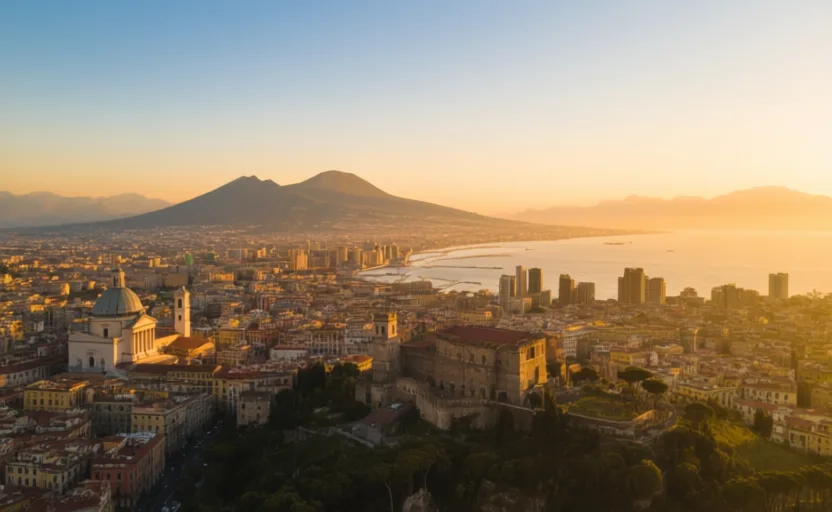 Naples · AI city illustration · Artistic impression
City · Europe
Naples
Also known as Napoli, Neapolis
Saved in this browser — no account needed. Sign in later and it comes with you.
Where it is
Naples climbs from the shore of its gulf up to about 450 metres, on soft volcanic tuff that has been quarried for building stone and hollowed into caves and Greco-Roman cisterns, so there is a second city underground. Two volcanic zones flank it: Mount Vesuvius to the south-east and the Phlegraean Fields, a caldera counted as a supervolcano, to the west. The small rivers that once crossed the centre are now covered by buildings. Procida, Capri and Ischia lie offshore, and the coast runs south to Sorrento and the Amalfi Coast. The climate is Mediterranean, mild and wet in winter and hot and humid in summer.
The land and water around it
The Gulf of Naplesbay
The city sits on a wide gulf on the western coast of southern Italy, with islands offshore. The Greeks chose headlands at the water’s edge, and when swamps made routes inland difficult, Neapolis lived from the sea and trade.
Vesuvius and the Phlegraean Fieldsvolcano
The city lies between two volcanic zones. Vesuvius destroyed the Roman towns of Pompeii, Herculaneum, Oplontis and Stabiae in 79 CE, and the Phlegraean Fields lie to the west, with the Roman naval harbours of Pozzuoli and Baia.
The tuff beneath the cityplateau
Much of the city is built from, and on, soft tuff stone. Centuries of mining left a network of caves and ancient reservoirs under the streets, and the city rests on a major geothermal zone.
Its history, in short
Greek sailors from Rhodes and settlers from Cumae founded Parthenope on the headland of Pizzofalcone, and in the sixth century BCE a new town, Neapolis, was laid out on a grid on the plateau nearby. It became one of the leading cities of Magna Graecia, and kept its Greek culture even after Rome took it in the Samnite Wars. After Ostrogothic and Byzantine rule it was a duchy from 661, then the capital of the Kingdom of Naples from 1282, under Angevin, Aragonese and Spanish rulers, with Spanish viceroys governing from the early sixteenth century. The Congress of Vienna combined Naples and Sicily into the Kingdom of the Two Sicilies in 1815, and in 1839 Naples got the Italian peninsula’s first railway. After Garibaldi’s expedition the city joined Italy in 1861, and an estimated 4 million people emigrated from the Naples area between 1876 and 1913. Bombing in 1943 and a rising against the Germans came before the Allies arrived, and the population peaked at about 1.23 million in 1971.
Timeline
Dates are shown on a timeline rather than as changing shapes on the map. The globe draws modern boundaries only, and tinting a modern outline to stand for a historical one would state something we cannot source.
Classical world
9th–8th century BCE
Parthenope
Rhodian sailors probably set up a small trading port at Megaride, and Cumaeans expand it onto Monte Echia and Pizzofalcone. Accounts differ on the exact dates.
6th century BCE
Neapolis
Cumaean aristocrats expelled by a tyrant refound the city as the “New City”, on a rectangular grid on a plateau, while the old settlement on Pizzofalcone becomes Palaipolis.
326 BCE
Roman siege
In the Second Samnite War a Roman army besieges the city for a year, and betrayal by Greek citizens leads to surrender to the Romans. It later becomes a Roman colony and municipium, but keeps Greek traditions.
Post-classical world
661
Duchy of Naples
After Byzantine rule, a duchy is created, which lasts until 1139. By 763 it is under papal suzerainty, although its Greco-Roman culture endures.
Well attestedWikipedia1282
Kingdom of Naples
After the Sicilian Vespers the Kingdom of Sicily is split in two, and Naples becomes the capital of the Angevin kingdom of the mainland south.
Well attestedWikipedia
Early modern & oceanic
1503
Spanish rule
Spain defeats the French at the battle of Garigliano and takes the city, then governs through viceroys. The most important, Pedro Álvarez de Toledo, brings social, economic and urban reform.
Well attestedWikipedia
Industrial & imperial
1839
First railway in Italy
The Naples–Portici line gives Naples the first railway on the Italian peninsula, in what was then the capital of the Two Sicilies.
Well attestedWikipedia27–30 September 1943
The Four Days of Naples
The city rises against the German occupiers, just before Allied forces arrive on 1 October. Allied bombing had severely damaged it earlier in the war.
Well attestedWikipedia
Places that carry meaning
The historic centreGreek street plan to the present
A listed centre that keeps the Greek-era street grid, Greek walls and a Roman theatre, medieval churches, the Angevin church and convent complexes of Santa Chiara and San Lorenzo, and the Castel Nuovo, which the Aragonese built largely in Tuscan style.
Castel dell’OvoNorman period onward
One of the most substantial surviving Norman buildings, later remodelled many times. In 1191 Empress Constance was imprisoned in it by Tancred during the dispute over the Sicilian succession.
Piazza del Plebiscito and the Royal Palace1600 onward
The palace was built in 1600 under Spanish rule, and the main square beside it was begun by Joachim Murat and finished under the Bourbon king Ferdinand IV.
Languages here
Places are usually multilingual. This lists what is actually spoken, not one language per border.
ItalianRomance family
The official language and that of schools and government.
Italian is the national language, and about 45.9 per cent of Italians speak it mainly at home, while another 32.2 per cent use a local language beside it. Those are national shares, not figures for the city.
NeapolitanRomance family
The southern Italian language that gives the city its voice and song tradition.
About 11 million people speak this dialect continuum across much of southern Italy, and UNESCO classes it as endangered. Naples has long been tied to song and opera through the Neapolitan School.
Greek and OscanIndo-European family
Languages of the ancient city.
Greek was the language of Neapolis, and it kept its Greek culture long after the Roman conquest. In the late fifth century BCE Oscan-speaking Samnites pressed in from the plains, and Oscan elites were admitted to the city’s public offices.
Immigrant languages
Spoken by the roughly 6.8 per cent of residents born abroad.
The largest groups come from Sri Lanka, Ukraine, Pakistan, China and Bangladesh. In the past, most were women, since male migrants tended to head for the richer north.
Learn the language here
- 1Understand which languages are spoken hereNaples is multilingual. Start with which languages are used, by whom, and for what — the phrase list only covers one of them.Written by Globe Quest
- 2Learn 11 phrasesCurated everyday phrases for Naples, with audio and a written form.Written by Globe Quest
- 3Say them out loudSpeaking practice with pronunciation feedback, one phrase at a time.Globe Quest material, your own additions
- 4Come back to themSpaced review, so what you learned this week is still there next month.Written by Globe Quest
Check yourself
What was Neapolis, in relation to Parthenope?
The “New City” refounded in the sixth century BCE, with Parthenope surviving as the “old city”
Cumaean aristocrats founded Neapolis on a grid, and the earlier settlement on Pizzofalcone was called Palaipolis, the old city.
What did Naples have in 1839 that no other Italian city had?
A railway
The Naples–Portici line was the first railway on the Italian peninsula, laid while Naples was the royal capital of the Two Sicilies.
Worth arguing about
- About 4 million people left the Naples area between 1876 and 1913, while the city’s population grew far more slowly than Turin’s or Milan’s. What does a city lose when its capital status goes?
- Naples lies between two volcanic zones, on ground hollowed out beneath. How should a city plan around hazards it cannot remove?
What we have not established
These are open questions, listed rather than filled in. We would rather show a gap than a plausible guess.
When was Parthenope founded?
Accounts place the first Greek trading port in the 9th century BCE and its expansion by Cumae in the 8th. The date of Neapolis’s refounding also varies, from 507 BCE in one telling to 470 BCE in another, and little archaeology of Parthenope itself has been found.
Sources
- Wikipedia · NaplesWikipedia · encyclopedia · checked 2026-11-24
- Wikipedia · History of NaplesWikipedia · encyclopedia · checked 2026-11-24
- UNESCO · Historic Centre of NaplesUNESCO World Heritage Centre · intergovernmental · checked 2026-11-24
- Wikipedia · ItalyWikipedia · encyclopedia · checked 2026-11-24
- Wikipedia · Languages of ItalyWikipedia · encyclopedia · checked 2026-11-24
Reviewed by Globe Quest editorial on 2026-11-24. Drafted with AI assistance and checked against the sources above before publication.