 Globe Quest
 Human Quest · LearningSign in
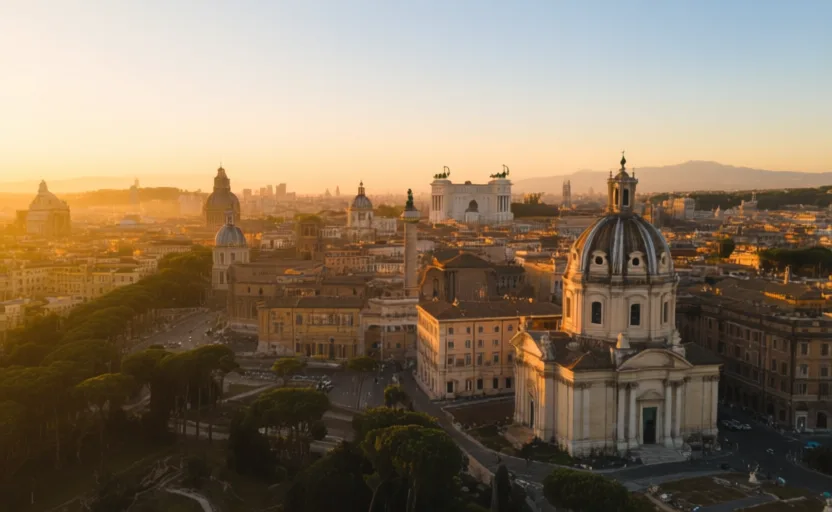 Rome · AI city illustration · Artistic impression
City · Europe
Rome
Also known as Roma, Urbs
Saved in this browser — no account needed. Sign in later and it comes with you.
Where it is
Rome grew where the Tiber makes a Z-shaped bend and the only natural ford in the area crosses beside Tiber Island, so traffic along the river valley met traders going up and down the western side of the peninsula. The first settlements stood on hills facing the crossing, the seven hills of the old city, with the Palatine above what became the Forum. The centre lies about 24 kilometres from the Tyrrhenian Sea, though the municipality reaches the coast at Ostia, and the central streets run between 13 and 139 metres above sea level. Summers are hot and dry and winters mild and damp, with light, rare snow. Vatican City is a separate state inside the municipal boundary.
The land and water around it
The Tiber and its island fordriver
A natural crossing beside Tiber Island fixed the site. The river also brought the city into reach of the sea at Ostia and made the Forum Boarium an important river port. Another river, the Aniene, joins from the north of the historic centre.
The seven hillsmountains
The Aventine, Caelian, Capitoline, Esquiline, Palatine, Quirinal and Viminal. Each held a village in the Bronze and Iron Ages, and the city formed by those villages merging around the largest, the Palatine.
A Mediterranean climateclimate
Hot dry summers peak in August at about 31.7 °C by day, and January is the coldest month, with daytime temperatures near 12.6 °C. The record is 42.9 °C, set on 18 July 2023, and snow is rare enough that the last big falls are remembered by year, 1986, 2012 and 2018.
Its history, in short
Rome’s own story, told by later Romans, starts with Romulus and Remus in 753 BCE, but archaeology shows villages on its hills for far longer, merging gradually into one city. After seven kings, the Romans expelled the last in 509 BCE and ran a republic of annually elected consuls, then under Augustus an empire whose capital reached more than a million inhabitants by most estimates. Rome stopped being the emperors’ home in the late third century, was sacked by Alaric in 410, and after the Gothic War of the sixth century shrank to 35,000 people living among ruins, vineyards and market gardens. The popes filled the gap. They governed the Papal States from the eighth century, and from Nicholas V in the fifteenth century they rebuilt the city as a showpiece, drawing the Renaissance from Florence and later the Baroque. The papal state ended when the city was annexed in 1870, and Rome became the capital of unified Italy the next year.
Timeline
Dates are shown on a timeline rather than as changing shapes on the map. The globe draws modern boundaries only, and tinting a modern outline to stand for a historical one would state something we cannot source.
Classical world
21 April 753 BCE
Traditional founding
Roman annalists date the founding to this day, with Romulus killing his brother Remus. Excavations in 2014 found 9th-century BCE walls and 8th-century pottery, evidence for settlement that predates the official date.
509 BCE
The last king expelled
The Romans expel the last of the seven kings, three of whom were said to be partly Etruscan, and set up a republic with two annually elected consuls. The accounts of the early Republic are largely legend.
27 BCE
Augustus
Octavian is named Augustus and princeps. He was later said to have found a city of brick and left one of marble.
273
The Aurelian Wall
In the Crisis of the Third Century, Emperor Aurelian encircles the capital with a wall close to 20 kilometres long. Within decades emperors stop living in Rome, and western emperors rule from Milan or Ravenna.
Well attestedWikipedia24 August 410
Sack by Alaric
The first fall of Rome to an enemy in almost 800 years, a landmark in the decline of the Western Empire. Rome was sacked again in 455 and 472.
Well attestedWikipedia
Post-classical world
535–554
The Gothic War
The war devastates the city in 546 and 550 and leaves around 35,000 people among ruins and market gardens, down from over a million centuries earlier.
Approximate dateWikipedia
Early modern & oceanic
1506
Julius II’s Rome
Under Pope Julius II a great artistic period begins, with Raphael’s rooms and Michelangelo’s Sistine Chapel frescoes and the new Saint Peter’s, finished in 1626.
Well attestedUNESCO World Heritage Centre
Industrial & imperial
1870–1871
Capital of Italy
Italian forces annex Rome, ending the Papal States in 1870, and the city becomes capital of the Kingdom of Italy in 1871. The Lateran Treaty of 11 February 1929 later recognises Vatican City as an independent state.
Places that carry meaning
The Roman Forum and the Capitoline Hill8th century BCE onward
The civic heart of ancient Rome, below the Palatine, where the Palazzo Senatorio on the Capitoline has been a town hall since 1144 and still seats the city government.
Vatican City4th century onward
A state of 44 hectares inside the city, built around the tomb of Saint Peter. Constantine founded the first basilica there in the 4th century, and the present Saint Peter’s, Sistine Chapel and the Vatican Palace record Renaissance and Baroque art.
The Via Appiafrom 312 BCE
A military road begun by the censor Appius Claudius Caecus, running from Rome to Capua and later extended on to Brindisi, whose route is known with certainty. Pilgrims and Crusaders later used it on the way to the Holy Land, and it is still an access route to villages.
Languages here
Places are usually multilingual. This lists what is actually spoken, not one language per border.
ItalianRomance family
The language of the state and of daily life.
Italian is the official language of Italy and of the capital. Romans also have their own dialect, which in the Middle Ages belonged to the southern family and was closer to Neapolitan than to Florentine, the basis of the standard.
LatinItalic family
The language of ancient Rome and ancestor of the Romance languages.
Latin spread with Roman conquest and became the ancestor of the languages of Italy, Gaul, the Iberian peninsula and Dacia. Its alphabet is now the writing system used by more languages than any other.
Immigrant languages
Spoken by about 14.7% of residents who were born abroad.
The largest foreign-born groups come from Romania, the Philippines, Bangladesh, Ukraine and Peru. Around the Termini station the Esquilino district has become a largely immigrant neighbourhood that is seen as Rome’s Chinatown.
Learn the language here
- 1Understand which languages are spoken hereRome is multilingual. Start with which languages are used, by whom, and for what — the phrase list only covers one of them.Written by Globe Quest
- 2Learn 11 phrasesCurated everyday phrases for Rome, with audio and a written form.Written by Globe Quest
- 3Say them out loudSpeaking practice with pronunciation feedback, one phrase at a time.Globe Quest material, your own additions
- 4Come back to themSpaced review, so what you learned this week is still there next month.Written by Globe Quest
Check yourself
What fixed Rome’s site beside the Tiber?
A natural ford beside Tiber Island at a bend of the river
The Tiber valley road and the north–south trade along the western coast crossed here, so settlements on the hills facing the ford grew into a city.
What happened to Rome’s population after the Gothic War?
It fell to about 35,000 people living among ruins and gardens
From over a million at its peak the population shrank to a fraction. The city became groups of inhabited buildings among vineyards, until the popes began to rebuild it.
Worth arguing about
- Rome shrank from a million people to a few tens of thousands and was then rebuilt by its bishops. What does it mean for a city to be reinvented by an institution rather than a state?
- The Fascist regime cut Via dei Fori Imperiali and Via della Conciliazione through old Rome. How should a city weigh the layers of its past against those of a later regime?
What we have not established
These are open questions, listed rather than filled in. We would rather show a gap than a plausible guess.
How big was ancient Rome at its peak?
Estimates of the imperial city’s population run from 450,000 to over 3.5 million, with one to two million the most popular among historians. They depend on assumptions about grain supply, aqueduct capacity and unreported women, children and slaves.
Sources
- Wikipedia · RomeWikipedia · encyclopedia · checked 2026-11-24
- Wikipedia · History of RomeWikipedia · encyclopedia · checked 2026-11-24
- Wikipedia · ItalyWikipedia · encyclopedia · checked 2026-11-24
- Wikipedia · History of ItalyWikipedia · encyclopedia · checked 2026-11-24
- UNESCO · Vatican CityUNESCO World Heritage Centre · intergovernmental · checked 2026-11-24
- UNESCO · Via Appia. Regina ViarumUNESCO World Heritage Centre · intergovernmental · checked 2026-11-24
Reviewed by Globe Quest editorial on 2026-11-24. Drafted with AI assistance and checked against the sources above before publication.