 Globe Quest
 Human Quest · LearningSign in
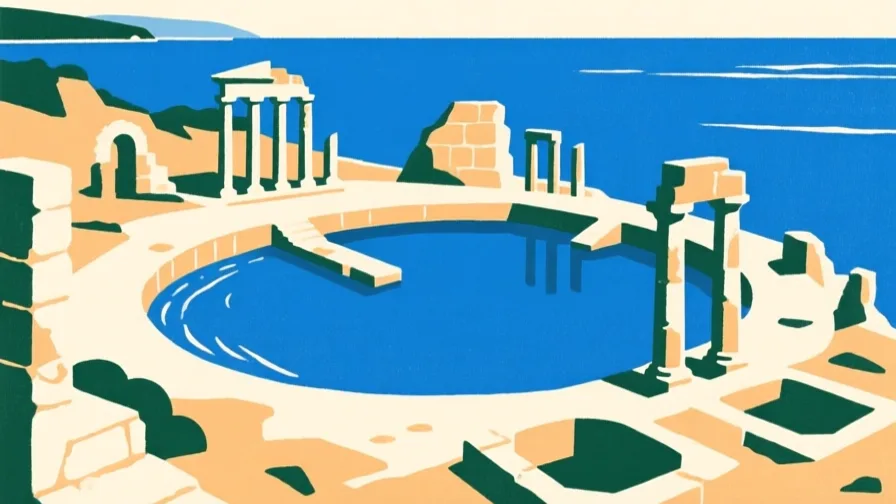 Carthage · AI illustration, not a photograph
Historical place · Africa
Carthage
Also known as Qart-ḥadašt, Carthago
A Phoenician foundation on the Tunisian coast that became a major Mediterranean maritime power, later rebuilt as a Roman city.
Saved in this browser — no account needed. Sign in later and it comes with you.
Where it is
Carthage was placed for the sea. The city took a promontory east of the Lake of Tunis, with inlets of the sea to its north and south, and its citadel hill, the Byrsa, stands about 50 metres above sea level, looking over the Gulf of Tunis. The headland to the north-east, now Sidi Bou Saïd, reaches about 100 metres, and a ridge joins the two. At the time of the founding this was the tip of a peninsula, tied to the mainland by an isthmus on the west. Offshore runs the channel between Sicily and the Tunisian coast, which ships crossing the Mediterranean had to use. Inland, the city's farmland reached along the lower Bagradas valley and out to Cape Bon.
The land and water around it
The Carthage promontorycoast
Most of the city's circuit of walls faced the water and could be built lighter, because Carthaginian ships made an attack from the sea unlikely. The landward isthmus on the west got three parallel walls, which the sources say were never broken. When the Romans came in 146 BCE they first landed on the strip of ground running south from the city.
The narrows between Sicily and Tunisiastrait
Shipping crossing the Mediterranean had to pass between Sicily and the Tunisian shore, and the sources make that position the basis of Carthage's command of sea trade. It also explains why Sicily was the ground Carthage fought over with the Greek cities, and why its navy mattered so much.
The Medjerda (the ancient Bagradas)river
Tunisia's only river that flows all year watered the lower valley inland from Utica, part of Carthage's farmland. Its silt also decided the city's second life: soil washed off grain fields in the Tunisian mountains filled the harbour of Utica at the river mouth until it was useless, and Rome had to rebuild Carthage instead.
Its history, in short
Tradition credits the founding to Elissa, or Dido, a queen from Tyre who is said to have marked out the site with strips cut from a single oxhide. Historians doubt she existed, and the city's own name, Qart-ḥadašt, simply means new city. It began as one of several Phoenician trading posts in the west serving Tyre, and by the close of the 7th century BCE was rising into the front rank of western Mediterranean trading cities. Unlike most colonial founders, it reportedly ruled the settlements it planted through officials sent out from home. Wars with the Greek cities over Sicily, and then three with Rome, ended in 146 BCE, when Scipio Aemilianus took Carthage after a siege of nearly three years, sold about 50,000 people into slavery and burned the city. The story that Rome sowed the ruins with salt has no evidence behind it; the claim goes back at least to 1863. Geography brought the city back. Utica, the Roman ally that inherited the region, lost its harbour to silt, and Julius Caesar laid out a new Carthage on the old site. It became the second city of the western Roman Empire, later the capital of a Vandal kingdom and of Byzantine Africa. Umayyad forces destroyed it in 698, regional power passed to Kairouan and Tunis, and in the 20th century the site became a suburb of Tunis.
Timeline
Dates are shown on a timeline rather than as changing shapes on the map. The globe draws modern boundaries only, and tinting a modern outline to stand for a historical one would state something we cannot source.
First cities & states
late 9th century BCE
A Tyrian foundation
Carthage is founded as one of several Phoenician outposts in the west that served the trade of Tyre. The traditional founder, Elissa-Dido, may be legendary, and excavated heaps of crushed murex shells show purple-dye works already running in the 8th century.
Classical world
end of the 7th century BCE
A leading trading city
For its first century or so Carthage probably looked much like the other Phoenician colonies. By about 600 BCE it was pulling ahead of them, on the way to becoming the capital of a Punic state that dominated much of the south-western Mediterranean.
264–146 BCE
The Punic Wars
Three wars with the Roman Republic, named from the Latin word for Phoenician. Hannibal occupies much of Roman Italy for fifteen years, yet the series ends with Carthaginian power broken.
146 BCE
Destruction
After a siege of nearly three years Scipio Aemilianus takes the city, the Byrsa holding out last. About 50,000 Carthaginians are sold as slaves and the city is burned and levelled, which is why so little of the Punic townscape survives.
49–44 BCE
Caesar's new Carthage
A first Roman colony on the site, founded by Gaius Gracchus in 122 BCE, is soon abolished by the Senate. Julius Caesar then builds a new city on the same ground, and by the first century CE it is the second-largest city of the western Roman provinces, with a peak population put at 500,000.
Well attestedWikipedia
Post-classical world
698
The Umayyad conquest
Umayyad forces sack the city to stop the Byzantines retaking it. Its walls are pulled down, its water supply cut and its harbours put out of use, and Kairouan and Tunis take over as the centres of the region.
13th century
Crusade and demolition
Still kept as a fort under Muslim rule, Carthage is taken from the Hafsids by crusaders during the Eighth Crusade and its inhabitants are massacred. The Hafsids then destroy its defences so that no hostile power can use it as a base again.
Approximate dateWikipedia
Industrial & imperial
1919
A suburb of Tunis
The coastal settlement spreading over the ruins is incorporated as the municipality of Carthage. The site had first been surveyed in 1830, by the Danish consul Christian Tuxen Falbe, and the Carthage National Museum was founded in 1875.
Well attestedWikipedia
Places that carry meaning
The Byrsa and the “Hannibal district”Punic and Roman
The citadel hill at the centre of the city, the reported site of a temple to Eshmun, the healing god, at the head of sixty steps, and the last quarter to fall in 146 BCE. The Romans later built their forum on top. Excavations led by Serge Lancel from 1982 uncovered beneath it a Punic neighbourhood of the early 2nd century BCE: a grid of clay-surfaced streets about 6 metres wide, shopfronts on the street, cisterns in the basements and courtyards reached by long corridors.
The Punic harboursPunic
Two artificial basins, called cothon in Punic, in the south-east of the city: one for merchant shipping and one for the navy, which the sources credit with 220 warships. Metal workshops and pottery kilns clustered beside them. What exactly happened in each basin, whether building, fitting out or repairing ships, is not fully known.
The tophetPunic, probably from the first settlers
An old burial ground south of the citadel near the harbours, outside the city when it began, holding upright stone stelae and the remains of infants. UNESCO describes it as a sacred place dedicated to Baal. The question became prominent after French excavations at Carthage in the 1920s turned up evidence for child sacrifice, and scholars still disagree about what the tophet records.
The Bible and Greek and Roman sources claimed child sacrifice, and some recent studies support it; many archaeologists read the site as a cemetery for infants.
The Roman and later city1st century BCE onward
Rome's levelling of the city left the Punic townscape largely lost, and UNESCO's list of the site's main parts includes a theatre, an amphitheatre, a circus, basilicas, the Antonine Baths and the Malaga cisterns, alongside the Punic ports and necropolises.
Languages here
Places are usually multilingual. This lists what is actually spoken, not one language per border.
PunicSemitic family
The city's own language, brought from the Levant.
The Phoenician settlers spoke Canaanite, a Semitic language, and its Carthaginian form is known in English as Punic, from the Latin word for Phoenician. It was a language of practical learning: Mago, a retired general, wrote 28 volumes on farming in Punic around 300 BCE, covering olives, vines, bees and estate management. The original is lost, as are its Latin and Greek translations; parts survive only as quotations in Roman writers such as Columella.
Latin
The language of Roman Carthage and of the name that outlived it.
Much of what is known about Carthage reaches us through Latin: Mago's farming advice through quotation, early Carthage as Virgil imagined it when his Aeneas arrives, and the word Punic itself. The Latin name Carthago passed into French and English, and survived on the spot as a local name reported as Cartagenna.
ArabicSemitic family
The language of the modern place name.
The Modern Standard Arabic name, Qarṭāj, is not inherited from antiquity. It was adopted from the French form, Carthage, and displaced the older local name that had carried the Latin one forward, so the name returned to the site by way of French.
Learn the language here
- 1Understand which languages are spoken hereCarthage is multilingual. Start with which languages are used, by whom, and for what — the phrase list only covers one of them.Written by Globe Quest
- 2Practise with people: Arabic practice · DohaAn in-person practice circle. It is a prepared plan and needs a host before it runs.Run by members
Check yourself
What does the Punic name behind “Carthage” mean?
New city
Qart-ḥadašt means new city, which implies a new Tyre: the colony was named in relation to the Phoenician mother city whose trade it was founded to serve.
Why did Rome rebuild Carthage about a century after razing it?
Silt from the Medjerda ruined the harbour at Utica, the city that had replaced it
Soil eroded from grain fields in the mountains filled Utica's harbour, so Rome went back to the better-placed site, and Julius Caesar's new city rose there between 49 and 44 BCE.
Worth arguing about
- Rome razed Carthage in 146 BCE, yet within about a century it was building a new city on the same ground because the alternative harbour had silted up. How far do sites like this choose themselves, whatever their conquerors decide?
- Most written accounts of Carthage come from Greek, Roman and biblical writers, while its own books, like Mago's, survive only in fragments quoted by others. How should the tophet's stelae and infant burials be weighed against what Carthage's enemies said about it?
What we have not established
These are open questions, listed rather than filled in. We would rather show a gap than a plausible guess.
When exactly was Carthage founded?
The sources give the end of the 9th century BCE, following the tradition of Elissa-Dido, whose existence is questioned. The same material dates the first urban core to the 7th century while placing purple-dye works in the 8th, and says Carthage probably could not be told apart from other Phoenician colonies in 800–700 BCE. We give the traditional century as approximate and do not choose a year.
How long were the city walls?
The main Wikipedia article gives two figures for the full circuit, 23 miles in one passage and about 33 kilometres in another, which do not agree, so this entry leaves the length out.
Sources
- Wikipedia · CarthageWikipedia · encyclopedia · checked 2026-11-24
- Wikipedia · History of CarthageWikipedia · encyclopedia · checked 2026-11-24
- UNESCO · Archaeological Site of CarthageUNESCO World Heritage Centre · intergovernmental · checked 2026-11-24
Reviewed by Globe Quest editorial on 2026-11-24. Drafted with AI assistance and checked against the sources above before publication.
Related places
Themes: Seas & navigation, Trade & exchange, Empires & independence