 Globe Quest
 Human Quest · LearningSign in
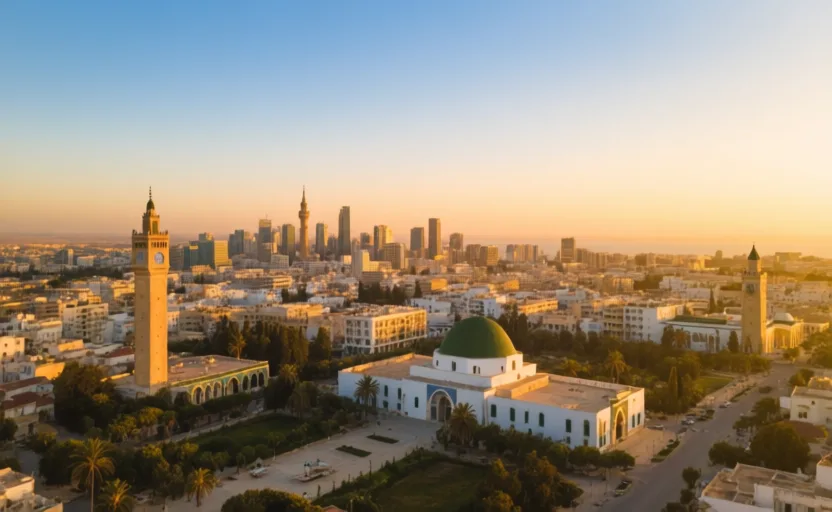 Tunis · AI city illustration · Artistic impression
City · Africa
Tunis
Saved in this browser — no account needed. Sign in later and it comes with you.
Where it is
A shallow lake, not the open sea, fronts Tunis. The city lies on the Gulf of Tunis behind the Lake of Tunis, with a canal linking the lake to the Mediterranean at the port of La Goulette. It spreads over a coastal plain and a ring of low hills, none much above 50 m. The old centre sits on a narrow strip of land between the lake and the Séjoumi salt flat, a natural bridge that carried roads to Carthage and the rest of North Africa. Winters are mild and wet, summers hot and dry, and autumn storms can flood parts of the city.
The land and water around it
The Lake of Tunislagoon
A shallow lake between the city and the sea, reached by canal from the Gulf of Tunis and the port of La Goulette. The lakeside land slopes down from the hills of the old city, and the lake and nearby lagoons cover some 20,000 hectares of the greater Tunis area.
The isthmus and the Tunis domeisthmus
The city stands on a limestone and sediment dome between the lake and the Séjoumi. This strip forms a natural crossing, and since antiquity roads to Egypt, to the rest of Tunisia and to Carthage have branched from it, which explains why a city grew on this particular spot.
A climate on the borderclimate
Tunis is classed as hot semi-arid, bordering on hot-summer Mediterranean. Winter brings more than a third of the year’s rain, summers are almost dry, and the sirocco wind can undo the cooling of sea breezes. The airport recorded 49.0 °C on 24 July 2023.
Its history, in short
Tunis began in the shadow of a more famous neighbour. The ancient city of Carthage stood a short way up the coast, and the place that became Tunis was a small Berber settlement, perhaps the “last stop” before it. Arab conquerors in the late seventh century built a commune and a mosque on the edge of the ruins in 698, founding the city and the Zaytuna Mosque, and gave it a dockyard that made it a naval base on the strait leading to Sicily. For a long time Kairouan and Mahdia outranked it. That changed in 1159, when the Almohads took Tunis and made it a provincial capital, and then in 1228–29 when Abu Zakariya founded the Hafsid dynasty, whose kingdom reached from Tripoli to Fez and built walls around the medina. Spanish and Ottoman forces fought over it in the sixteenth century. The French protectorate of 1881 added a European city beside the old one, and by the end of the colonial period half the population was of European origin. Since independence in 1956 the Europeans have largely left, the suburbs have grown outward, and Tunis has been the stage of the 2011 uprising.
Timeline
Dates are shown on a timeline rather than as changing shapes on the map. The globe draws modern boundaries only, and tinting a modern outline to stand for a historical one would state something we cannot source.
Post-classical world
698
Arab foundation
Hassan ibn al-Nu’man sets up a commune and a mosque next to the ruins of Carthage, the beginnings of the city of Tunis and of the Zaytuna Mosque. Under Caliph Abd al-Malik a dockyard is added, and Tunis becomes the naval base of the Umayyads and later the Abbasids in the western Mediterranean.
Well attestedWikipedia1159
Almohad capital
'Abd al-Mu’min takes Tunis, overthrows the last Khurasanid ruler and installs a government in the kasbah. Previously behind Kairouan and Mahdia, Tunis now becomes a provincial capital and has been the capital of Tunisia ever since.
Well attestedWikipedia1228–1229
The Hafsid kingdom
Governor Abu Zakariya seizes power in 1228 and takes the title of emir a year later. His Hafsid kingdom stretches toward Tripoli and Fez, and walls are built round the medina, the kasbah and the new suburbs.
Well attestedWikipedia1270
Louis IX at Carthage
Louis IX of France takes the city briefly, hoping to convert the Hafsid ruler to Christianity. His army captures Carthage but then falls to an outbreak of dysentery.
Well attestedWikipedia
Early modern & oceanic
1534–1574
Ottomans and Spain contest the city
Hayreddin Barbarossa captures Tunis for the Ottomans in 1534. Charles V sends a fleet in 1535 and restores the Hafsid sultan under Spanish suzerainty, and the Ottoman commander Uluç Ali Reis retakes the city in 1569. Ottoman control lasts until 1881.
Industrial & imperial
1881
French protectorate
The protectorate leads to the redevelopment of the city in two or three decades. It spills out of its walls, with the traditional Arab old city on one side and a new European city on the other, supplied with water, gas, electricity and public transport.
Well attestedWikipedia
Contemporary
1956
Independence
Tunisia gains independence and the new constitution places the national institutions in Tunis and its suburbs. Europeans leave in growing numbers, and migrants from the rest of the country take their place.
18 March 2015
Bardo Museum attack
Two gunmen attack the Bardo National Museum and take hostages. Twenty civilians and a policeman are killed, and about 50 others wounded; both gunmen are killed by police.
Well attestedWikipedia
Places that carry meaning
The Medina of Tunisfrom 698
A walled old town of about 280 hectares with some 700 historic monuments, among them the Zaytuna Mosque, the Kasbah Mosque, the Youssef Dey Mosque and souks such as the Souq el-Attarine. It is listed as one of the best-preserved Islamic cities, and was reckoned one of the greatest and wealthiest in the Arab world under the Almohads and Hafsids.
Carthagefrom the 9th century BC
The archaeological site on a hill above the Gulf of Tunis, with the Punic ports, the tophet, the acropolis of Byrsa, and Roman theatre, amphitheatre and baths. It was the capital of Punic civilisation in Africa and of the Roman province of Africa, and is today a northern suburb of Tunis.
Bardo National Museumsince the late 18th century
Housed in the old palace of the Bey of Tunis, it is the leading archaeological museum of the Maghreb and holds one of the richest collections of Roman mosaics in the world.
Ville Nouvelle and Avenue Habib Bourguibafrom 1881
The colonial-era city begins at the Sea Gate east of the medina. Its main boulevard, nicknamed the Tunisian Champs-Élysées, shows how clearly the French protectorate laid a second city beside the first.
Languages here
Places are usually multilingual. This lists what is actually spoken, not one language per border.
Tunisian ArabicSemitic family
The everyday spoken language of the capital.
Standard Arabic is the official language, but the national vernacular is Tunisian Arabic, called Tounsi. As Europeans left after independence, the city’s population became steadily more Arabic-speaking.
FrenchRomance family
Used in schools, the press and business though it has no official status.
French is the language of instruction for science in secondary school, and shop signs and road signs in Tunisia are normally in both French and Arabic. In the protectorate years, Tunis had a large French and Italian population.
Italian and Berber languages
Minority languages.
Italian is understood by a small part of the population, a legacy of the Italian settlers of the colonial era. Berber languages, spoken by about 2% of Tunisians, survive in Djerba and Matmata rather than in the capital.
Learn the language here
- 1Understand which languages are spoken hereTunis is multilingual. Start with which languages are used, by whom, and for what — the phrase list only covers one of them.Written by Globe Quest
- 2Learn 11 phrasesCurated everyday phrases for Tunis, with audio and a written form.Written by Globe Quest
- 3Say them out loudSpeaking practice with pronunciation feedback, one phrase at a time.Globe Quest material, your own additions
- 4Come back to themSpaced review, so what you learned this week is still there next month.Written by Globe Quest
- 5Practise with people: Arabic practice · DohaAn in-person practice circle. It is a prepared plan and needs a host before it runs.Run by members
Check yourself
What natural feature explains why roads converge on Tunis?
A narrow isthmus between the lake and the Séjoumi
The city sits on a limestone dome that forms a natural bridge between Lake Tunis and the Séjoumi, so overland routes to Carthage, Egypt and the rest of Tunisia all pass through it.
What changed for Tunis in 1159?
It became a provincial capital under the Almohads
Before 1159 Kairouan and Mahdia mattered more. The Almohad conquest raised Tunis to provincial capital, and it has remained the capital since.
Worth arguing about
- Tunis grew up beside Carthage, a city Rome erased. How should a modern capital relate to a famous ruin that stands inside its own suburbs?
- The protectorate built a European city next to the medina, and independence emptied it of Europeans without ending the divide. Which of the two halves do you think now defines Tunis?
What we have not established
These are open questions, listed rather than filled in. We would rather show a gap than a plausible guess.
How many people live in Tunis?
The answer depends entirely on the boundary: the municipality, the governorate, and Greater Tunis, with about 2.7 million people around 2020, are different areas, and the built-up city has spread over four governorates, so no single figure is the city’s population.
Where does the name Tunis come from?
Scholars link it to a Berber root meaning to lie down or camp, to the goddess Tanit, or to the ancient Tynes; a difference in spelling on Neo-Punic coins makes the Tanit link doubtful, but no explanation is settled.
Sources
- Wikipedia · TunisWikipedia · encyclopedia · checked 2026-11-24
- Wikipedia · TunisiaWikipedia · encyclopedia · checked 2026-11-24
- UNESCO · Medina of TunisUNESCO World Heritage Centre · intergovernmental · checked 2026-11-24
- UNESCO · Archaeological Site of CarthageUNESCO World Heritage Centre · intergovernmental · checked 2026-11-24
Reviewed by Globe Quest editorial on 2026-11-24. Drafted with AI assistance and checked against the sources above before publication.