 Globe Quest
 Human Quest · LearningSign in
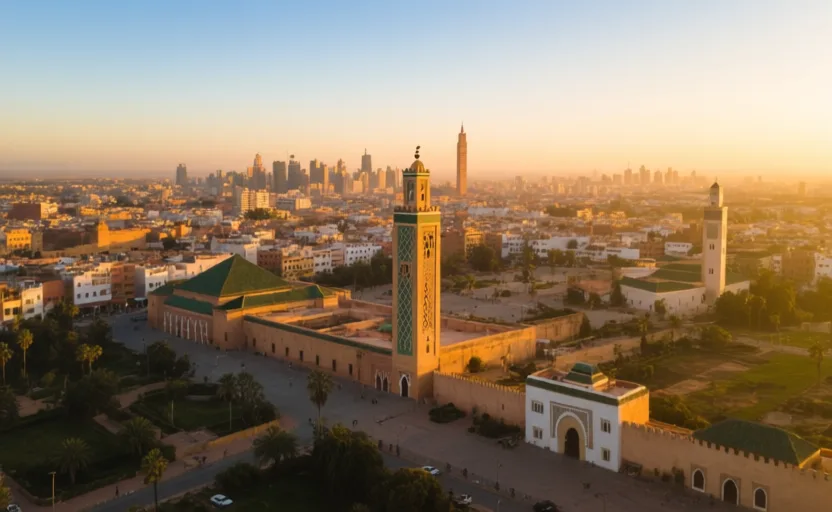 Rabat · AI city illustration · Artistic impression
City · Africa
Rabat
Saved in this browser — no account needed. Sign in later and it comes with you.
Where it is
Rabat stands where the Bou Regreg river reaches the Atlantic, facing its twin town Salé across the water. A rampart-ringed old quarter, the Oudayas fortress and the Hassan district all meet at that river mouth, and the newer city spreads inland and along the shore behind them. The climate is Mediterranean with ocean influence: dry, warm summers and mild, damp winters, about 560 millimetres of rain a year, and cool nights even in summer. The estuary gave medieval rulers a defensible harbour, and it also gave pirates a hiding place for centuries.
The land and water around it
The Bou Regreg estuaryestuary
The river mouth is the city’s reason for existing. Rabat sits on the south bank and Salé on the north. Both towns sheltered pirates, who kept operating into the early nineteenth century, and the Almohad kasbah on the bluff commands the entrance.
The Atlantic shorecoast
A line of neighbourhoods runs west along the waterfront, starting with the old districts around the ramparts and continuing through working-class quarters. The sea keeps the climate mild, with warm summer days and cool nights.
Its history, in short
The site has been used since Roman times, when a town called Sala Colonia stood at Chellah, just south of the present walls and one of two main Roman naval outposts on the province’s Atlantic coast. In the tenth century a ribat, a fortified religious outpost, guarded this stretch of coast against the Barghawata, and the Almohad caliph Abd al-Mu’min raised a citadel in 1150 or 1151, which survives as the Kasbah of the Udayas. In 1170 the Almohads made the place a naval base and named it the “ribat of conquest”, from which the name Rabat comes. After Moriscos expelled from Spain settled here in the early seventeenth century, Rabat and Salé together formed a corsair republic in 1627. The Alawi sultans allowed piracy to continue until early in the nineteenth century. Rabat’s modern role was fixed in 1912, when the French resident general, Hubert Lyautey, moved the capital there from Fez, and in 1913 hired Henri Prost to lay out a new administrative city beside the old one. King Mohammed V kept it as capital at independence in 1956.
Timeline
Dates are shown on a timeline rather than as changing shapes on the map. The globe draws modern boundaries only, and tinting a modern outline to stand for a historical one would state something we cannot source.
Classical world
Roman period
Sala Colonia at Chellah
Romans built a city on top of older Mauretanian structures. Whether the Phoenicians had a settlement here first is debated by archaeologists.
Approximate dateWikipedia
Post-classical world
1150 or 1151
The Almohad kasbah
Abd al-Mu’min replaced a ribat destroyed by the Almohads with a new citadel, containing a palace and a mosque. It is the origin of the present Kasbah of the Udayas.
Approximate dateWikipedia1170
A naval base called Ribat al-Fath
The Almohads established the city as a naval base, and the name Rabat is a shortening of the title they gave it, the “ribat of conquest”.
Well attestedWikipedia
Early modern & oceanic
1627
The Republic of Bou Regreg
After 1609, thousands of Moriscos expelled from Spain settled around Salé. Rabat and Salé joined to form an autonomous republic whose corsairs, the “Salé Rovers”, attacked shipping around western Europe.
Well attestedWikipedia1666
The Alawis take the area
Al-Rashid, founder of the Alawi dynasty, conquered the corsair coast and united most of Morocco. Later Alawi sultans expanded the kasbah and settled the Udayas military tribe there.
Well attestedWikipedia
Industrial & imperial
1829
Austria shells the city
Austria bombarded Rabat after one of its ships was lost to a pirate attack, one of the last results of the corsairs’ trade.
Well attestedWikipedia1912–1913
Lyautey’s capital
After riots followed the Treaty of Fes, the French administrator Lyautey moved the capital from Fez to Rabat. He argued that its coast was more pleasant and accessible, and that it was close to Casablanca. Henri Prost designed the modern quarter in 1913.
Well attestedWikipedia
Contemporary
1956
Capital of independent Morocco
King Mohammed V chose to keep the capital at Rabat. By 1971 the population was about 368,000, only 3.5 per cent of them foreigners.
Well attestedWikipedia
Places that carry meaning
Kasbah of the Udayas12th century onward
The oldest part of the city, built by the Almohads and later refortified by corsairs and Alawi rulers. Today it is a residential district of white and blue houses, with the city’s oldest mosque, an Andalusian garden and a museum in a palace of Moulay Isma’il.
ChellahRoman period onward
The ruins of Sala Colonia, with older Mauretanian structures beneath the Roman ones, stand just south of the walled city.
The modern capitalFrom 1913
A planned administrative city built beside the old medina. It combines modernist planning with local forms and keeps its historic monuments, with a medina and kasbah, residential quarters, middle-class housing and the neo-traditional quarter of Habous Diour Jamaa. It is inscribed as a shared heritage of ancient, Islamic, Hispano-Maghrebian and European cultures.
Languages here
Places are usually multilingual. This lists what is actually spoken, not one language per border.
Neo-PunicSemitic family
A historical language of the coastal settlements.
Local people were still writing in Neo-Punic, a late form of the Phoenician tongue, around the 1st century BC, even as Rome’s influence over the region grew.
ArabicSemitic family
The language of the city, in its Moroccan form, Darija.
The city’s name is Arabic, and Moriscos and Andalusi refugees who arrived in the seventeenth century added to its Arabic-speaking population. It is Morocco’s official language, together with Amazigh.
FrenchRomance family
The language of the colonial administration and still of much of government and business.
Rabat became the administrative centre of the French protectorate in 1912, and French civil servants and settlers shaped the modern quarter.
Learn the language here
- 1Understand which languages are spoken hereRabat is multilingual. Start with which languages are used, by whom, and for what — the phrase list only covers one of them.Written by Globe Quest
- 2Learn 11 phrasesCurated everyday phrases for Rabat, with audio and a written form.Written by Globe Quest
- 3Say them out loudSpeaking practice with pronunciation feedback, one phrase at a time.Globe Quest material, your own additions
- 4Come back to themSpaced review, so what you learned this week is still there next month.Written by Globe Quest
- 5Practise with people: Arabic practice · DohaAn in-person practice circle. It is a prepared plan and needs a host before it runs.Run by members
Check yourself
What does the name Rabat mean?
A fortified religious outpost, short for the ribat of conquest
The Almohads built a naval base here in 1170 and called it Ribat al-Fath, the ribat of conquest. Over time it shortened to Rabat.
Why did Lyautey move the capital from Fez to Rabat in 1912?
Rabat’s coastal site was pleasant and accessible, and near Casablanca
Riots in Fez after the Treaty of Fes were one trigger, but Lyautey chose the coast because it was pleasanter, easier to reach, and close to Casablanca, which he expected to become the main economic centre.
Worth arguing about
- A capital founded as a fortress, ruled by pirates and later laid out by French planners. Which layer of Rabat’s history do its residents consider most their own?
- Rabat is the political capital while Casablanca is the economic one. Is that split a strength for Morocco or a drain on both?
What we have not established
These are open questions, listed rather than filled in. We would rather show a gap than a plausible guess.
Where did Rabat’s tenth-century ribat stand?
It was most likely on the same site as the present Kasbah of the Udayas, but historians have not confirmed the location, so the exact origin of the city’s earliest fortified outpost remains uncertain.
Sources
- Wikipedia · RabatWikipedia · encyclopedia · checked 2026-11-24
- Wikipedia · MoroccoWikipedia · encyclopedia · checked 2026-11-24
- UNESCO · Rabat, Modern Capital and Historic City: a Shared HeritageUNESCO World Heritage Centre · intergovernmental · checked 2026-11-24
Reviewed by Globe Quest editorial on 2026-11-24. Drafted with AI assistance and checked against the sources above before publication.