 Globe Quest
 Human Quest · LearningSign in
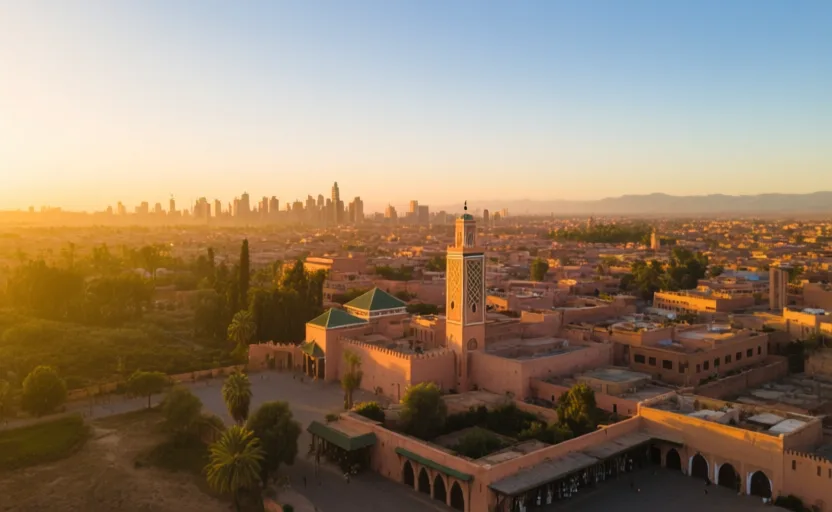 Marrakech · AI city illustration · Artistic impression
City · Africa
Marrakech
Also known as Marrakesh, مراكش
Saved in this browser — no account needed. Sign in later and it comes with you.
Where it is
Marrakech is a plains city with a wall of mountains behind it. It lies in the valley of the Tensift river, which skirts the north of the city, with the snow-covered High Atlas rising to the south, on average above 3,000 metres. The mountains stop rain from the Atlantic, so the climate is hot and semi-arid, with only about 280 millimetres of rain a year, and the city lives off water that moves underground rather than in rivers. That position, on the north side of the range, made it the last major stop before the Saharan caravan routes.
The land and water around it
The High Atlasmountains
The highest mountain barrier in North Africa, mostly of Jurassic limestone, with an average height above 3,000 metres and snow in winter. It runs along the Atlantic coast, rises east of Agadir and extends north-east into Algeria. The Ourika valley, about 30 kilometres south, descends from it.
The Tensift valleyvalley
The Tensift river passes along the northern edge of the city. Marrakech grew on its plain, close enough to the mountains to draw their meltwater, which the Almoravids channelled underground through a system called the khettara.
A semi-arid climateclimate
Winters are brief and mild and summers long, hot and dry, and the average rainfall in 1961 to 1990 was about 281 millimetres. The city is not a desert, since moisture moves underground, but its supply is under strain: since 2002 groundwater levels have fallen by about 0.9 metres a year across most of the area.
Its history, in short
Marrakech was founded around 1070 by the Almoravids, a Berber dynasty of reformers whose emirate stretched from the edge of Senegal to the middle of Spain. They made it their capital and gave it its first mosques, a fortified residence and the open square that became Jemaa el-Fnaa. Under the Almohads from 1147 it remained an imperial capital, but the Marinids took it in 1269 and moved the court to Fez, leaving it a southern regional centre that often rebelled. The Saadian sultans seized it in 1525 and made it the capital of a unified Morocco, financing palaces from the wealth they amassed. The Alawis captured it in 1669, and its fame as a city of saints grew in the same century. For many centuries Europeans called the whole country the Kingdom of Marrakesh, and the name Morocco comes from it. In 1912 the French took Marrakech with the help of the Glaoui family, whose leader T’hami El Glaoui was its pasha through the whole protectorate. Today it is Morocco’s most visited city, and drawing water for it is a growing worry.
Timeline
Dates are shown on a timeline rather than as changing shapes on the map. The globe draws modern boundaries only, and tinting a modern outline to stand for a historical one would state something we cannot source.
Post-classical world
c. 1070
Founded by the Almoravids
Abu Bakr ibn Umar, a cousin of the Almoravid king Yusuf ibn Tashfin, founded the city as capital of the dynasty. Medieval chroniclers gave dates between 1062 and 1078.
Ibn Abi Zar and Ibn Khaldun give 1062, al-Idrisi gives 1078, and most modern historians use 1070
1120s
Walls and the Ben Youssef Mosque
Ali ibn Yusuf built the red city walls and the main mosque, and extended the water supply with the khettara.
Approximate dateWikipedia1147
Almohad capital
The Almohads, who had overthrown the Almoravids, kept Marrakech as their imperial capital.
Well attestedWikipedia1269
The court moves to Fez
The Marinids captured Marrakech and relocated the capital, leaving it as a regional capital of the south that often broke away into semi-autonomy.
Well attestedWikipedia
Early modern & oceanic
1525
Saadian capital
Saadian sharifs took Marrakech, and in 1549 they captured Fez and made it the capital of a unified Morocco.
Well attestedWikipedia1578
El Badi Palace begun
Ahmad al-Mansur began a palace built with costly materials, among them marble from Italy, for receiving ambassadors from Spain, England and the Ottoman Empire.
Well attestedWikipedia
Industrial & imperial
1912
French conquest
After the French Mangin column defeated Ahmed al-Hiba at Sidi Bou Othman, the French seized Marrakech, helped by the rallying of the Glaoui family, in turmoil that included a massacre of its citizens.
Well attestedWikipedia
Contemporary
September 2023
The earthquake
A deadly earthquake affected the city. A month later it hosted the annual meetings of the IMF and the World Bank, held from 9 to 15 October.
Well attestedWikipedia
Places that carry meaning
Jemaa el-Fnaa11th century onward
The central square began as an open public space outside the gates of the Almoravid palace, known as the Rahbat al-Ksar. The main souks grew up between it and the principal mosque and are still there.
The ramparts12th century
Some 19 kilometres of red walls enclose the medina, and the ochre colour of the city’s buildings gave Marrakech its nickname, the Red City.
El Badi PalaceFrom 1578
A Saadian palace made to show the sultan’s wealth to foreign ambassadors, and an example of the sumptuous buildings of the Saadian golden age.
The tombs of the seven saintsLate 17th century onward
Under Moulay Ismail, at the height of Sufism, the sultan asked for a festival of Marrakech’s seven patron saints. The tombs of several renowned figures were moved here to attract pilgrims, and the pilgrimage is now firmly established.
Languages here
Places are usually multilingual. This lists what is actually spoken, not one language per border.
ArabicSemitic family
The everyday language, in the Moroccan dialect, Darija.
In Moroccan Arabic the city’s name is pronounced with stress on the second syllable. Andalusi craftsmen brought from Cordoba and Seville also left their mark on the city’s buildings.
Amazigh (Berber)Afroasiatic family
The language of the High Atlas and of the city’s founders.
One proposed origin of the name is the Berber words amur n akuc, “land of God”. Powerful Amazigh tribal leaders of the High Atlas backed the southern claim to the sultanate in 1907, and the Glaoui family came from an Amazigh tribe.
FrenchRomance family
A language of business and tourism since the protectorate.
The city is especially popular with French visitors, and many French people have bought property there. The French spelling Marrakech is common alongside the English Marrakesh.
Learn the language here
- 1Understand which languages are spoken hereMarrakech is multilingual. Start with which languages are used, by whom, and for what — the phrase list only covers one of them.Written by Globe Quest
- 2Learn 11 phrasesCurated everyday phrases for Marrakech, with audio and a written form.Written by Globe Quest
- 3Say them out loudSpeaking practice with pronunciation feedback, one phrase at a time.Globe Quest material, your own additions
- 4Come back to themSpaced review, so what you learned this week is still there next month.Written by Globe Quest
- 5Practise with people: Arabic practice · DohaAn in-person practice circle. It is a prepared plan and needs a host before it runs.Run by members
Check yourself
What connects Marrakech to the name of the whole country?
The Spanish name for Morocco comes from the city, which was long the royal capital
The English name Morocco comes from the Spanish Marruecos, derived from Marrakech. Because the city was so often the capital, the country was known as the Kingdom of Marrakesh until the 20th century.
Why is water a concern in Marrakech?
Groundwater levels have dropped about 0.9 metres a year since 2002
The city is semi-arid and relies partly on groundwater, which fell by about 0.9 metres a year in most of the area since 2002, and by more than two metres a year in the worst places.
Worth arguing about
- Marrakech was founded to be a capital and has been capital, regional centre and tourist city by turns. What does it take for a city to keep reinventing its role?
- Tourism has turned old houses in the medina into riads and hotels. Who benefits when a living neighbourhood becomes a heritage setting?
What we have not established
These are open questions, listed rather than filled in. We would rather show a gap than a plausible guess.
When were Marrakech’s walls built?
Accounts give the walls as built in 1122–1123 in one place and in 1126–1127 in another, both under Ali ibn Yusuf, so the timeline gives only the 1120s.
What does the name Marrakech mean?
A Berber origin meaning “land of God” competes with an 11th-century manuscript that glosses it as “country of the sons of Kush”, and a possible link to Mauretania is controversial.
Sources
- Wikipedia · MarrakeshWikipedia · encyclopedia · checked 2026-11-24
- Wikipedia · History of MarrakeshWikipedia · encyclopedia · checked 2026-11-24
- Wikipedia · MoroccoWikipedia · encyclopedia · checked 2026-11-24
Reviewed by Globe Quest editorial on 2026-11-24. Drafted with AI assistance and checked against the sources above before publication.