 Globe Quest
 Human Quest · LearningSign in
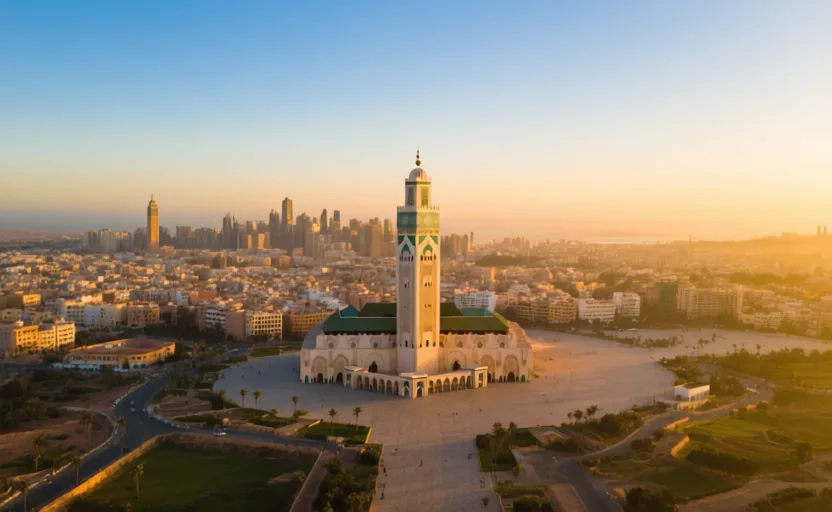 Casablanca · AI city illustration · Artistic impression
City · Africa
Casablanca
Also known as Dar el-Beida, الدار البيضاء, Anfa
Saved in this browser — no account needed. Sign in later and it comes with you.
Where it is
Casablanca is a port city with almost nothing natural to hold it together. It lies on the Atlantic edge of the Chaouia plain, historically the breadbasket of Morocco, with no real river: the one creek, the seasonal Oued Bouskoura, ran to the sea near the present harbour until 1912 and has mostly been built over. The cool Canary Current offshore keeps summers moderate, giving a Mediterranean climate often compared with coastal Los Angeles. What the place has instead is flat, open ground and a sheltered shoreline, which is why a large artificial harbour and a grid of boulevards could be laid out on it.
The land and water around it
The Chaouia plainplain
The flat, fertile plain behind the coast has long supplied grain to Morocco. The tribes of the Chaouia were the ones who, in 1907, pressed the city’s governor to stop the French port works.
Oued Bouskourariver
A small seasonal creek, the only watercourse in the city. Until 1912 it reached the ocean close to where the port now stands, and most of its bed has since been covered by building. The nearest permanent river, the Oum Rabia, is about 70 kilometres away.
The Canary Currentclimate
A cool Atlantic current that narrows temperature swings. It gives the city a hot-summer Mediterranean climate bordering on semi-arid, with about 412 millimetres of rain a year.
Its history, in short
The settlement was called Anfa and was already a port by Phoenician and Roman times. In the fifteenth century it became a refuge for pirates, and Portugal wrecked it in 1468 and later built a fort, calling the village Casa Branca, “white house”. An earthquake in 1755 destroyed it. Sultan Mohammed ben Abdallah rebuilt the port and the town from 1756, and translated the Portuguese name into Arabic as ad-Dar al-Bayda. In the nineteenth century wool exports to Britain grew the population to about 10,000 by the 1880s. Then came the French. A treaty in 1906 gave a French company the port, building began in 1907, and when tribesmen attacked the works that summer French cruisers bombarded the town and troops landed. After the protectorate began in 1912, Henri Prost laid out a European new town fanning out from the walled medina, and the city grew to 110,000 by 1921. Europeans were almost half of all residents. Casablanca then became the centre of Moroccan industry, banking and anti-colonial protest, and it remains the country’s economic capital.
Timeline
Dates are shown on a timeline rather than as changing shapes on the map. The globe draws modern boundaries only, and tinting a modern outline to stand for a historical one would state something we cannot source.
Early modern & oceanic
1468
Portugal destroys Anfa
The Portuguese bombarded the pirate harbour into ruins. They built a fort on the site in 1515, and a village of “Casa Branca” grew up around it.
1755
Earthquake and rebuilding
An earthquake flattened the town and the Portuguese left. Sultan Mohammed ben Abdallah rebuilt the port and the medina, giving the town its Arabic name.
Industrial & imperial
5–7 August 1907
Bombardment and invasion
Work on a French-built port and a railway across a sacred cemetery led local tribes to rise against the works. French warships shelled the town and landed troops, the start of the invasion of Morocco from the west. French control was formalised by the Treaty of Fez in 1912.
1921
A city of 110,000
Growth through European migration and shanty settlements took the population from about 12,000 around 1906 to 110,000. In 1914 Europeans formed 40 per cent of the city.
Approximate dateWikipediaJanuary 1943
The Anfa Conference
Churchill and Roosevelt met in Casablanca to discuss the progress of the war. Charles de Gaulle and Henri Giraud attended but played only minor roles.
Well attestedWikipedia
Contemporary
7 April 1947
The massacre before Muhammad V’s Tangier speech
Working-class Moroccans were massacred by Senegalese soldiers serving in the French army just as the sultan was due to speak in Tangier appealing for independence.
4–7 January 1961
The Casablanca Group
Gamal Abdel Nasser, Kwame Nkrumah, Modibo Keïta, Ahmed Sékou Touré and Ferhat Abbas were among the leaders received in the city by King Muhammad V.
Well attestedWikipedia16 May 2003
Suicide bombings
Twelve bombers struck five locations, killing 33 civilians and injuring more than 100. The government answered with a crackdown on Islamist extremists.
Places that carry meaning
The old medinaFrom 1756
The walled town rebuilt after the earthquake. The French called it the ville indigène and built their own city outside its eastern walls.
Place de France (United Nations Square)From 1908
A former market outside the eastern wall of the medina, remade under French planning and dominated by a clock tower built in 1908. It marked the point where the Moroccan medina met the European new town.
The portFrom 1907
Among the biggest man-made harbours on the continent, ranked third in North Africa behind Tanger-Med and Port Said, and home to the Royal Moroccan Navy’s main base. Its construction triggered the French invasion.
Hassan II MosqueModern era
Ranked second in Africa and seventh in the world by size, and the sight that draws most visitors to the city.
Languages here
Places are usually multilingual. This lists what is actually spoken, not one language per border.
ArabicSemitic family
The language of everyday life, in its Moroccan dialect, Darija.
The city’s name in Arabic, ad-Dar al-Bayda or Dar el-Beida, is a translation of Casa Branca. Most of the population is descended from Bedouin tribes of the Atlantic plains, with the Fessi elite from Fez at the top of urban society.
Amazigh (Berber)Afroasiatic family
The language of the Soussis, Berbers from the Souss region.
The Soussis, also called the Shilha, are one of the city’s three main groups. Tashelhit is the most widely spoken Berber variety in Morocco, at about 14 per cent.
FrenchRomance family
A language of business, banking and education since the protectorate.
Under the protectorate the French formed the largest part of the European community, which also included Spanish, Italian and Portuguese speakers.
Learn the language here
- 1Understand which languages are spoken hereCasablanca is multilingual. Start with which languages are used, by whom, and for what — the phrase list only covers one of them.Written by Globe Quest
- 2Learn 11 phrasesCurated everyday phrases for Casablanca, with audio and a written form.Written by Globe Quest
- 3Say them out loudSpeaking practice with pronunciation feedback, one phrase at a time.Globe Quest material, your own additions
- 4Come back to themSpaced review, so what you learned this week is still there next month.Written by Globe Quest
- 5Practise with people: Arabic practice · DohaAn in-person practice circle. It is a prepared plan and needs a host before it runs.Run by members
Check yourself
Where does the name Casablanca come from?
From the Portuguese Casa Branca, “white house”, translated into Arabic in the 18th century
The Portuguese village was called Casa Branca. Sultan Mohammed ben Abdallah rebuilt the town after 1755 and gave it the Arabic version, ad-Dar al-Bayda, while the French later adopted the Spanish form.
How large a share of Casablanca’s people were Europeans during the protectorate?
About 40 per cent in 1914, and almost half at the height
Europeans formed about 40 per cent of residents in 1914 and almost half at the peak. They had their own schools, churches and hospitals, and most left after independence in 1956.
Worth arguing about
- A modern city was built beside the old medina and kept at arm’s length from it. What did that two-city plan do to how Casablanca grew after independence?
- Casablanca is the country’s largest city and economic centre, while the capital is Rabat. What does a country gain from splitting those roles?
What we have not established
These are open questions, listed rather than filled in. We would rather show a gap than a plausible guess.
How many people live in Casablanca?
The commune recorded 3.22 million in the 2024 census, the urban area is put at about 3.2 million and Greater Casablanca at over 4.27 million, so the figure depends on where the boundary is drawn.
Sources
- Wikipedia · CasablancaWikipedia · encyclopedia · checked 2026-11-24
- Wikipedia · History of CasablancaWikipedia · encyclopedia · checked 2026-11-24
- Wikipedia · MoroccoWikipedia · encyclopedia · checked 2026-11-24
Reviewed by Globe Quest editorial on 2026-11-24. Drafted with AI assistance and checked against the sources above before publication.