 Globe Quest
 Human Quest · LearningSign in
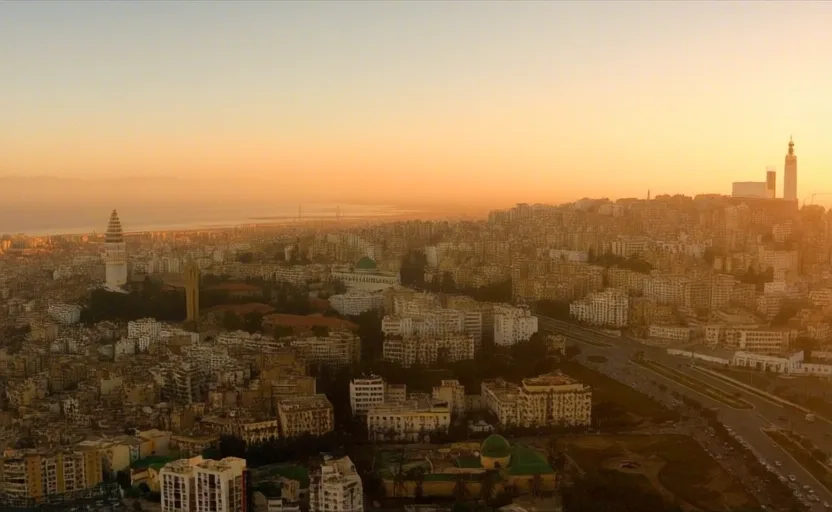 Algiers · AI city illustration · Artistic impression
City · Africa
Algiers
Saved in this browser — no account needed. Sign in later and it comes with you.
Where it is
Whitewashed buildings climb the coastal hills of the Algiers Sahel above a wide bay on the Mediterranean, which is why Algerians call the city al-bidha, the white. The old town sits on the steep slope at the eastern end of the bay, and the city has since spilled over the hills and onto the Mitidja Plain behind them, with the Bouzaréah massif rising to the west. Streams, called oueds, cut down to the sea. The largest, the El Harrach, divides a historic and urban east from a suburban west. The climate is Mediterranean, with about 686 millimetres of rain a year, mostly between October and April, and snow is so rare that the last fall was in 2012.
The land and water around it
The Bay of Algiers and the Sahel hillsbay
The historic centre was built on the coastal hills east of the bay, known as the Algiers Sahel, and the city grew outward over them. The four islets that gave the city its name once stood off the cape and were joined to the shore by Kheireddine pier.
The Mitidja Plainplain
Behind the hills lies the fertile plain that now carries most of the city's growth. Under French rule it was cleared of malarial swamp for vineyards and citrus, and its suburbs now cover most of it.
The ouedsriver
Short rivers run from the Bouzaréah massif and the surrounding hills to the sea. Half of the waterways on the Bouzaréah side have been artificialised and are carried in buried collectors, and the El Harrach, the main one, separates the east of the city from the west.
Its history, in short
The name al-Jazāʾir means the islands and refers to four islets off the western cape, which were joined to the mainland by a pier in 1525. A Phoenician trading post stood on the site, a small port called Icosium under Carthage and later Rome. Buluggin ibn Ziri founded the Muslim city in 972. Its importance grew after the fall of Granada, when Moors from Spain took refuge here, and in 1516 the corsair brothers Oruç and Hayreddin Barbarossa seized it from the Spaniards, who had built a fort on an islet in the bay. Hayreddin offered the territory to the Ottoman sultan, and under the Ottomans the city became the seat of the Barbary corsairs and the capital of the regency. The French took it in 1830 and made it the capital of French Algeria, tearing down the walls and building a European city beside the old one. In 1962 it became the capital of independent Algeria, having lost its whole European population, and it has since spread over most of the Mitidja plain. Its streets saw protests in October 1988 that ended the one-party system.
Timeline
Dates are shown on a timeline rather than as changing shapes on the map. The globe draws modern boundaries only, and tinting a modern outline to stand for a historical one would state something we cannot source.
Post-classical world
972
Buluggin ibn Ziri founds the city
He builds over the remains of the earlier Punic town of Icosium and calls it Jazāʾir Banī Mazghanna, the islands of the Banu Mazghanna.
Well attestedWikipedia
Early modern & oceanic
1510
A Spanish fort on an islet
After the end of Moorish Spain, the Spanish led by Pedro Navarro establish a fortified base on one of the islets off the coast, the Peñón of Algiers, and the emir of the city swears loyalty to Ferdinand II of Aragon.
1516
Barbarossa takes Algiers
Invited by the local emir to expel the Spaniards, Oruç Reis has the emir killed and seizes the town. After a loss in 1524, Hayreddin Barbarossa recovers it in 1529 and offers it to Suleiman, bringing it into the Ottoman empire.
Well attestedWikipedia
Industrial & imperial
1830
French conquest
Algiers becomes capital of French Algeria. The old walls are pulled down, a European side is added and the two are joined into one municipality in 1832. Annexation to France is declared in 1834.
Well attestedWikipedia
Contemporary
1957
The Battle of Algiers
From 7 January 1957 French paratroopers, acting on orders from Paris, carry out a campaign of attacks against the fighters for independence in the city, a turning point in the war that ran from 1954 to 1962.
Well attestedWikipedia5 July 1962
Capital of independent Algeria
Independence is achieved with Algiers as capital. The city loses its pied-noir population but expands massively afterwards.
Well attestedWikipediaOctober 1988
The Spring of Algiers
Demonstrations demand an end to the single-party system and a real democracy. The authorities repress them, and more than 300 people are killed, but the movement is a turning point in modern Algerian politics.
Well attestedWikipedia1992
Cancelled elections and civil war
After the Islamic Salvation Front gains strongly in the first round of the 1992 elections, the army cancels the process and a civil war lasting a decade begins.
Well attestedWikipedia
Places that carry meaning
The Kasbah of AlgiersZirid era onward; ramparts of the late 16th century
The old town within the Ottoman ramparts, a dense tangle of courtyard houses, palaces, hammams, mosques and souks laid over a very hilly site. Around 50,000 people still live there, which has kept it in use. It was inscribed as a World Heritage Site in 1992 for its influence on town planning across North Africa and Andalusia.
Djamaa el Kebir11th century, minaret 1324
The oldest mosque in Algiers, first built by Yusuf ibn Tashfin and reconstructed several times. An inscription on its pulpit shows the building stood in 1097, and the minaret was added by the sultan of Tlemcen in 1324.
Martyrs' Memorial1982
A concrete monument shaped like three palm leaves that shelter an eternal flame, opened on the twentieth anniversary of independence. A statue of a soldier stands at the edge of each leaf, each representing a stage of the struggle.
Languages here
Places are usually multilingual. This lists what is actually spoken, not one language per border.
ArabicSemitic family
The language of most residents.
In one breakdown of the city's residents, 53 percent come from an Arabic-speaking background, and the name of the city in Arabic, al-Jazāʾir, gave the country its name. The everyday variety is Algerian Arabic.
BerberBerber family
The second large community language, official since 2016.
44 percent have a Berber-speaking background, and the city's name has a Berber form, Dzayer. Standard Amazigh and Arabic are both official at the national level.
FrenchRomance family
Influential, with no official status.
A legacy of French rule that began with the conquest of Algiers in 1830 and ended in 1962. It has no official status but remains influential, though English is gradually becoming the main foreign language.
Learn the language here
- 1Understand which languages are spoken hereAlgiers is multilingual. Start with which languages are used, by whom, and for what — the phrase list only covers one of them.Written by Globe Quest
- 2Learn 11 phrasesCurated everyday phrases for Algiers, with audio and a written form.Written by Globe Quest
- 3Say them out loudSpeaking practice with pronunciation feedback, one phrase at a time.Globe Quest material, your own additions
- 4Come back to themSpaced review, so what you learned this week is still there next month.Written by Globe Quest
- 5Practise with people: Arabic practice · DohaAn in-person practice circle. It is a prepared plan and needs a host before it runs.Run by members
Check yourself
What does al-Jazāʾir, the Arabic name of Algiers, mean?
The islands
The name refers to the islets off the western cape, joined to the mainland in 1525. The nickname al-bidha, the white, is a separate name that comes from the whitewashed buildings.
Why does the Kasbah of Algiers matter to urban history?
It influenced town planning across North Africa and Andalusia
UNESCO inscribed it because its houses and street pattern shaped building and planning in North Africa, Andalusia and sub-Saharan Africa during the 16th and 17th centuries.
Worth arguing about
- The old Kasbah is lived in by about 50,000 people and is also a World Heritage Site. Who decides how a living neighbourhood is restored?
- Algiers lost its entire European population in 1962 and then grew to about a tenth of the country. What does a capital owe to the people it displaced and to the people who arrived?
What we have not established
These are open questions, listed rather than filled in. We would rather show a gap than a plausible guess.
How many people live in Algiers?
A figure of about 3.3 million is given for 2012 and about 4.3 million for the urban area in 2025, while another estimate says nearly 5 million. The numbers depend on whether the surrounding communes are counted, so we give no single total.
How many people died in the Algerian War?
Published estimates range between 350,000 and 1,500,000, mostly Algerians but also French and settlers. The range is wide because the sources count differently, so we do not give a single toll.
Sources
- Wikipedia · AlgiersWikipedia · encyclopedia · checked 2026-11-24
- Wikipedia · AlgeriaWikipedia · encyclopedia · checked 2026-11-24
- Wikipedia · History of AlgeriaWikipedia · encyclopedia · checked 2026-11-24
- Wikipedia · Geography of AlgeriaWikipedia · encyclopedia · checked 2026-11-24
- UNESCO · Kasbah of AlgiersUNESCO World Heritage Centre · intergovernmental · checked 2026-11-24
Reviewed by Globe Quest editorial on 2026-11-24. Drafted with AI assistance and checked against the sources above before publication.