 Globe Quest
 Human Quest · LearningSign in
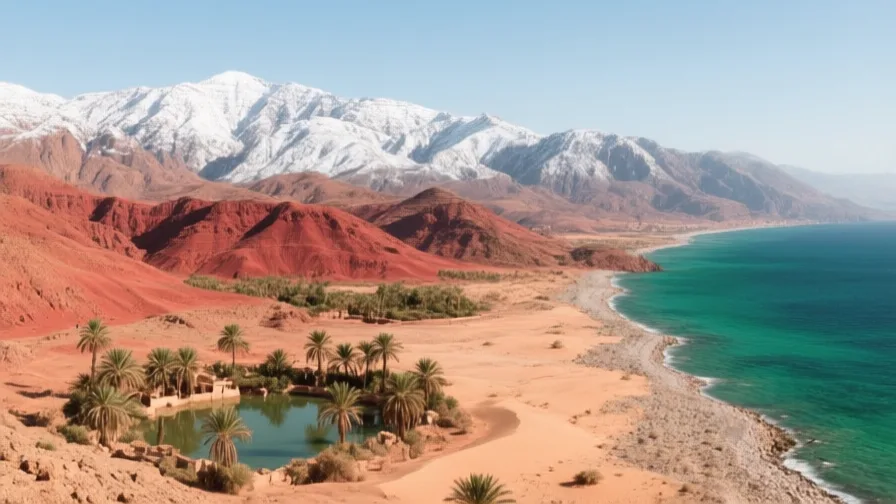 The Maghreb · AI landscape illustration · Artistic impression
Region · Africa
The Maghreb
Also known as al-Maghrib, Tamazgha
Northwest Africa west of Egypt, bounded by the Mediterranean, the Atlantic and the Sahara.
Saved in this browser — no account needed. Sign in later and it comes with you.
Where it is
Mountains shape the Maghreb more than borders do. The Atlas range runs from Morocco into Tunisia, and the Greeks named the whole region after it. North of the mountains, and along the coasts of Tripolitania and Cyrenaica in Libya, lie Mediterranean woodland, forest and scrub; south of them the land dries into steppe and then the Sahara. The divide is roughly the 100 mm rainfall line, the southern limit of the olive and the northern limit of the date palm. On the Atlantic side, fog rising off the cool Canary Current keeps a narrow coastal desert alive. Politically the region spans Morocco, Algeria, Tunisia, Libya, Mauritania and the disputed territory of Western Sahara.
The land and water around it
The Atlas Mountainsmountains
Stretching from Morocco to Tunisia, they divide the Mediterranean Maghreb from the Saharan south and have long sheltered communities that lowland powers could not reach.
The Saharadesert
The southern Maghreb is desert: sand seas, stone plateaus, gravel plains, dry valleys and salt flats in its hyper-arid centre, with occasional winter rain on its northern fringe. Its drying around 3500 BC turned it into a barrier.
The chottslake
Salt depressions that flood with the seasons, among them the salt lakes of central Tunisia and Chott Melghir in Algeria. Salt-tolerant plant communities cover some 54,000 km² of them across the region.
Its history, in short
Berber peoples have lived in the west of North Africa for at least twelve thousand years, since 10,000 BC or earlier. When the Sahara dried out around 3500 BC it cut the north off from the rest of the continent, and the coast's ties ran instead across the Mediterranean, to southern Europe and western Asia. Phoenician traders came in the first millennium BC; by tradition Carthage was founded around 800 BC. Rome defeated Carthage in the Punic Wars and made its Province of Africa in 146 BC, yet mountain country such as the Rif stayed outside Roman control, and the Kabyle kept their highlands through Roman, Vandal and Byzantine rule and even the Arab conquest. Arabs took the region between 639 and 700, and Arab migration began. The arrival of the Banu Hilal and Banu Sulaym in the 11th century carried Bedouin Arabic and nomadism across the countryside: Berber communities withdrew to the mountains while the plains were Arabised, and Tunisia was almost entirely Arabised by about the 15th century. France, Spain and Italy colonised the region from the 19th century, and decolonisation brought wars in Algeria, Ifni and Western Sahara. The Arab Maghreb Union, founded in 1989, is now largely dormant, held back by tension between Algeria and Morocco over Western Sahara and their unresolved border.
Timeline
Dates are shown on a timeline rather than as changing shapes on the map. The globe draws modern boundaries only, and tinting a modern outline to stand for a historical one would state something we cannot source.
First cities & states
By 10,000 BC
Berber North Africa
The Berber people are living in western North Africa by this date at the latest.
Approximate dateWikipediac. 3500 BC
The desert closes
Changes in the tilt of Earth's orbit appear to drive a rapid desertification of the Sahara, creating a natural barrier that sharply limits contact between the Maghreb and sub-Saharan Africa.
Approximate dateWikipedia
Classical world
c. 800 BC
Carthage
Phoenicians found their colony of Carthage on the Gulf of Tunis. With Utica, it becomes the centre of Berber and Phoenician settlement that controls western Mediterranean trade for centuries.
Approximate dateWikipediaThe founding date is traditional
146 BC
The Province of Africa
Victory in the Punic Wars (264–146 BC), helped when Massinissa, afterwards King of Numidia, changed sides, lets Rome set up a province and take over the ports. Rome eventually holds the whole Maghreb north of the Atlas.
Well attestedWikipedia430–534
Vandals, then Byzantium
The Vandals found a kingdom with its capital at Carthage. A Byzantine force under Belisarius destroys it in 534, and Byzantine rule, contested by the Berbers, lasts about 150 years.
Well attestedWikipedia
Post-classical world
639–700
The Arab conquest
With the coming of Islam to Mediterranean North Africa, Arabs take control of the whole Maghreb and Arab migration into the region begins.
Approximate dateWikipedia11th century
The Banu Hilal
Arab tribes of the Banu Hilal and Banu Sulaym, set on the Berbers by the Fatimids after their Zirid clients broke away and abandoned Shiism, spread Bedouin Arabic and nomadism into countryside that had been farmed.
Approximate dateWikipedia
Contemporary
1989
The Arab Maghreb Union
Algeria, Libya, Mauritania, Morocco and Tunisia form a union aimed at a common market, with Western Sahara implicitly included under Morocco's membership. Progress soon stalls.
Well attestedWikipedia
Places that carry meaning
CarthageFrom c. 800 BC (by tradition)
Phoenician colony on the Gulf of Tunis, defeated by Rome in the Punic Wars and later the capital of the Vandal kingdom.
The RifRoman era
Among the most mountainous parts of Morocco, and one of the regions that remained outside Roman control, an early case of the highland independence that recurs across the Maghreb.
The Kabyle mountainsAntiquity to the Middle Ages
Held by the Kabyle people through Carthaginian, Roman, Vandal and Byzantine rule and still in their hands during the Arab conquest. When Arab nomads spread across the plains in the 11th century, the Kabyles were pushed north and the Zenata west.
IfriqiyaMedieval
The medieval region covering today's Tunisia, the Constantinois and Tripolitania. Through the Middle Ages the Maghreb was usually split into three states, roughly Morocco, western Algeria, and eastern Algeria with Tunisia, and only briefly united, as under the Almohads.
Languages here
Places are usually multilingual. This lists what is actually spoken, not one language per border.
ArabicSemitic family
The majority language, spread first by conquest and then by Bedouin migration.
Arabs arrived from the 7th century, but the decisive change came with the Banu Hilal and Banu Sulaym, whose Bedouin Arabic reached the countryside, the steppes and the edge of the Sahara. People of Arab origin now make up about 97% of Libyans and 98% of Tunisians, and 70 to 80% of Algerians. What people speak is Maghrebi Arabic, a chain of dialects in which Algerian speech merges into Moroccan on one border and Tunisian on the other; Modern Standard Arabic is learned at school and kept for writing and formal use. In Morocco's 2024 census 80.6% named Arabic as their mother tongue, and Algeria's last census to ask, in 1966, found 81.5%. Hassaniya Arabic is spoken in Western Sahara, a territory claimed by both Morocco and the Sahrawi Arab Democratic Republic, and by Sahrawi refugees at Tindouf.
Berber (Amazigh)Berber family
The region's oldest languages, held strongest in the mountains.
Berber peoples were here long before Arabic. As the plains were Arabised after the 11th century, Berber communities kept to high ground. People of Berber origin are estimated at about 20% of Algerians, 10% of Libyans and only 1% of Tunisians, and somewhere between 35 and 60% of Moroccans. Silver jewellery worn by Amazigh women marked Berber identity across much of the region into the second half of the 20th century. Tamazight became an official language in Morocco in 2011 and in Algeria in 2016. Morocco's 2024 census found 24.8% of people speaking an Amazigh language, though some linguists put the figure at 40 to 45%. About 17% of Algerians speak Berber, among them some 3 million Kabyle speakers and about 2 million speakers of Shawiya in the Aurès. In Tunisia only a few thousand people keep it, in southern villages such as Chenini and Matmata and on Djerba.
FrenchRomance family
The language of business, science and higher education, without official status in Morocco, Algeria or Tunisia.
French came with colonial schools and offices and outlived the drives to Arabise education after independence. About a third of Moroccans use it as a second language, and by 2020 Morocco had brought it back for teaching science and mathematics. Some observers call it the true lingua franca of Algeria, where the Francophonie counted 14.9 million speakers in 2022 and university science and business courses are still taught in it. Tunisia told the same body in 2022 that 6.32 million people, 52% of the population, spoke French, nearly all as a second language. English is gaining ground: some young Moroccan protest groups want it to replace French as the country's second foreign language.
SpanishRomance family
A second language of northern Morocco, left by Spanish rule.
Spanish occupation of northern Morocco and Western Sahara left Spanish in use around Tangier and Tetouan, but after 1956 French and Arabic took over government and schooling. In a 2005 survey 21.9% of Moroccans said they spoke it; by 2017 the share had dropped to about 4.5%.
Learn the language here
- 1Understand which languages are spoken hereThe Maghreb is multilingual. Start with which languages are used, by whom, and for what — the phrase list only covers one of them.Written by Globe Quest
- 2Practise with people: Arabic practice · DohaAn in-person practice circle. It is a prepared plan and needs a host before it runs.Run by members
Check yourself
What marks the boundary between the Mediterranean Maghreb and the Saharan Maghreb?
Roughly the 100 mm rainfall line, where the olive gives way to the date palm
The 100 mm line is both the southern limit of the olive and the northern limit of the date palm, so it separates Mediterranean woodland from the desert's northern fringe.
What did most to spread Arabic into the Maghreb's countryside?
The 11th-century arrival of the Banu Hilal and Banu Sulaym
Arab rule began in the 7th century, but these Bedouin tribes carried Arabic and nomadic herding onto the plains in the 11th, while Berber communities withdrew into the mountains.
Worth arguing about
- The Maghreb's mountains held out against Rome, the Vandals and the Arab conquest alike. What does it do to a country's politics when its highlands and plains have such different histories?
- The Arab Maghreb Union was meant to build a common market but stalled over Western Sahara. Can regional integration move ahead while a territorial dispute stays open?
What we have not established
These are open questions, listed rather than filled in. We would rather show a gap than a plausible guess.
What share of Moroccans are Berber?
Estimates of Morocco's Berber population run from 35% to 60%, with the Arab share correspondingly put at 44% to 67%. The range is too wide to quote a single figure, and no estimate within it is clearly better grounded than the others.
Sources
- Wikipedia · MaghrebWikipedia · encyclopedia · checked 2026-11-24
- Wikipedia · Languages of MoroccoWikipedia · encyclopedia · checked 2026-11-24
- Wikipedia · Languages of AlgeriaWikipedia · encyclopedia · checked 2026-11-24
- Wikipedia · Languages of TunisiaWikipedia · encyclopedia · checked 2026-11-24
Reviewed by Globe Quest editorial on 2026-11-24. Drafted with AI assistance and checked against the sources above before publication.
Related places
Themes: Trade & exchange, Seas & navigation, Migration & diaspora, Languages & contact