 Globe Quest
 Human Quest · LearningSign in
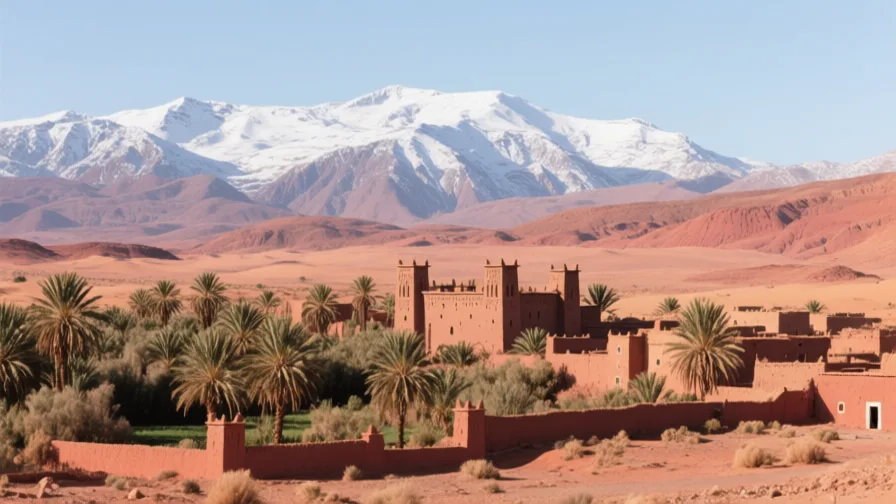 Morocco · AI landscape illustration · Artistic impression
Country · Africa
Morocco
Saved in this browser — no account needed. Sign in later and it comes with you.
Where it is
Only three countries in the world, Morocco, Spain and France, have both an Atlantic and a Mediterranean coast, and here the two seas meet at the 13-kilometre Strait of Gibraltar. Mountains fill most of the interior. The Atlas run roughly 1,350 kilometres across the centre and south-west, with Toubkal at 4,165 metres the highest point, and the Rif curves along the north. A plateau of plains along the Atlantic carries most of the farmland, while the south-east dries into the Sahara. The mild north-west is where about 95 per cent of Moroccans live.
The land and water around it
The Atlas Mountainsmountains
The spine of the country, running some 1,350 kilometres from the central north to the south-west. The Rif, a separate range, rises in the north between Tangier and Nador. Berber communities live mainly in both ranges, and mountain winters bring heavy snow that feeds the plains below.
The Atlantic plainsplain
A broad plateau runs along the ocean from Tangier to Essaouira and inland to the Saiss Plains near Fez and the Tansift plain near Marrakesh. This fertile belt supports about 15 per cent of the economy, and several of the old imperial cities stand on its edge.
The Saharan fringedesert
The extreme south-east is arid because it borders the Sahara. Palm oases grow at Figuig and Zagora, and the Draa, at 1,100 kilometres the longest river in the country, drains the dry south.
Its history, in short
Morocco’s past reaches back unusually far: fossils at Jebel Irhoud, dated to at least 300,000 years ago, are the oldest known Homo sapiens. Phoenician traders set up depots on the coast, and Berber kings ruled the north as Mauretania until Rome absorbed it. The Muslim conquest reached the region by 709, and the Idrisid dynasty, founded in 788, is counted as the first Moroccan state. Berber dynasties then built the country’s greatest empires: the Almoravids and the Almohads, from the eleventh and twelfth centuries, ruled Morocco and parts of southern and eastern Iberia. Morocco resisted Portugal and the Ottomans, and was the only North African country to escape Ottoman rule. The Alawi dynasty, in power since the seventeenth century, still reigns. France and Spain divided the country into protectorates in 1912, and independence came in 1956 under Sultan Muhammad V. Since the 1970s the status of Western Sahara, which Morocco claims and largely controls, has remained the country’s most disputed question, with a UN referendum agreed in 1991 and never held.
Timeline
Dates are shown on a timeline rather than as changing shapes on the map. The globe draws modern boundaries only, and tinting a modern outline to stand for a historical one would state something we cannot source.
Deep time
About 315,000 years ago
Jebel Irhoud
Human remains found near the Atlantic coast, dated in 2017 to at least 300,000 years old, are the oldest known examples of Homo sapiens.
Classical world
8th–6th century BCE
Phoenician depots
Phoenician traders arrived on the Atlantic and Mediterranean coasts and set up depots for salt and ore at Chellah, Lixus and Mogador.
Approximate dateWikipedia
Post-classical world
788
The Idrisid dynasty
Idris I, a descendant of Hasan ibn Ali who had fled the Abbasids, persuaded the Awraba Berbers to break with the distant caliphs. Historians treat his dynasty as the founder of the first Moroccan state.
c. 1060
The Almoravids
Sanhaja Berber nomads from the Lamtuna group unified Morocco and founded Marrakesh, which later gave the country its European name.
Early modern & oceanic
1631
The Alawi dynasty takes power
The Alawi family, who claim descent from the Prophet through Fatima and Ali, unified the country under Mulay al-Rashid and consolidated it under Ismail. It is among the oldest reigning dynasties in the world. In 1777 Morocco was the first state to recognise the independent United States.
Industrial & imperial
1912
The protectorates
The Treaty of Fez made Morocco a French protectorate, and a second agreement gave Spain zones in the north and south. Tangier later became an international zone. The sultan remained the nominal sovereign.
Contemporary
1956
Independence
France relinquished its protectorate on 7 April after a French–Moroccan agreement signed in March, and Tangier was reintegrated in October. Sultan Muhammad V became king in 1957.
1975 onward
Western Sahara
After the Green March in November 1975 and Spain’s withdrawal, Morocco and Mauritania took over the territory, and the Polisario Front proclaimed a Saharawi republic in exile. Mauritania gave up its claim in 1979, and Morocco later built a long sand berm around most of the territory. A ceasefire has held since 1991, but no referendum has taken place.
Morocco, which claims and controls most of the territory, and the Polisario Front, which seeks independence
Places that carry meaning
Jebel IrhoudAbout 300,000 years ago
A site on the Atlantic side of the Atlas where the earliest known Homo sapiens remains were excavated in 1991. Hominin fossils from Thomas Quarry I in Casablanca push the record of human ancestors back much further.
Volubilis1st–3rd century CE
Capital of the Roman province of Mauretania Tingitana. Roman authority ran through alliances with tribes, never reached the interior, and moved its regional capital to Tangier around 278 CE.
Marrakesh11th century onward
Founded under the Almoravids and capital of the Almoravid, Almohad and Saadian dynasties. The English name Morocco comes from the Spanish form of its name.
Casablanca20th century
Under the protectorate it received about half a million Europeans, who made up almost half the city, and became the centre of the French-run economy. It is now Morocco’s largest city, though not its capital.
Languages here
Places are usually multilingual. This lists what is actually spoken, not one language per border.
ArabicSemitic family
Official language; Moroccan Arabic, Darija, is the everyday lingua franca.
Arabic arrived with the Muslim conquest in the seventh and eighth centuries. In the 2024 census about 92.7 per cent of people could speak it, and 80.6 per cent named it as their native language.
Amazigh (Berber)Afroasiatic family
Official language since 2011, spoken in three main varieties.
Tashelhit is spoken by about 14 per cent, Central Atlas Tamazight by about 7 per cent and Tarifit by about 3 per cent. Berber teaching started in primary schools in 2003, and the 2011 constitution made Amazigh an official language.
FrenchRomance family
A language of administration, business and literature since the protectorate.
Moroccan writing appears mainly in Arabic, Berber, Hebrew and French. Spanish also has a footprint in the north, where Spain held a protectorate.
Learn the language here
- 1Understand which languages are spoken hereMorocco is multilingual. Start with which languages are used, by whom, and for what — the phrase list only covers one of them.Written by Globe Quest
- 2Practise with people: Arabic practice · DohaAn in-person practice circle. It is a prepared plan and needs a host before it runs.Run by members
Check yourself
What was found at Jebel Irhoud?
The oldest known remains of Homo sapiens
The remains, excavated in 1991 and re-dated in 2017 to at least 300,000 years old, are the oldest known examples of Homo sapiens.
What distinguishes Morocco from other North African countries in the Ottoman era?
It escaped Ottoman rule entirely
The Marinid and Saadi dynasties resisted foreign domination, and Morocco was the only North African country to avoid Ottoman dominion, even though Portugal seized some coastal territory.
Worth arguing about
- Morocco was divided into French and Spanish zones, with an international city at Tangier. What traces of that three-way division can still be seen in its language and institutions?
- The status of Western Sahara has been unresolved since 1975. What would a fair way of settling it look like, and who should have a voice in it?
What we have not established
These are open questions, listed rather than filled in. We would rather show a gap than a plausible guess.
How many Moroccans speak Amazigh?
The 2024 census records about 24.8 per cent as regular speakers, while Amazigh activists argue the true share is closer to 35 to 40 per cent. The official statistics bureau also collects no data on ethnicity.
What is the final status of Western Sahara?
The International Court of Justice found historical ties between Morocco and some Saharan tribes but no basis to depart from self-determination, and a UN-backed referendum has never been held, so the question remains open.
Sources
- Wikipedia · MoroccoWikipedia · encyclopedia · checked 2026-11-24
- Wikipedia · History of MoroccoWikipedia · encyclopedia · checked 2026-11-24
- Wikipedia · Geography of MoroccoWikipedia · encyclopedia · checked 2026-11-24
Reviewed by Globe Quest editorial on 2026-11-24. Drafted with AI assistance and checked against the sources above before publication.