 Globe Quest
 Human Quest · LearningSign in
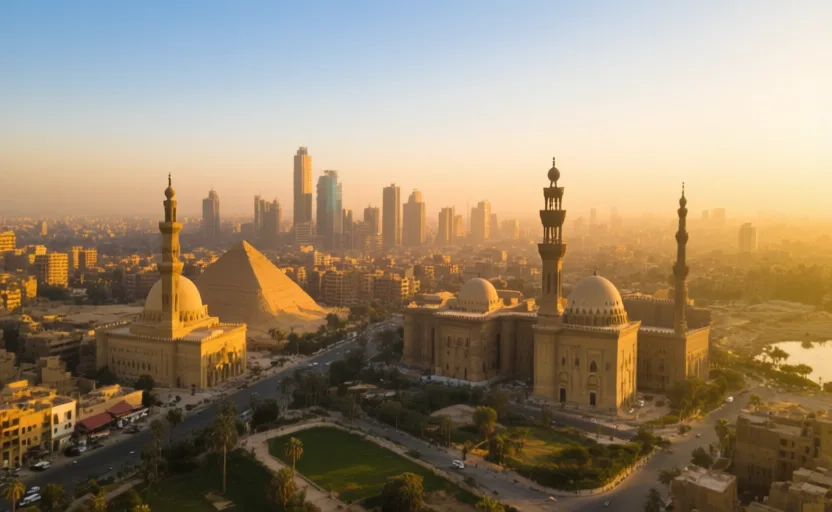 Alexandria · AI city illustration · Artistic impression
City · Africa
Alexandria
Also known as Al-Iskandariyya, Alexandreia
Saved in this browser — no account needed. Sign in later and it comes with you.
Where it is
Alexandria is a strip of city about 40 kilometres long on the Mediterranean, at the western edge of the Nile Delta. It faces the sea to the north and in ancient times had a second waterfront to the south, on Lake Mariout, which linked it to the delta and its farmland. The coast moderates a climate that would otherwise be desert: the north wind makes summers less severe than inland, winters bring storms and some hail, and annual rainfall averages about 211 millimetres, which makes it one of the wettest places in Egypt. The ground is soft sediment, oolitic sand and limestone, so the low coastline is badly exposed to a rising sea.
The land and water around it
Pharos and the two harboursharbour
Alexander meant to join the island of Pharos to the mainland by a causeway, the Heptastadion, which would form two natural harbours. The Lighthouse of Alexandria followed under Ptolemy I, and the Mamluk Citadel of Qaitbay now stands at the northern tip of the island.
Lake Marioutlake
The large lake south of the city gave ancient Alexandria a freshwater side and a link to the delta, which the geographer Strabo praised. Drying out moved the lake's waterfront away in the 9th century, and a canal was dug to connect the city to the Nile.
Abu Qir Bay and the western Deltadelta
East of the city, where Abu Qir Bay is now, there were once marshes and islands with port cities such as Canopus and Heracleion, active from the 7th century BCE. Heracleion has been rediscovered under water. The Canopic branch of the Nile once carried shipping through this area.
Its history, in short
A fishing village called Rhakotis already stood on the shore when, in April 331 BCE, Alexander the Great chose the site for a Greek port city that would link Greece to the Nile valley. The architect Dinocrates laid it out on a grid, and a causeway to the island of Pharos created two harbours. After Alexander's death Ptolemy moved his capital here in 305 BCE, and within a century it was the largest city in the world. Its Museum and Library drew scholars, and the Septuagint, a Greek translation of the Hebrew Bible, was produced here by one of the ancient world's largest Jewish communities. Rome took it after the death of Cleopatra, and it became a centre of Christian theology. In 641 the Arabs captured it after a siege of fourteen months, and the capital moved to Fustat, beginning a long decline. Napoleon seized the city in 1798 and the British retook it. Under Muhammad Ali, in the early 19th century, new building and its position on the cotton trade and the route between the Mediterranean and the Red Sea revived it.
Timeline
Dates are shown on a timeline rather than as changing shapes on the map. The globe draws modern boundaries only, and tinting a modern outline to stand for a historical one would state something we cannot source.
Classical world
April 331 BCE
Alexander founds the city
After taking Egypt from the Persians, Alexander the Great founds a new Greek city on the coast near Rhakotis. He leaves a few months later and never returns.
Well attestedWikipedia305 BCE
Capital of the Ptolemies
Ptolemy declares himself pharaoh and moves his capital from Memphis to Alexandria. The Lighthouse and the Serapeum date to his reign, and the Museum to that of Ptolemy II.
47 BCE
Caesar besieged in the city
Julius Caesar is besieged in Alexandria during the war between Cleopatra and her brother. The Library is said to have faced destruction in the siege.
Approximate dateWikipedia391
The Serapeum is destroyed
Emperor Theodosius I orders the destruction of pagan temples and the Patriarch Theophilus carries it out, destroying the Serapeum, which housed part of the Great Library. The philosopher Hypatia is later murdered by a Christian mob.
DisputedWikipediaAccounts differ on when and how the Library ended; one account says the destruction of the Serapeum may have finished it
Post-classical world
641
Arab conquest
After a siege of 14 months the Arabs under Amr ibn al-As take the city from the Byzantines, who had recovered it from Persian hands. The capital of Egypt moves to Fustat.
Early modern & oceanic
1477
The Citadel of Qaitbay
The Mamluk sultan Qa'it Bay builds a fortress at the mouth of the Eastern Harbour, on the north-eastern tip of Pharos.
Well attestedWikipedia1798
Napoleon takes Alexandria
The French capture the city and the British soon take it from them. Britain keeps Alexandria within its sphere of influence for 150 years.
Well attestedWikipedia
Industrial & imperial
Early 19th century
Muhammad Ali's rebuilding
Under the ruler who founded modern Egypt, infrastructure and modernisation projects begin, and Alexandria revives as a port for Egyptian cotton and for the overland link between the Mediterranean and the Red Sea.
Places that carry meaning
Citadel of Qaitbay1477
A fortress on the sea edge at the tip of Pharos.
Catacombs of Kom El ShoqafaRoman era
A multi-level labyrinth reached by a spiral staircase, with chambers of sculpted pillars, statues and burial niches that mix Roman and Egyptian religious symbols.
Kom El Deka4th to 7th centuries
The excavated Roman quarter, with a theatre, public baths, lecture halls, workshops and houses buried beneath later Muslim-era graves. Its baths and theatre were built in the fourth century, with smaller buildings around them.
Pompey's PillarRoman era
A Roman triumphal column on the ancient acropolis, once part of a temple colonnade and one of the best-known ancient monuments standing in the city.
Languages here
Places are usually multilingual. This lists what is actually spoken, not one language per border.
Egyptian ArabicSemitic family
The everyday language of the city.
Egyptian Arabic is the spoken language of about 68 percent of Egyptians, and Literary Arabic is the official language. The Arabic name of the city, al-Iskandariyya, comes from the Greek name.
GreekHellenic family
The language of the Ptolemaic city and its scholarship.
Ancient Alexandria was a Greek city, with Greek law and Greek learning, and non-Greek texts entered its library only once translated into Greek. Greek, with Armenian and Italian, is still named among the languages of Egypt's older immigrant communities.
CopticAfro-Asiatic family
The last stage of the ancient Egyptian language.
The old Egyptian name for the site survived in Coptic as Rakoti. Spoken Coptic was mostly extinct by the 17th century.
Learn the language here
- 1Understand which languages are spoken hereAlexandria is multilingual. Start with which languages are used, by whom, and for what — the phrase list only covers one of them.Written by Globe Quest
- 2Learn 11 phrasesCurated everyday phrases for Alexandria, with audio and a written form.Written by Globe Quest
- 3Say them out loudSpeaking practice with pronunciation feedback, one phrase at a time.Globe Quest material, your own additions
- 4Come back to themSpaced review, so what you learned this week is still there next month.Written by Globe Quest
- 5Practise with people: Arabic practice · DohaAn in-person practice circle. It is a prepared plan and needs a host before it runs.Run by members
Check yourself
Who founded Alexandria, and what was there before?
Alexander the Great, beside the Egyptian settlement of Rhakotis
Alexander founded it in 331 BCE next to a small Egyptian fishing village, which became the city's Egyptian quarter. His general Ptolemy moved the capital here a quarter of a century later.
What ended Alexandria's time as the capital of Egypt?
The Arab conquest in 641, which led to a new capital at Fustat
After the Arabs took the city in 641, the new capital was founded at Fustat on the Nile, and Alexandria fell into a long decline.
Worth arguing about
- The Library of Alexandria is remembered as a single catastrophe, yet accounts spread its end over centuries. Why do we prefer one dramatic moment to a slow loss?
- The ancient city kept its Greek, Egyptian and Jewish populations apart and unequal. What does that tell us about how cosmopolitan cities actually work?
What we have not established
These are open questions, listed rather than filled in. We would rather show a gap than a plausible guess.
When and how was the Library of Alexandria destroyed?
The sources mention damage in Caesar's siege of 47 BCE and the destruction of the Serapeum in 391, which may have finished it, but do not settle a single date. We present the dates as they appear rather than choose one.
How many people live in Alexandria?
The city extends beyond its administrative limits and beyond its urban agglomeration, and a figure of 5.7 million for 2024 is given for an area of about 1,661 square kilometres. Any total depends on where the boundary is drawn.
Sources
- Wikipedia · AlexandriaWikipedia · encyclopedia · checked 2026-11-24
- Wikipedia · History of AlexandriaWikipedia · encyclopedia · checked 2026-11-24
- Wikipedia · EgyptWikipedia · encyclopedia · checked 2026-11-24
Reviewed by Globe Quest editorial on 2026-11-24. Drafted with AI assistance and checked against the sources above before publication.