 Globe Quest
 Human Quest · LearningSign in
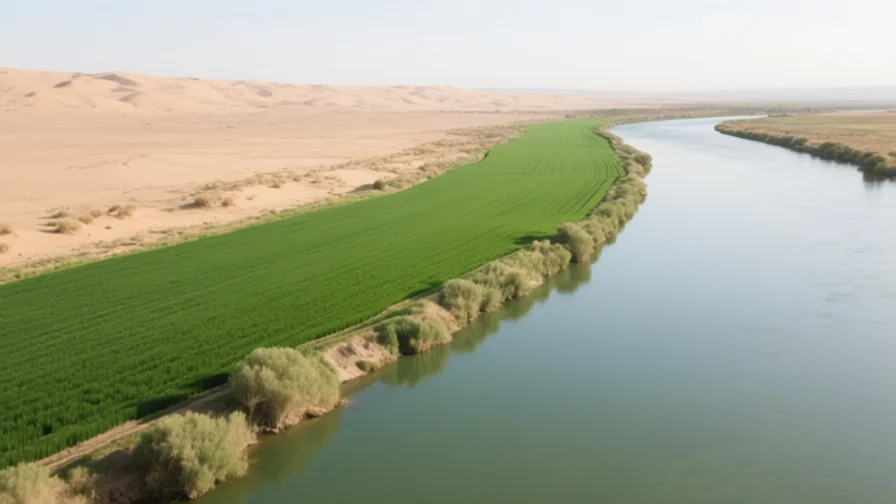 Egypt · AI landscape illustration · Artistic impression
Country · Africa
Egypt
Saved in this browser — no account needed. Sign in later and it comes with you.
Where it is
Egypt is mostly desert with one green thread through it. The Nile Valley and Delta hold nearly everyone: about 99 percent of Egyptians live on roughly 5.5 percent of the land, in a strip of black alluvial soil that the ancient Egyptians named for its colour, Kemet, against the red land of the desert, deshret. Elsewhere the country is Sahara and Libyan Desert, with scattered oases, and dunes that rise above 100 feet. Rain falls mainly in winter along a thin northern coast, up to about 410 millimetres, and elsewhere it is nearly absent. The country also stretches over the Isthmus of Suez into Sinai, where Mount Catherine rises to 2,642 metres, and joins two continents and two seas.
The land and water around it
The Nile Valley and Deltariver
The river provides about 90 percent of the country's water, a share of 55 billion cubic metres a year fixed since 1954. Demand exceeds 90 billion, so water per person had fallen to 570 cubic metres by 2018, below the threshold the world treats as scarcity.
The desertsdesert
Egypt includes parts of the Sahara and of the Libyan Desert, with wind-built dunes and a few oases. The pastoral lands around them began drying out by about 8000 BCE, and the early peoples who lived there moved toward the Nile and settled to farm.
The Isthmus of Suez and Sinaipeninsula
A land bridge between Africa and Asia carries the Suez Canal, a waterway that lets ships pass between the Mediterranean and the Indian Ocean through the Red Sea. East of it the Sinai peninsula holds Egypt's highest mountain, with snow on its peaks in winter.
Its history, in short
A civilisation grew along the river from the 6th to 4th millennia BCE, and around 3150 BCE the Nile's Upper and Lower lands were unified under one ruler. Three thousand years of pharaonic rule produced the pyramids of the Old Kingdom and the Middle and New Kingdoms that followed. Persians, then the Ptolemies, who ruled from Alexandria, held the country, until Rome absorbed it after Cleopatra VII. Arab forces took it between 639 and 642 and founded Fustat, replaced by Cairo in 969. The Ottomans conquered Egypt in 1517. The Suez Canal opened in 1869, and debts led the ruler to sell the country's shares to Britain in 1875. Britain occupied the country in 1882, and Egypt gained independence as a monarchy in 1922. The 1952 revolution led to a republic, declared in 1953, which Gamal Abdel Nasser came to dominate. After wars with Israel in 1948, 1956, 1967 and 1973, the Camp David Accords of 1978 returned the Sinai by 1982. Mass protests in 2011 ended Hosni Mubarak's rule and began years of political turmoil.
Timeline
Dates are shown on a timeline rather than as changing shapes on the map. The globe draws modern boundaries only, and tinting a modern outline to stand for a historical one would state something we cannot source.
First cities & states
c. 3150 BCE
The Two Lands are unified
A king unifies Upper and Lower Egypt and begins a line of dynasties that rules for about three millennia. The Old Kingdom, from about 2700 to 2200 BCE, builds the pyramids at Giza.
Classical world
305 BCE
The Ptolemies rule from Alexandria
The Ptolemaic Kingdom, a Hellenistic state with Alexandria as its capital, adopts pharaonic custom to win acceptance. The last ruler, Cleopatra VII, dies after Octavian captures Alexandria.
Well attestedWikipedia
Post-classical world
639–642
Arab conquest
Arab Muslim forces under Amr ibn al-As defeat Byzantine armies and bring Islam to Egypt, founding Fustat. Cairo replaces it in 969.
Approximate dateWikipedia969
Cairo founded
Cairo takes over from Fustat in 969 and goes on to serve the Fatimid caliphs, and later the Mamluk sultans from the 13th century.
Well attestedWikipedia
Early modern & oceanic
1517
Ottoman conquest
Egypt becomes a province of the Ottoman Empire, though the Mamluks keep influence. Between 1687 and 1731 it suffers six major famines.
Well attestedWikipedia
Industrial & imperial
1869
The Suez Canal
The canal, completed with French help, becomes a major strategic and commercial asset. Egypt's shares are sold to Britain in 1875 and Britain occupies the country in 1882.
Well attestedWikipedia
Contemporary
1952
The revolution
The Free Officers take power, parties are banned and the republic is declared on 18 June 1953. Gamal Abdel Nasser gradually takes control.
Well attestedWikipedia25 January–11 February 2011
The 2011 uprising
Protests that began on 25 January and centred on Tahrir Square in Cairo force President Hosni Mubarak to resign on 11 February after 18 days. A period of political unrest follows.
Well attestedWikipedia
Places that carry meaning
Cairo969 onward
The capital, largest city and leading cultural centre, which replaced Fustat as the seat of government.
AlexandriaPtolemaic period onward
The former capital and second-largest city, a hub of global knowledge through its library and the capital of the Ptolemies.
GizaOld Kingdom
The site of famous pyramids built in the Old Kingdom, the phase of Egyptian history placed at about 2700 to 2200 BCE.
Languages here
Places are usually multilingual. This lists what is actually spoken, not one language per border.
Egyptian ArabicSemitic family
The spoken language of most Egyptians.
About 68 percent speak Egyptian Arabic, while Saʿidi Arabic accounts for another 29 percent. Literary Arabic is the official language, and Bedawi and Sudanese Arabic are spoken at smaller scale.
CopticAfro-Asiatic family
The last stage of the ancient Egyptian language.
Coptic remained the most widely spoken language of Egypt for centuries after the Arab conquest, to at least the 10th century. Spoken Coptic had mostly died out by the 17th century, though it may have survived in isolated pockets of Upper Egypt as late as the 19th century.
Nobiin, Beja, Siwi and Domari
Minority languages of Nubians, the Beja, Siwa Oasis and Dom clans.
Nubian communities cluster along the Nile and speak Nobiin. The Beja live in the south-east, the Berber-speaking Siwis in the Siwa Oasis, and Dom clans, who speak Domari, in the Delta and Faiyum.
Greek, Armenian, Italian and Ethiopian languages
Immigrant languages, old and new.
Greek, Armenian and Italian are the main languages of older immigrant communities, and more recently Amharic and Tigrinya have been added. English, French, German and Italian are taught in schools, English being the most popular.
Learn the language here
Check yourself
Roughly how much of Egypt's land do almost all its people live on?
About 5.5 percent
Because of the desert, 99 percent of Egyptians live on about 5.5 percent of the territory, along the Nile Valley and Delta.
What share of Egypt's water comes from the Nile?
About 90 percent
The river supplies roughly 90 percent of the country's water resources, a fixed share of 55 billion cubic metres a year, against demand above 90 billion.
Worth arguing about
- A fixed share of one river feeds more than a hundred million people. What should happen when the demand outgrows the share?
- Egypt has been ruled from Memphis, Alexandria, Fustat and Cairo. What makes a capital move, and what do the old ones keep?
What we have not established
These are open questions, listed rather than filled in. We would rather show a gap than a plausible guess.
Who unified Egypt, and when?
One account credits King Menes around 3150 BCE and another King Narmer around 3150 BC. The two names may refer to the same ruler, but sources do not agree, so the entry names no king.
How many people live in Egypt?
One account gives over 107 million inhabitants and another about 120 million as of 2026, so the total depends on which estimate is used.
Sources
- Wikipedia · EgyptWikipedia · encyclopedia · checked 2026-11-24
- Wikipedia · History of EgyptWikipedia · encyclopedia · checked 2026-11-24
Reviewed by Globe Quest editorial on 2026-11-24. Drafted with AI assistance and checked against the sources above before publication.