 Globe Quest
 Human Quest · LearningSign in
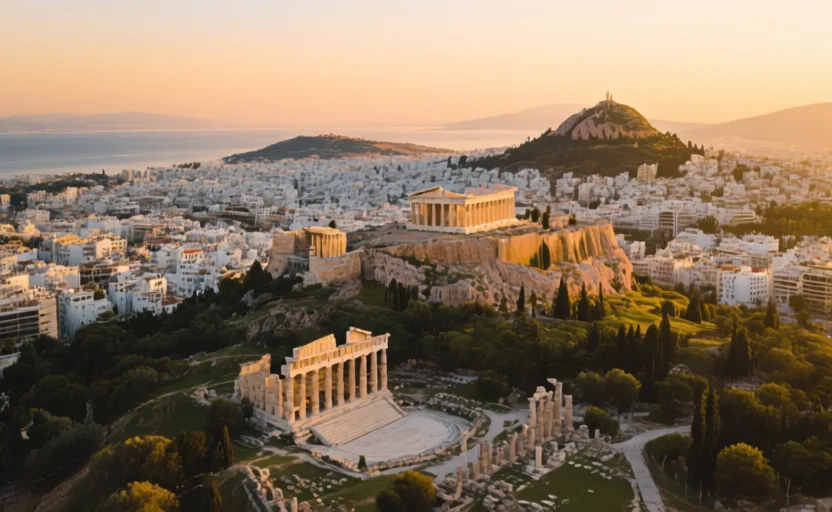 Athens · AI city illustration · Artistic impression
City · Europe
Athens
Also known as Athína, Αθήνα
Saved in this browser — no account needed. Sign in later and it comes with you.
Where it is
The city fills a dry basin on the Attic plain, ringed by four mountains: Aigaleo to the west, Parnitha to the north, Pentelicus to the north-east and Hymettus to the east. Parnitha is the tallest, at 1,413 metres. The Saronic Gulf opens to the south-west, and the basin is dotted with limestone hills, among them Lycabettus and the flat-topped, steep-sided Acropolis, which rises about 156 metres. With a hot-summer Mediterranean climate and a mean annual temperature of 19.2 °C at the central station, Athens runs warmer than many cities nearer the equator. The mountain ring also traps air, which is why smog became the city’s main environmental problem from the 1980s.
The land and water around it
The Attica Basinplain
A central plain bounded by Aigaleo, Parnitha, Pentelicus and Hymettus, with the Thriasian plain extending west beyond Aigaleo. The urban area runs more than 50 kilometres from north to south across it, and Parnitha is now a national park.
The Acropolis and the city’s hillsplateau
A rocky hill with an extensive nearly flat summit, steep on all sides but the west. It was easy to fortify, and walls have surrounded it for more than 3,300 years. Lycabettus, another high hill, gives a view over the whole basin.
The Saronic Gulfgulf
The sea lies to the south-west, and the port of Piraeus is the second-busiest passenger port in Europe. Shipping has tied the city to the sea since antiquity, and the Athenian fleet was the basis of its power in the Persian wars.
Its history, in short
Athens has been inhabited for at least 5,000 years, and the Cave of Schist holds the oldest known trace of people, dated somewhere between the 11th and 7th millennia BCE. By 1400 BCE it was an important Mycenaean centre with a fortress on the Acropolis. The city’s great era came in the 5th century BCE: Cleisthenes introduced democracy in 508 BCE, and after the Greek victories over Persia the Athenians, led by Pericles, built the Parthenon and the other monuments of the Acropolis. Defeat by Sparta ended its political dominance, and under Rome it lived on as a free city prized for its schools. Sacks in 267 and 396 shrank it to a small fortified area, and Justinian’s ban on pagan philosophy teaching in 529 is generally taken as the close of its ancient history. The Parthenon served as a church, then a mosque; the Ottomans held the city from 1458, and in 1687 a Venetian shell hit a powder store in the Parthenon. When Athens became the capital of independent Greece in 1834 it was a town of about 4,000 people. It then grew into a metropolis, fastest in the 1950s and 1960s.
Timeline
Dates are shown on a timeline rather than as changing shapes on the map. The globe draws modern boundaries only, and tinting a modern outline to stand for a historical one would state something we cannot source.
Classical world
508 BCE
Cleisthenes introduces democracy
Reforms begun by Solon after sixth-century social unrest lead to the introduction of democracy by Cleisthenes.
Well attestedWikipedia490 and 480 BCE
Marathon and Salamis
Athens, with Sparta and Plataea, leads the Greek coalition that repels the Persians, winning at Marathon under Miltiades and, decisively, at Salamis under Themistocles.
Well attestedWikipedia447–432 BCE
The Parthenon
Under Pericles the Athenians build the Parthenon, designed by Iktinos and Kallikrates, with Pheidias as sculptor, alongside the Propylaia, the Erechtheion and the temple of Athena Nike.
267 CE
A sack by the Herules
A Germanic tribe burns the public buildings, and the city north of the Acropolis is hastily refortified. A further sack by the Visigoths in 396 confines Athens to a small walled area.
Post-classical world
529
Justinian bans pagan teaching
The emperor’s ban on teaching philosophy by pagans is generally taken as the end of ancient Athens, although its real effect on the city is much debated.
Approximate dateWikipedia
Early modern & oceanic
1458
Ottoman conquest
Mehmed II takes the city and forbids looting of its monuments on pain of death, but under Ottoman rule Athens loses its importance and much of its population. The Parthenon becomes the main mosque.
26 September 1687
The Parthenon explodes
During a Venetian siege led by Francesco Morosini, a shot sets off a powder magazine kept inside the Parthenon, damaging the building heavily and giving it much of its present appearance.
Well attestedWikipedia
Industrial & imperial
1834
Capital of Greece
Athens replaces Nafplio as capital, chosen mainly for historical and sentimental reasons. After the damage of the war of independence it has about 4,000 people, and King Otto’s architects, Kleanthis and Schaubert, draw up a modern city plan.
Well attestedWikipedia
Places that carry meaning
The Acropolis13th century BCE onward
The most complete ancient Greek monumental complex still standing. The first wall surrounded a Mycenaean ruler’s house, a cult of Athena took root there in the 8th century BCE, and the 5th-century buildings of Pericles’ programme survive in various states.
Tower of the WindsRoman period
Designed by the Macedonian astronomer Andronicus of Cyrrhus for the Roman forum, it mostly survives and records how the city kept some civic life after Sulla’s siege of 88–85 BCE.
PlakaOttoman period onward
The neighbourhood at the foot of the Acropolis where, by one estimate, around 400 houses stood in 1833. Its position illustrates how small the city was before it became the capital.
Languages here
Places are usually multilingual. This lists what is actually spoken, not one language per border.
GreekIndo-European family
The language of the city and the state.
Greek has been the main language of Athens throughout its history. In the Roman imperial period both Latin and Greek were used, and after the empire became Christian Latin declined in favour of Greek alone.
AlbanianIndo-European family
The language of the city’s largest migrant community.
The 2021 census counted 140,146 Albanian citizens in Attica, most of them in Athens. Pakistanis, Romanians, Georgians and Bangladeshis are among the other main migrant communities.
Learn the language here
- 1Understand which languages are spoken hereAthens is multilingual. Start with which languages are used, by whom, and for what — the phrase list only covers one of them.Written by Globe Quest
- 2Learn 12 phrasesCurated everyday phrases for Athens, with audio and a written form.Written by Globe Quest
- 3Say them out loudSpeaking practice with pronunciation feedback, one phrase at a time.Globe Quest material, your own additions
- 4Come back to themSpaced review, so what you learned this week is still there next month.Written by Globe Quest
Check yourself
How did the Parthenon come to be so badly damaged in 1687?
A siege shot hit a powder magazine stored inside it
The Ottomans stored gunpowder in the Parthenon, and a shot fired during the Venetian bombardment of the Acropolis set it off, producing the ruin seen today.
What was Athens like when it became capital of Greece in 1834?
A town of about 4,000 people crowded below the Acropolis
The war of independence had halved its population. The new state chose Athens for its ancient associations rather than its size, and a modern city plan was drawn up for it.
Worth arguing about
- Athens was picked as capital in 1834 for historical and sentimental reasons, when it was little more than a village. What does a nation gain and lose by choosing a capital for its past?
- Strict height limits keep the Acropolis visible across the city. Should the view of an ancient monument decide how a modern city is built?
What we have not established
These are open questions, listed rather than filled in. We would rather show a gap than a plausible guess.
How many people live in Athens?
The figure depends on the boundary: the municipality had 643,452 people in 2021, the urban area about 3.06 million, and the metropolitan area is given as both 3,638,281 and 3,744,059 for the same year.
Sources
- Wikipedia · AthensWikipedia · encyclopedia · checked 2026-11-24
- Wikipedia · History of AthensWikipedia · encyclopedia · checked 2026-11-24
- UNESCO · Acropolis, AthensUNESCO World Heritage Centre · intergovernmental · checked 2026-11-24
Reviewed by Globe Quest editorial on 2026-11-24. Drafted with AI assistance and checked against the sources above before publication.