 Globe Quest
 Human Quest · LearningSign in
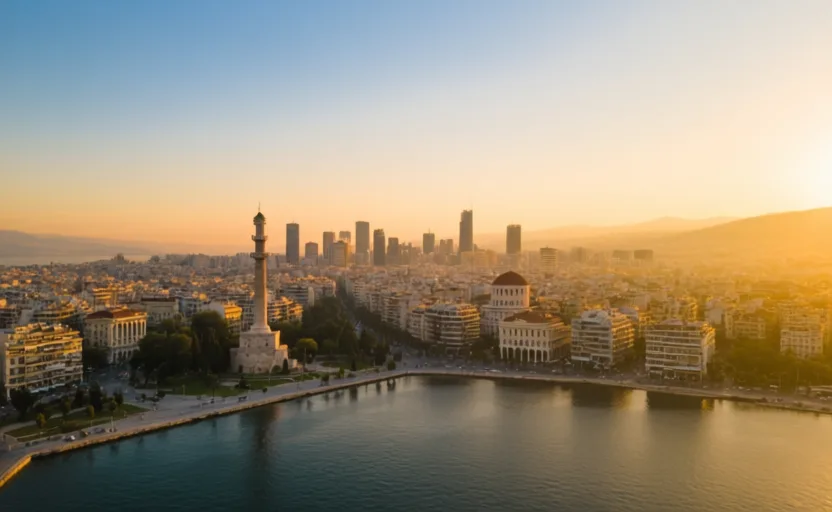 Thessaloniki · AI city illustration · Artistic impression
City · Europe
Thessaloniki
Also known as Salonica, Selanik, Θεσσαλονίκη
Saved in this browser — no account needed. Sign in later and it comes with you.
Where it is
Greece’s northern port stands at the top of the Thermaic Gulf, the north-western corner of the Aegean, about 500 kilometres north of Athens. The delta of the Axios river lies just to the west, and Mount Chortiatis rises behind the city to the south-east. Those mountains and the fault lines beneath them have given the city a long record of earthquakes, notably in 1759, 1902, 1978 and 1995. The Pindus range dries the westerly winds, so the climate is cold semi-arid at the edge of several zones, with frost on about 32 days a year and summers that sometimes pass 40 °C, softened by a sea breeze off the gulf.
The land and water around it
The Thermaic Gulfgulf
A sheltered arm of the north Aegean on which the city and its port sit. The gulf is why Thessaloniki could serve as a seaport for Macedonia and Thrace and for the Balkan interior behind them.
The Axios deltadelta
The river’s mouth lies west of the city. Silt from the Axios was used to reclaim land and extend the harbour that the Romans had cut into the shoreline, which is why remains of the old docks now lie beneath a city street.
Mount Chortiatis and the fault linesmountains
The highlands to the south-east, with the faults near them, have made the city prone to earthquakes. The tremors of June 1978 damaged buildings and some Byzantine monuments, and one apartment block collapsed, bringing the death toll to 51.
Its history, in short
Cassander of Macedon founded the city around 315 BCE by merging Therma and some two dozen villages, and named it for his wife Thessalonike, whose half-brother was Alexander the Great. Under Rome it grew rich on the Via Egnatia, the road between Byzantium and the Adriatic. When the Byzantine Empire took shape it became the second city after Constantinople, with about 150,000 people in the mid-12th century. The Ottomans took it in 1430, and the sack was followed by centuries of prosperity as a multi-ethnic port. Sephardic Jews arrived from Spain and made it Europe’s largest Sephardic centre; from the 16th century into the 20th, Jews were the majority here, which was true of no other European city. After the Greek army entered on 8 November 1912 the Jewish share fell, and the great fire of 1917 destroyed much of the centre, which was rebuilt on a new plan. German occupation from 1941 brought transports of the city’s Jewish residents to Auschwitz and Bergen-Belsen, and only about 4 per cent of the 45,000 sent to Auschwitz survived. Postwar growth, a UNESCO listing in 1988 and the European Capital of Culture year in 1997 mark the modern city.
Timeline
Dates are shown on a timeline rather than as changing shapes on the map. The globe draws modern boundaries only, and tinting a modern outline to stand for a historical one would state something we cannot source.
Classical world
c. 315 BCE
Cassander founds the city
On or near the site of Therma and 26 other villages, Cassander of Macedon establishes a city named for his wife. Pella stays the Macedonian capital, but Thessaloniki becomes the most important city in Macedonia.
Approximate dateWikipedia379
Capital of a Roman prefecture
When the Prefecture of Illyricum is divided between East and West, Thessaloniki becomes the capital of the reduced eastern prefecture, second in importance only to Constantinople in the Balkans and Aegean area.
Well attestedWikipedia
Post-classical world
1430
Ottoman conquest
Sultan Murad II captures and sacks the city; contemporary reports say about a fifth of the inhabitants were enslaved. Its trading importance survives, and it remains one of the empire’s two main commercial hubs with Smyrna.
Well attestedWikipedia
Industrial & imperial
8 November 1912
Passes to Greece
During the First Balkan War the Ottoman commander finds the city indefensible, and it passes to the Kingdom of Greece. Prime Minister Venizelos had told the army to take Thessaloniki at all costs.
Well attestedWikipedia1917
The Great Fire
A fire destroys much of the city centre. Planners including Thomas Mawson and Ernest Hébrard take the Byzantine era as the basis for the rebuilt centre, while the Upper Town on the slope escapes the flames.
Well attestedWikipediafrom 15 March 1943
Deportation of the Jews
After forcing Jewish residents into a ghetto near the railway, German occupiers begin deporting them to Auschwitz and Bergen-Belsen. Most of the 45,000 sent to Auschwitz were killed on arrival, and the long-standing Jewish majority ended.
Contemporary
June 1978
Earthquakes
A series of strong earthquakes on 19–20 June, measuring up to 6.5, damages buildings and ancient monuments. The city recovers quickly.
1988
Byzantine monuments listed
Several early Christian and Byzantine monuments are added to the UNESCO World Heritage list, and in 1997 the city is the European Capital of Culture.
Places that carry meaning
Church of Saint Demetrius463 onward
The patron saint was credited with miracles that saved the city, and the church stands where Demetrius is said to have been killed in a Roman prison. Its mosaics are counted among the major works of early Christian art.
Ano Poli (Upper Town)Byzantine and Ottoman
The heritage district on the slope north of the centre that the fire of 1917 did not reach. It preserves the pre-fire street pattern, in contrast to the planned grid below.
City walls2nd century BCE onward
The first walls date to the 2nd century BCE, and the 4-kilometre circuit of fortifications belongs to the World Heritage listing. The acropolis in the northern hills was built in 55 BCE after Thracian raids.
The Roman harbourRoman period to the 18th century
A spacious dug-out harbour built by the Romans served the city’s trade into the 18th century. Silt from the Axios later let the port expand, and docks survive beneath Frangon Street.
Languages here
Places are usually multilingual. This lists what is actually spoken, not one language per border.
GreekIndo-European family
The main language of the city and the region.
The ethnic Greek share of the population increased after the incorporation of the city into Greece in the early 20th century. A Greek-speaking Romaniote Jewish community also lived here long before the Sephardim arrived.
Ladino (Judeo-Spanish)Romance family
Once the language of the Sephardic Jewish majority.
Sephardic Jews who came from Spain under the Ottomans made the city the largest centre of their community in Europe and called it la madre de Israel, “Israel’s mother”. The community was almost wholly destroyed in the Second World War.
ArmenianIndo-European family
The language of an Armenian community dating back to Byzantine and Ottoman times.
Many Armenians reached Greece as refugees in the 20th century, after the genocide and the Greek army’s defeat of 1919–22. The city has an Armenian church and cemetery.
BulgarianSlavic family
The language of a community that grew in the late 19th century.
The Bulgarian community ran its own high schools and trade union, and many of its members were Catholic through the work of the Lazarists. Slavs also settled the hinterland as early as the 6th and 7th centuries.
Learn the language here
- 1Understand which languages are spoken hereThessaloniki is multilingual. Start with which languages are used, by whom, and for what — the phrase list only covers one of them.Written by Globe Quest
- 2Learn 11 phrasesCurated everyday phrases for Thessaloniki, with audio and a written form.Written by Globe Quest
- 3Say them out loudSpeaking practice with pronunciation feedback, one phrase at a time.Globe Quest material, your own additions
- 4Come back to themSpaced review, so what you learned this week is still there next month.Written by Globe Quest
Check yourself
Who founded Thessaloniki and who was it named for?
Cassander, after his wife Thessalonike
Cassander of Macedon founded it around 315 BCE and named it for his wife, Alexander the Great’s half-sister, whose own name means “Thessalian victory”.
What was unusual about Thessaloniki’s population from the 16th century to the early 20th?
It had a Jewish majority, unlike any other European city
Sephardic Jews arriving from Spain under Ottoman rule made the city Europe’s largest Sephardic centre, with Jews forming half or more of its population into the early 1900s.
Worth arguing about
- After the 1917 fire the centre was rebuilt on a planned grid, while the Upper Town kept its old streets. What does a city gain and lose when it is redesigned from scratch?
- Thessaloniki was a majority-Jewish Ottoman port and is now a Greek city. How should a city remember communities that no longer live in it?
What we have not established
These are open questions, listed rather than filled in. We would rather show a gap than a plausible guess.
How many people live in Thessaloniki?
Counts for the same year differ by boundary and by source. The 2021 municipality is given as 319,045 and as 317,778, and the metropolitan area as 1,006,112 and as 1,091,424, so we describe the scale rather than one figure.
Sources
- Wikipedia · ThessalonikiWikipedia · encyclopedia · checked 2026-11-24
- Wikipedia · History of ThessalonikiWikipedia · encyclopedia · checked 2026-11-24
- UNESCO · Paleochristian and Byzantine Monuments of ThessalonikaUNESCO World Heritage Centre · intergovernmental · checked 2026-11-24
Reviewed by Globe Quest editorial on 2026-11-24. Drafted with AI assistance and checked against the sources above before publication.