 Globe Quest
 Human Quest · LearningSign in
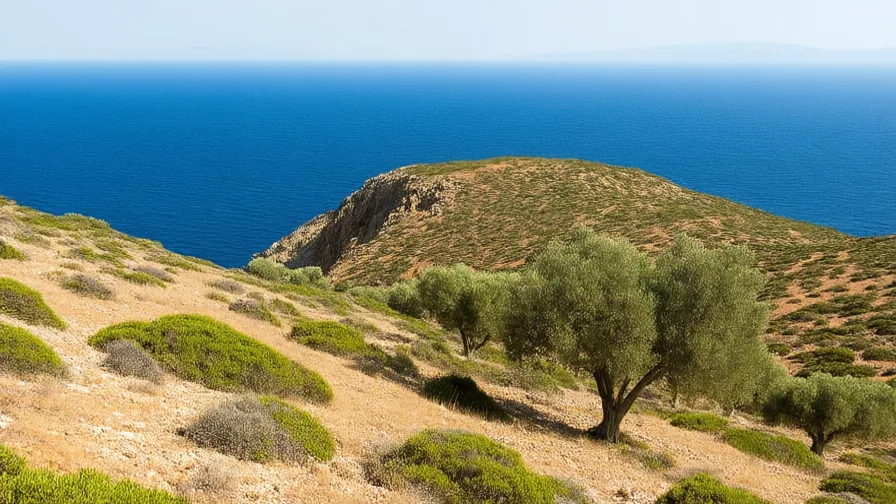 Greece · AI landscape illustration · Artistic impression
Country · Europe
Greece
Saved in this browser — no account needed. Sign in later and it comes with you.
Where it is
Four-fifths of Greece is mountain, and most of the rest is sea. A mountainous peninsula runs south from the Balkans, ending in the Peloponnese, which is cut off from the mainland only by the narrow Isthmus of Corinth. Around it lie the Ionian Sea to the west and the Aegean to the east, scattered with islands: 227 of them are inhabited. The result is the longest coastline on the Mediterranean, about 13,700 kilometres, against a land border of barely 1,100. The Pindus range down the middle makes the west wet and the east dry, so rain and farmland are unevenly spread.
The land and water around it
The Pindus rangemountains
The spine of the mainland, running north-west to south-east and separating Epirus from Thessaly and Macedonia. Moisture arriving from the south-west falls on its western side, while the east lies in a rain shadow, which is why parts of the Athens coast and some of the Cyclades are semi-arid and some northern cities are cold semi-arid.
The Aegean and Ionian islandsisland
Crete is the largest, followed by Euboea, Lesbos and Rhodes. They are traditionally grouped into clusters such as the dense Cyclades in the central Aegean, the Dodecanese near Turkey and the Ionian Islands off the west coast. Shipping has been central to the economy since ancient times.
The Peloponnese and the Isthmus of Corinthpeninsula
A large peninsula at the southern end of the mainland, joined to it by a narrow isthmus now cut by a canal. Mycenae, Pylos and Tiryns, key Bronze Age centres, are in the Peloponnese.
Its history, in short
Farming reached Europe through this land, arriving from the Near East, and its Neolithic villages are among the oldest on the continent. Bronze Age Crete and then Mycenae gave way to a dark age, after which independent city-states formed around the Aegean and spread colonies around the Mediterranean and the Black Sea. In the 4th century BCE Philip II of Macedon brought most Greek lands under one rule, and his son Alexander carried Greek culture as far as north-western India. Rome annexed Macedonia in 146 BCE and the rest soon followed, but Greek stayed the language of the eastern empire, Byzantium, and its Orthodox Church later shaped modern Greek identity. After the Fourth Crusade in 1204 the territory fragmented, and most of it came under Ottoman rule by the mid-15th century, though Venice held Crete until 1669. A war of independence began in 1821 and produced a small state in 1830, which expanded through the Balkan Wars and then lost its gamble in 1922. Occupation, civil war and a dictatorship from 1967 to 1974 preceded the present republic. Greece joined the European Community in 1981 and the euro in 2001, and a debt crisis began in 2010.
Timeline
Dates are shown on a timeline rather than as changing shapes on the map. The globe draws modern boundaries only, and tinting a modern outline to stand for a historical one would state something we cannot source.
Early human world
About 200,000 years ago
Apidima Cave
Remains in the Apidima Cave in Mani have been suggested to be the oldest early modern human fossils outside Africa. Other researchers argue they belong to archaic humans, and the question is open.
DisputedWikipediaResearchers who read the Apidima remains as modern humans, and those who read them as archaic humans
First cities & states
7th millennium BCE
Europe’s earliest farming villages
Neolithic settlements here are the oldest in Europe, because farming entered Europe by way of Greece, coming from the Near East.
Approximate dateWikipediac. 1600–1100 BCE
Mycenaean civilisation
A warrior aristocracy emerges on the mainland under Minoan influence and writes an early form of Greek in the Linear B script. It collapses around 1100 BCE, and the following centuries leave no written records.
Classical world
776 BCE
The first Olympic Games
Tradition dates the end of the Dark Ages to the year of the first Games. By the century that follows, the Iliad and the Odyssey are believed to have been composed.
Approximate dateWikipedia146 BCE
Rome takes control
Macedonia is annexed as a Roman province and the rest of Greece becomes a protectorate, after Macedon’s defeat at Pydna in 168 BCE. Greece then becomes part of the Roman and later Byzantine empires.
Well attestedWikipedia
Post-classical world
1204
The Fourth Crusade
Greek lands, with the rest of the Byzantine Empire, break up into Latin and Byzantine successor states. Most are under the Ottomans by the mid-15th century.
Well attestedWikipedia
Industrial & imperial
1821–1832
War of independence
A secret society, the Filiki Eteria, formed in 1814 among Westernised Greek-speaking elites, helps prepare the revolt. The modern nation-state emerges in 1830, with Bavarian Prince Otto installed as monarch after the London Conference of 1832.
Well attestedWikipedia
Contemporary
1974
Return to democracy
After a military dictatorship that began in 1967, the country starts its transition, holds multiparty elections, and in 1975 adopts a republican constitution after a referendum rejects restoring the monarchy.
Well attestedWikipedia
Places that carry meaning
KnossosBronze Age
The main palace site of Minoan Crete, excavated from 1900 by Sir Arthur Evans. It was the only Minoan palace to survive the fires of 1425 BCE, which allowed the Mycenaeans to expand into the island.
Mycenaec. 1600–1100 BCE
The site in the north-east Argolid that gives the Mycenaean civilisation its name. Beehive tombs and gold grave goods mark a warrior aristocracy whose world the Homeric epics later describe.
Mount OlympusNatural landmark
Greece’s highest mountain, about 2,900 metres, which separates Thessaly from Macedonia.
Languages here
Places are usually multilingual. This lists what is actually spoken, not one language per border.
GreekIndo-European family
The official and almost universal language.
Greek has been written in the region since Mycenaean times, when Linear B recorded an early form of it. It was the language of the Byzantine Empire and has formal and everyday registers: a conservative formal Modern Greek, Katharevousa, exists alongside the everyday language, in which the country is Ελλάδα (Elláda). Around 99.5% of the population speak it, though not always as a first language.
Regional Greek varietiesIndo-European family
Dialects and distinct Hellenic languages that sit beside the standard.
Over half a million people on Crete speak Cretan Greek, and Pontic Greek, brought from the Black Sea coast, by about 500,000 more. Tsakonian, in the Peloponnese, descends from ancient Doric rather than from Attic and has about 1,200 speakers. Cappadocian and Yevanic, the Jewish dialect of the Romaniotes, are close to extinct.
Minority languages
Albanian, Aromanian, Turkish, Romani, Slavic dialects, Armenian and Ladino.
Albanian is the language of the largest immigrant group, counted at 443,550 in 2001, beside the old Arvanitika community. Aromanian, an Eastern Romance language, has around 250,000 speakers, Romani about 160,000, and Turkish between 50,000 and 60,000, mostly in Western Thrace. Slavic dialects, Armenian and Ladino, once dominant among Thessaloniki’s Sephardic Jews, survive in smaller numbers.
Greek Sign Language and learned languages
The Deaf community’s language, and the foreign tongues most often studied.
Greek Sign Language has legal recognition as the official language of the country’s Deaf community. Of foreign languages, Greeks most often learn English, German, French and Italian, while Russian and Georgian became widely heard in the north after migration in the 1990s.
Learn the language here
Check yourself
What effect does the Pindus range have on Greece’s climate?
It makes the west wetter and the east drier through a rain shadow
South-westerly systems drop their moisture on the western side of the range, leaving the east in a rain shadow. This is why some coastal areas of the south and the cities of the north can be semi-arid.
When did the modern Greek state emerge from the war of independence?
1830
The war began in 1821, but the nation-state took shape in 1830, and many Greeks still lived outside its borders, which fuelled territorial expansion over the next century.
Worth arguing about
- Greece is often described as the cradle of Western civilisation. What does that framing include, and what does it leave out?
- A country with thousands of islands and a mountainous mainland has always depended on the sea. How did that shape its politics compared with land-based states?
What we have not established
These are open questions, listed rather than filled in. We would rather show a gap than a plausible guess.
How many Greek islands are there?
Counts range from about 1,200 to 6,000 depending on whether rocks and islets are included, and other descriptions give about 3,000. Only 227 are inhabited, which is the figure that is stable.
Sources
- Wikipedia · GreeceWikipedia · encyclopedia · checked 2026-11-24
- Wikipedia · History of GreeceWikipedia · encyclopedia · checked 2026-11-24
- Wikipedia · Geography of GreeceWikipedia · encyclopedia · checked 2026-11-24
- Wikipedia · Languages of GreeceWikipedia · encyclopedia · checked 2026-11-24
Reviewed by Globe Quest editorial on 2026-11-24. Drafted with AI assistance and checked against the sources above before publication.