 Globe Quest
 Human Quest · LearningSign in
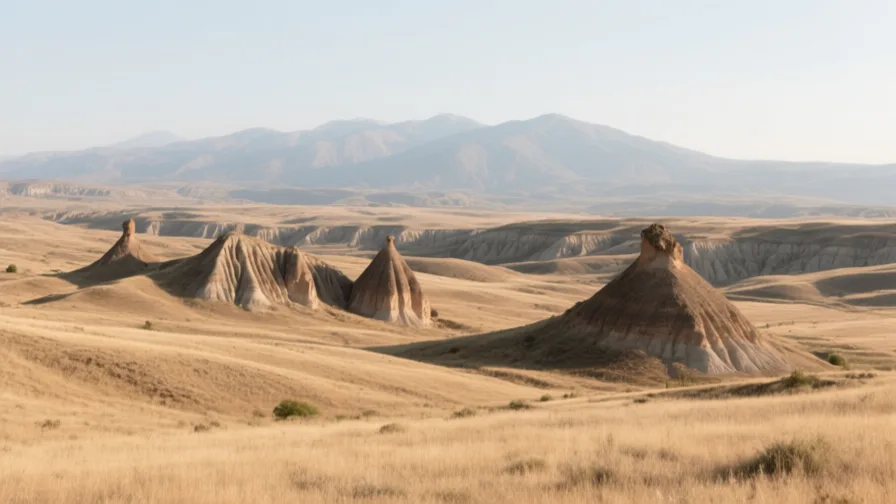 Turkey · AI landscape illustration · Artistic impression
Country · Europe
Turkey
Also known as Türkiye
Saved in this browser — no account needed. Sign in later and it comes with you.
Where it is
Turkey straddles two continents. Its Asian part, Anatolia, is 97% of the land, and East Thrace in Europe takes up 3% but holds about 15% of the people. The Turkish straits and the Sea of Marmara divide them. Seas lie on three sides, the Black Sea, the Aegean and the Mediterranean, and the interior is a high plateau that grows more rugged toward the east, framed by the Pontic mountains in the north and the Taurus in the south. Climate runs from rainy Black Sea coasts to dry, hot summers on the Aegean and Mediterranean shores, and severe winters on the plateau. The country sits on seismic faults and is prone to frequent earthquakes.
The land and water around it
The Anatolian Plateauplateau
The interior is a high plateau that grows more rugged going east. It is the dry heartland, with severe winters, hot summers and only about 400 millimetres of rain a year, and the driest basins around Konya and Malatya get less than 300.
The Straits and the Marmarastrait
The Bosphorus, the Sea of Marmara and the Dardanelles separate East Thrace from Anatolia and join the Black Sea to the Aegean. They put the country in two continents.
The Pontic and Taurus rangesmountains
Mountains run along the Black Sea coast and the Mediterranean, and by blocking sea air they give the interior its continental climate. The Black Sea coast is the one region with heavy rain all year, reaching about 2,500 millimetres in the east.
Its history, in short
Anatolia holds some of the oldest Neolithic sites in the world, and its first written records are the clay tablets of an Assyrian trading colony at Kültepe, around 2000 BC. Hattians, Hittites, Phrygians, Lydians, Persians and Greeks followed, and Greek cities lined the west coast. Rome absorbed the peninsula, and in the early 4th century Constantine founded a new capital at Constantinople, from which the Byzantine Empire grew. Seljuk Turks began to move into Anatolia in the 11th century, and the Seljuk Sultanate of Rum ruled until the Mongol invasion of 1243 broke it into principalities. Beginning in 1299, the Ottomans united them, took Constantinople in 1453 and became a global power under Selim I and Suleiman. Decline set in from the 18th century, with territorial losses and a flow of Muslim refugees into Anatolia. The empire entered the First World War in 1914 and was defeated. Mustafa Kemal led the War of Independence from Ankara, the Treaty of Lausanne followed, and the Republic was proclaimed on 29 October 1923.
Timeline
Dates are shown on a timeline rather than as changing shapes on the map. The globe draws modern boundaries only, and tinting a modern outline to stand for a historical one would state something we cannot source.
First cities & states
c. 12,000 years ago
Göbekli Tepe
One of the world's oldest Neolithic sites is built in Anatolia, part of the region where farming began.
c. 2000 BC
The Kültepe tablets
Clay tablets from an Assyrian trade colony open Anatolia's written history. They show a land of Hattian, Hurrian, Hittite, Luwian and Palaic speakers.
Classical world
early 4th century
Constantinople
Constantine establishes a new administrative centre at Constantinople. By the end of the century the Roman Empire splits in two, and the eastern half is later called the Byzantine Empire.
Approximate dateWikipedia
Post-classical world
1243
Mongol invasion
The Mongols defeat the Seljuk Sultanate of Rum, which breaks up into Turkish principalities.
Well attestedWikipedia
Early modern & oceanic
29 May 1453
The fall of Constantinople
Mehmed II captures the Byzantine capital, completing the Ottoman conquest of the empire.
1699
Treaty of Karlowitz
The treaty gives Austria Hungary and Transylvania, Venice most of Dalmatia and the Morea, and Poland Podolia. It begins the Ottoman territorial retreat.
Well attestedWikipedia
Industrial & imperial
1914–1918
War and the Armenian, Greek and Assyrian subjects
The Ottoman Empire enters the First World War on the Central Powers' side. Mass killings and deportations of its Armenian, Greek and Assyrian subjects in these years are classed as genocides by many historians, and how they are named is contested.
Accounts that classify the wartime killings and deportations of Armenians, Greeks and Assyrians as genocide
29 October 1923
The Republic
After the War of Independence and the Treaty of Lausanne, Atatürk proclaims the Republic, and the country emerges as a more homogeneous nation state. Ankara had already been named capital on 13 October.
Well attestedWikipedia
Places that carry meaning
Göbekli Tepec. 12,000 years ago
Among the oldest Neolithic sites on earth, it belongs to a region that includes part of the Fertile Crescent, an origin of agriculture.
Kültepec. 2000 BC
The site of the Assyrian trading colony whose tablets are the oldest written records found in Anatolia.
Hagia SophiaByzantine
The best example of Byzantine architecture, which in Turkey goes back to the 4th century, in the city Constantine made a capital.
Ankara1923 onward
The capital, in the middle of Anatolia, replaced Istanbul as seat of government after the fall of the empire.
Languages here
Places are usually multilingual. This lists what is actually spoken, not one language per border.
TurkishTurkic family
The sole official language.
The constitution makes Turkish the official language, and 77% of adult citizens identified as Turks in 2021. Proto-Turkic is thought to have originated in Central-East Asia, and the Seljuk rulers came from the Oghuz Turks.
KurdishIndo-European family
The most widespread minority language.
Kurds are the largest ethnic minority, with their numbers estimated anywhere from 12% to a fifth of the population, and form a majority in many eastern provinces. Article 42 of the constitution bars schools from teaching citizens any language but Turkish as a mother tongue, a rule Kurdish groups have criticised.
Armenian, Greek, Hebrew and Bulgarian
Minority languages recognised by treaty.
The Treaty of Lausanne in 1923 recognises Armenian, Greek and Hebrew, and a 1925 friendship treaty with Bulgaria recognises Bulgarian. A court ruled in 2013 that the Lausanne provisions also apply to Assyrians and the Syriac language.
Judaeo-SpanishRomance family
The traditional language of Sephardic Jews, now declining.
Sephardic Jews came after their expulsion from Spain. In 1927 it was the mother tongue of 85% of Turkish Jews, but it was never taught in school, and it has declined since.
Learn the language here
Check yourself
How much of Turkey's land lies in Europe?
About 3%
East Thrace is about 3% of the land but holds around 15% of the population. The remaining 97% is Anatolia, in Asia.
When was the Republic of Turkey proclaimed?
29 October 1923
The Republic was proclaimed on 29 October 1923, after the War of Independence and the Treaty of Lausanne. The assembly in Ankara had been established in April 1920.
Worth arguing about
- Turkey spans two continents and many peoples, and the Republic defined a Turk as any citizen. What does it mean to build a national identity on citizenship in such a country?
- No census since 1965 has counted ethnicity. Would counting make minorities visible or put them at risk?
What we have not established
These are open questions, listed rather than filled in. We would rather show a gap than a plausible guess.
How many Kurds live in Turkey?
Census figures have not included ethnicity since 1965, so no reliable count exists. Estimates run from 12% to a fifth of the population, and the numbers are themselves disputed.
Sources
- Wikipedia · TurkeyWikipedia · encyclopedia · checked 2026-11-24
- Wikipedia · History of TurkeyWikipedia · encyclopedia · checked 2026-11-24
- Wikipedia · Geography of TurkeyWikipedia · encyclopedia · checked 2026-11-24
- Wikipedia · Languages of TurkeyWikipedia · encyclopedia · checked 2026-11-24
Reviewed by Globe Quest editorial on 2026-11-24. Drafted with AI assistance and checked against the sources above before publication.