 Globe Quest
 Human Quest · LearningSign in
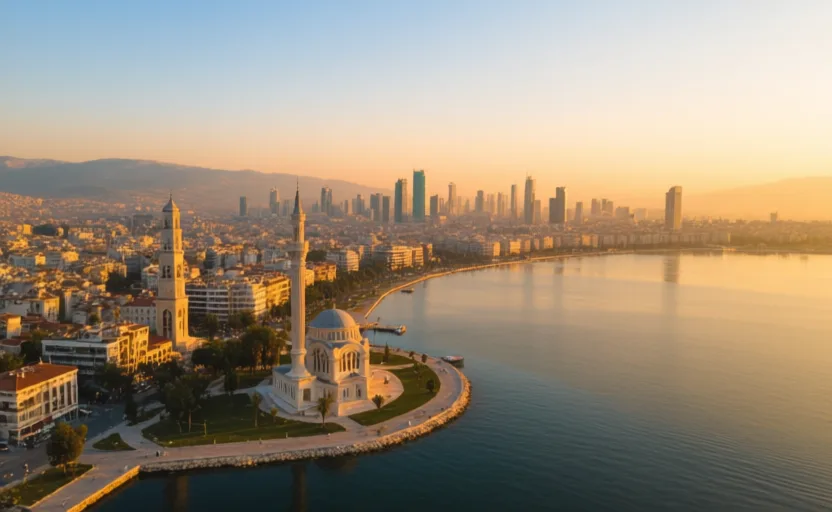 İzmir · AI city illustration · Artistic impression
City · Europe
İzmir
Also known as Smyrna, İzmir
Saved in this browser — no account needed. Sign in later and it comes with you.
Where it is
İzmir lies at the head of a deep gulf about halfway down the Aegean coast of Anatolia, and the position has made it one of the main trading cities of the eastern Mediterranean. The built-up area runs round the gulf and north across the delta of the Gediz, east along an alluvial plain made by small streams, and south into rougher ground. Summers are long, hot and dry, with highs often 30 to 40 °C from June to September, while about 730 millimetres of rain falls mostly between November and March. The meltem, the Aegean's summer north wind, blows through the gulf regularly. Snow is rare and seldom lies for more than a few hours.
The land and water around it
The Gulf of İzmirgulf
The gulf is a deep inlet midway down the western Anatolian coast, which gave the city its harbour and its commercial role. Silt from streams along its edge pushed the shoreline outward and left earlier settlements inland.
The Gediz delta and the Bornova plaindelta
The city spreads north over the delta of the Gediz and east over an alluvial plain. At Yeşilova Höyük in the small delta of the Meles, excavations found Neolithic and Chalcolithic layers from roughly the 7th to 4th millennium BC, on land that the sea has since left.
Mount Pagos and Mount Yamanlarmountains
The first settlement to command the whole gulf sat on Mount Yamanlar to the north-east. Later the city moved onto the slopes of Mount Pagos, today Kadifekale, because the old peninsula was big enough for only a few thousand people.
Its history, in short
Settlement here goes back some 8,500 years, to Neolithic and Chalcolithic villages on the Bornova plain. A Greek city, Old Smyrna, stood on a small peninsula at Bayraklı from about 1000 BC, and Persia destroyed it in 545 BC. Around 340 BC it was refounded on the slopes of Mount Pagos, beyond the Meles River, a move credited to Alexander the Great. Seljuk commander Çaka Bey took the city in 1076 and the Ottomans in 1389, and Timur sacked it in 1402. From the late 16th century cotton and other regional goods drew French, English, Dutch and Venetian merchants, and the trading privileges of 1620 made it a leading commercial centre of the empire. Consulates followed, and the city kept a European orientation and a large Greek-speaking population until the exchange of 1923. Greek forces landed on 15 May 1919 and left on 8 September 1922, the Turkish army entered the next day and a great fire broke out on 13 September. Around 1930 the Greek name Smyrna was dropped abroad in favour of İzmir.
Timeline
Dates are shown on a timeline rather than as changing shapes on the map. The globe draws modern boundaries only, and tinting a modern outline to stand for a historical one would state something we cannot source.
First cities & states
7th–4th millennium BC
Prehistoric villages at Yeşilova
Neolithic and Chalcolithic settlement on the Bornova plain, found in excavations after 2004, pushes the start of the city's past back further than earlier thought.
Approximate dateWikipedia
Classical world
725–700 BC
Old Smyrna
The oldest preserved ruins at Bayraklı date to these years, and pottery shows Greek settlement from about 1000 BC. Herodotus says Aeolians founded the city and Ionians later took it.
Approximate dateWikipedia545 BC
Destruction by the Persians
Cyrus the Great, after conquering the Lydian capital, attacks the Aegean coast and destroys Old Smyrna, ending its history as a notable urban centre.
Well attestedWikipediac. 340 BC
Refoundation on Mount Pagos
A new city is built on the slopes of Mount Pagos, an act credited to Alexander the Great, and the population recovers.
Approximate dateWikipedia
Post-classical world
1076
Çaka Bey
The Seljuk commander takes Smyrna and uses it as a base for naval operations, before the Byzantines retake it in 1097.
Well attestedWikipedia
Early modern & oceanic
1620
The capitulations
Privileged trading conditions for foreigners make the city one of the main commercial centres of the Ottoman Empire. French and British consulates arrive by 1619 and 1621.
Well attestedWikipedia
Industrial & imperial
1919–1922
Occupation and the fire
Greek forces land in May 1919 and are defeated in September 1922, when the Turkish army retakes the city. A great fire breaks out four days later.
Well attestedWikipediac. 1930
The name changes abroad
Government efforts lead the international use of Smyrna to give way to the Turkish form İzmir, which is its rendering of the same Greek name.
Approximate dateWikipedia
Places that carry meaning
Old Smyrna at Bayraklıc. 1000–545 BC
The Archaic Greek city stood on a hill at Tepekule that was then a small peninsula. The oldest house found there dates to 925–900 BC.
KadifekaleHellenistic onward
The hill is the slope of Mount Pagos, where the city was rebuilt after Old Smyrna was destroyed.
İzmir Archaeological MuseumAncient Greek to Byzantine collections
One of the largest museums in the city, in Konak, it holds more than 200,000 objects of Ancient Greek, Roman and Byzantine date. The French Consulate-General of 1906 nearby is now the Arkas Art Centre.
Languages here
Places are usually multilingual. This lists what is actually spoken, not one language per border.
TurkishTurkic family
The official and everyday language.
Turkic speakers first took the city under Çaka Bey in 1076, and today the city also has large communities descended from Balkan Turks.
GreekHellenic family
The historical language of the city as Smyrna.
Until the population exchange of 1923 İzmir had a very large Greek-speaking community, and the Greek name Smyrna stayed in use in English and other languages until around 1930.
Judaeo-SpanishRomance family
The historical language of the Sephardic Jewish community.
Judaeo-Spanish was the mother tongue of 85% of Turkish Jews in 1927 and is now described as dying. İzmir has the country's second-largest Jewish community after Istanbul, about 2,500 people.
Learn the language here
- 1Understand which languages are spoken hereİzmir is multilingual. Start with which languages are used, by whom, and for what — the phrase list only covers one of them.Written by Globe Quest
- 2Learn 12 phrasesCurated everyday phrases for İzmir, with audio and a written form.Written by Globe Quest
- 3Say them out loudSpeaking practice with pronunciation feedback, one phrase at a time.Globe Quest material, your own additions
- 4Come back to themSpaced review, so what you learned this week is still there next month.Written by Globe Quest
Check yourself
What was İzmir called in classical antiquity and in English until about 1930?
Smyrna
The modern name is the Turkish rendering of the Greek Smyrna, which stayed in use abroad until government efforts promoted İzmir.
Why was the city rebuilt on Mount Pagos after the Persian destruction?
Because the old peninsula held only a few thousand people
Old Smyrna on its small hill by the sea was large enough for only a few thousand people, so a new city was laid out on the slopes of Pagos.
Worth arguing about
- For centuries İzmir was a cosmopolitan trading port with Greek, Jewish, Levantine and Turkish communities. What changes in a city when the population exchange of 1923 removes one of them?
- The city has been destroyed and rebuilt in a new place more than once, by Persia and by fire. Is a city defined by its site, its name or its people?
What we have not established
These are open questions, listed rather than filled in. We would rather show a gap than a plausible guess.
Is Ti-smurna in the Kültepe tablets İzmir?
A place called Ti-smurna appears in tablets from the Assyrian trade colony at Kültepe from the early second millennium BC, but it has not been shown that this name refers to modern İzmir.
Sources
- Wikipedia · İzmirWikipedia · encyclopedia · checked 2026-11-24
- Wikipedia · TurkeyWikipedia · encyclopedia · checked 2026-11-24
- Wikipedia · Languages of TurkeyWikipedia · encyclopedia · checked 2026-11-24
Reviewed by Globe Quest editorial on 2026-11-24. Drafted with AI assistance and checked against the sources above before publication.