 Globe Quest
 Human Quest · LearningSign in
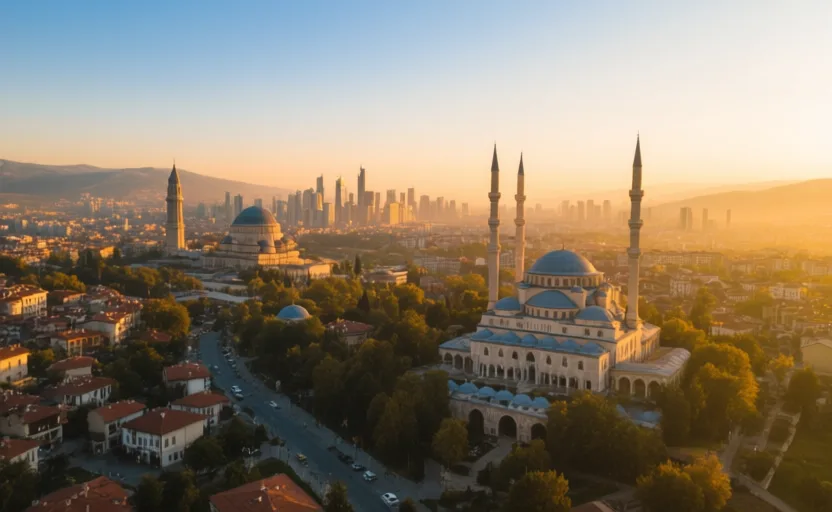 Bursa · AI city illustration · Artistic impression
City · Europe
Bursa
Saved in this browser — no account needed. Sign in later and it comes with you.
Where it is
Bursa climbs the north-western flank of Uludağ, the mountain the ancients called the Mysian or Bithynian Olympus, in the southern Marmara region. The Nilüfer River runs beside it and a fertile plain spreads below, which is why the surrounding region was farmed long before it was industrialised. Hot springs rise on the slopes and were known in antiquity as the royal waters. Summers are hot and dry from June to September, winters cool and damp, with snow that lies a week or two. Air pollution is a chronic problem. Forests and gardens earned it the nickname Green Bursa.
The land and water around it
Uludağmountains
The mountain rises behind the city and holds a ski resort and a national park. The Greeks and Romans knew it as the Olympus of Bithynia and Mysia, and the town was called Prusa at its foot.
The Nilüfer and the plainplain
The river and the fertile plain fed the city for centuries. Cumalıkızık, the best-preserved village of the waqf system, sits on this land and once provided income to a sultan's complex.
The thermal springsclimate
Hot springs such as Çekirge and Keramet are among those around the city. Prusa was known for them in antiquity, and baths were built there under Roman rule.
Its history, in short
A village on the Ilıpınar Mound, around 6000 BC, is the earliest known settlement nearby. The city proper was founded as Prusa by a king of Bithynia, and its hot springs drew Roman bath-building. The last Bithynian king left his realm to Rome in 75 or 74 BC. Under Byzantium it became a garrison town in 562 and an early silk-weaving centre. The Ottomans captured it in 1326 and made it their first capital. A succession of sultans built endowed complexes of mosque, school, bath, kitchen and tomb on its hills, and the districts grew around them. The Ottomans moved their court to Edirne in the 1360s, but Bursa kept its spiritual and commercial weight, and the silk trade made it a hub of the Silk Road. Timur's grandson sacked it in 1402, and in 1492 Sephardic Jews expelled from Spain arrived. Today it is the largest production centre of the Turkish car industry.
Timeline
Dates are shown on a timeline rather than as changing shapes on the map. The globe draws modern boundaries only, and tinting a modern outline to stand for a historical one would state something we cannot source.
First cities & states
c. 6000 BC
Ilıpınar Mound
The earliest known settlement near the present city stands on this mound.
Approximate dateWikipedia
Classical world
75/74 BC
Bithynia bequeathed to Rome
Nicomedes IV, the last king of Bithynia, leaves his kingdom to the Roman Republic in his will, and Prusa becomes Roman.
Approximate dateWikipedia
Post-classical world
562
Byzantine garrison town
Imperial guards are stationed in Prusa, which by the middle of the 6th century was already known for silk manufacture. Justinian I is said to have built a palace there.
Approximate dateWikipedia1326
First Ottoman capital
The Ottomans capture Bursa from the Byzantines. Hospitals, caravanserais, madrasas and the first official Ottoman mint follow.
1396–1400
The Grand Mosque
Sultan Bayezid I orders the Ulu Cami, whose twenty domes are said to stand in for twenty mosques he promised after the Battle of Nicopolis.
Well attestedWikipedia1402
Timur's grandson sacks the city
After Bayezid is captured at the Battle of Ankara, Bursa is pillaged and burned. Mehmed Çelebi annexes it in May 1403.
Well attestedWikipedia
Early modern & oceanic
1492
Sephardic arrivals
Jews expelled from Spain settle in Bursa. Their Judaeo-Spanish overtakes Judaeo-Greek as the community's main language.
Well attestedWikipedia
Industrial & imperial
1915
Refugees and deportations
Thousands of Orthodox Christians forced from coastal villages take refuge in the city, and deportation orders then reach its Armenian population.
Well attestedWikipedia
Places that carry meaning
Ulu Cami1396–1400
The largest mosque in the city is an early Ottoman landmark with Seljuk elements. Its twenty domes stand in four rows of five, on twelve columns, and the architect was Ali Neccar.
The sultans' külliye complexesEarly 14th to mid-15th century
Five sultans, from Orhan Ghazi to Murad II, each founded a complex of mosque, school, bath, public kitchen and tomb on a hill. Houses grew around them, and the complexes set the city's boundaries. They are inscribed as the birth of the Ottoman Empire.
CumalıkızıkEarly Ottoman
A waqf village on the plain that belonged permanently to the Orhan Ghazi complex and paid its upkeep. It is the best-preserved village of its kind near Bursa.
Koza HanOttoman
One of the caravanserais built as the Ottoman city grew, in a commercial centre where silk was the main trade.
Languages here
Places are usually multilingual. This lists what is actually spoken, not one language per border.
TurkishTurkic family
The official and everyday language.
The city was the first Ottoman capital, so Turkish has been its ruling language since 1326.
Judaeo-SpanishRomance family
The language of the Sephardic Jewish community.
After 1492 Judaeo-Spanish replaced the Judaeo-Greek of the earlier Romaniote community. The Jewish population fell from about 3,500 before the First World War to 60 by 2021.
GreekHellenic family
The language of the city's Orthodox Christian community.
The city's Greek name was Prusa. A Greek community lived here into the early 20th century, and in 1915 thousands of Orthodox Christians forced from coastal villages took refuge in the city.
Learn the language here
- 1Understand which languages are spoken hereBursa is multilingual. Start with which languages are used, by whom, and for what — the phrase list only covers one of them.Written by Globe Quest
- 2Learn 12 phrasesCurated everyday phrases for Bursa, with audio and a written form.Written by Globe Quest
- 3Say them out loudSpeaking practice with pronunciation feedback, one phrase at a time.Globe Quest material, your own additions
- 4Come back to themSpaced review, so what you learned this week is still there next month.Written by Globe Quest
Check yourself
What was Bursa's role in Ottoman history?
The first capital of the Ottoman state
The Ottomans captured Bursa in 1326 and made it their first capital. They moved to Edirne in the 1360s and to Constantinople after 1453.
What did each early sultan build on the hills of Bursa?
A külliye of mosque, school, bath, kitchen and tomb
The complexes supplied public services before neighbourhoods existed and fixed the city's boundaries, paid for by endowed villages such as Cumalıkızık.
Worth arguing about
- Bursa was planned around endowed complexes that provided services first and houses afterwards. Could a modern city be organised that way?
- A city of silk and thermal springs became the centre of Turkey's car industry. What does a place keep when its main trade changes?
What we have not established
These are open questions, listed rather than filled in. We would rather show a gap than a plausible guess.
When did Bursa become the Ottoman capital?
One account has Bursa capital from 1335 to the 1360s, another dates it to its capture in 1326, so the exact start of its role as capital stays open.
Sources
- Wikipedia · BursaWikipedia · encyclopedia · checked 2026-11-24
- UNESCO · Bursa and Cumalıkızık: the Birth of the Ottoman EmpireUNESCO World Heritage Centre · intergovernmental · checked 2026-11-24
- Wikipedia · TurkeyWikipedia · encyclopedia · checked 2026-11-24
- Wikipedia · History of TurkeyWikipedia · encyclopedia · checked 2026-11-24
- Wikipedia · Languages of TurkeyWikipedia · encyclopedia · checked 2026-11-24
Reviewed by Globe Quest editorial on 2026-11-24. Drafted with AI assistance and checked against the sources above before publication.