 Globe Quest
 Human Quest · LearningSign in
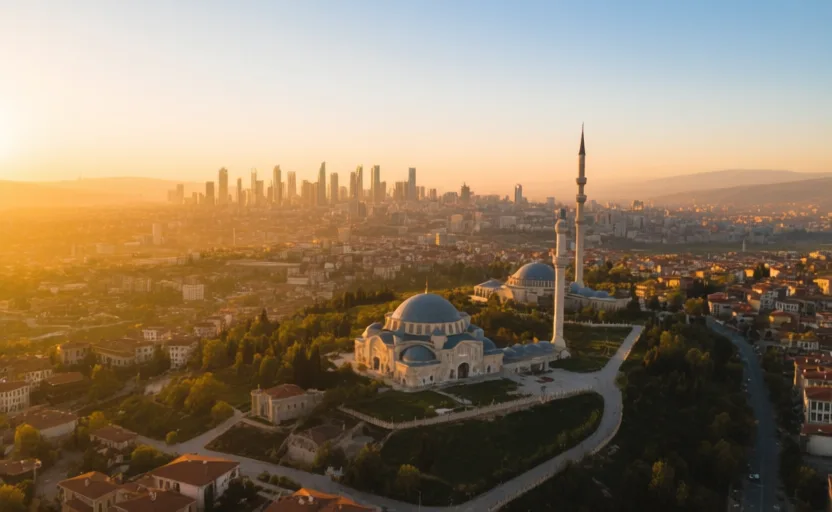 Ankara · AI city illustration · Artistic impression
City · Europe
Ankara
Saved in this browser — no account needed. Sign in later and it comes with you.
Where it is
Ankara is a highland city in the middle of Anatolia, between the Kızılırmak and Sakarya rivers. Its old core is a rocky hill about 150 metres high, above the river that flows into the Sakarya, and a ruined castle still crowns it. The surrounding country is steppe, with forest only on the southern edge, and it is one of the driest parts of Turkey: about 414 millimetres of rain a year, falling mostly in spring and autumn. Winters are cold and snowy and summers hot and dry, with a January mean near 1 °C and a July mean above 24 °C. The city has still managed about 72 square metres of green space per resident.
The land and water around it
The citadel hillplateau
The old city sits on a rock that rises about 150 metres above the river. Ruins of the castle crown it, and well-preserved Roman and Ottoman buildings survive below.
The Ankara River and Çubuk Brookriver
The small Ankara River marked the northern edge of the Roman, Byzantine and Ottoman town and has since been covered over and diverted. The Çubuk Brook runs through the centre and joins it in the western suburbs.
The Central Anatolian steppesteppe
The land around the city is dry grassland, with a cold semi-arid climate. It has long supported grain, fruit, pears, honey and Muscat grapes, and herds of Angora goats.
Its history, in short
Bronze Age Hattic settlements around the hill were absorbed by the Hittites, and the town expanded under the Phrygians from about 1000 BC. Celtic Galatians took it in 278 BC and made it a centre of the Tectosages, and in 25 BC Augustus raised Ancyra to capital of the Roman province of Galatia, where a temple carried the record of his deeds. In the 4th century emperors visited so often that it served as a summer retreat from the humid Bosphorus, and church councils met here. Seljuk Turks annexed it in 1073, Timur defeated the Ottomans in a battle outside it in 1402, and for centuries the town, called Angora in Europe, was known for the wool of its goats and rabbits. Its modern life began in 1920, when Mustafa Kemal Atatürk made it the headquarters of the national resistance, and the assembly met on 23 April. It replaced Istanbul as capital on 13 October 1923. Planned for 500,000 people, it grew far faster from the 1950s, and migrants from the countryside built unplanned gecekondu housing around the edge.
Timeline
Dates are shown on a timeline rather than as changing shapes on the map. The globe draws modern boundaries only, and tinting a modern outline to stand for a historical one would state something we cannot source.
First cities & states
c. 2000–1700 BC
Hattic settlements absorbed
The Bronze Age Hattic people around the hill are gradually taken over by the Hittites. A Hittite cult centre called Ankuwaš has been linked to the site, though that remains debated.
Approximate dateWikipediac. 1000 BC
Phrygian expansion
The city grows significantly under the Phrygians, helped by people moving from Gordion after an earthquake. Phrygians credited King Midas with its founding, though the place is far older.
Classical world
278 BC
The Galatians
Celtic Galatians occupy central Anatolia and make Ancyra the base of the Tectosages tribe. A small warrior class ruled over Phrygian-speaking peasants.
25 BC
Capital of Roman Galatia
Augustus makes Ancyra a polis and capital of the province. It grows into a large metropolis, with an estimated 200,000 residents in good times.
Post-classical world
1073
Seljuk annexation
After victory at Manzikert in 1071 opens Anatolia to the Turks, the city is annexed. It changes hands among Danishmends, Byzantines and Seljuks of Rum over the following decades.
1402
Battle of Ankara
Timur defeats the Ottomans outside the city and captures it, though by 1403 it is Ottoman again.
Industrial & imperial
23 April 1920
The Grand National Assembly
The Turkish National Movement under Atatürk sets up its headquarters in Angora. The assembly that meets there directs the War of Independence.
Well attestedWikipedia13 October 1923
New capital
Angora replaces Constantinople as capital, a few days before the Republic is proclaimed on 29 October, and officials declare the city's name to be Ankara.
Places that carry meaning
Ankara CastleAncient to Ottoman
Ruins on the rock hill overlook the old city. Few outer works survive, but the quarter below preserves Roman and Ottoman buildings.
Monumentum AncyranumRoman
The Temple of Augustus and Rome carries on its marble walls the Res Gestae Divi Augusti, the official record of the emperor's acts. It makes the city famous among historians of Rome.
ÇankayaRoman to modern
The hill south of the centre lay outside the Roman town and may have been a summer resort. Today it holds the presidential residence and is the most populous district.
Languages here
Places are usually multilingual. This lists what is actually spoken, not one language per border.
TurkishTurkic family
The official and everyday language.
Turkish settlers reached the area after 1073, and the town was known in Ottoman Turkish as Engürü. Article 3 of the constitution makes Turkish the national language.
GalatianCeltic family
A vanished Celtic language of the area.
Celtic was still spoken around Ankara in the late 4th century, when St Jerome noted that it resembled the speech near Trier. The Celtic rulers were few, so the older Phrygian-speaking peasants may have adopted it.
GreekHellenic family
The language of the name Ánkyra and of the Hellenistic, Roman and Byzantine city.
Greek traders from Pontos developed the city as a trading centre, and Greek became the common language across Anatolia as the older local languages died out by about the 1st century BCE. The name means anchor.
Learn the language here
- 1Understand which languages are spoken hereAnkara is multilingual. Start with which languages are used, by whom, and for what — the phrase list only covers one of them.Written by Globe Quest
- 2Learn 12 phrasesCurated everyday phrases for Ankara, with audio and a written form.Written by Globe Quest
- 3Say them out loudSpeaking practice with pronunciation feedback, one phrase at a time.Globe Quest material, your own additions
- 4Come back to themSpaced review, so what you learned this week is still there next month.Written by Globe Quest
Check yourself
When did Ankara replace Istanbul as the capital of Turkey?
13 October 1923
Ankara became capital on 13 October 1923. The Republic itself was proclaimed on 29 October, and the Grand National Assembly had first met there in April 1920.
Which people made Ancyra a tribal centre in 278 BC?
The Galatians
The Galatians were a Celtic group who occupied central Anatolia and made the city the headquarters of the Tectosages. The Phrygians, Lydians and Persians ruled before them.
Worth arguing about
- Ankara was a modest town when it was chosen as capital in 1923 and planned for 500,000 people. What does it mean to build a capital from a small place instead of inheriting an old one?
- From the 1950s migrants built gecekondu neighbourhoods faster than the plan allowed. Should a planned city treat informal housing as a failure or as part of its history?
What we have not established
These are open questions, listed rather than filled in. We would rather show a gap than a plausible guess.
Was Ankara the Hittite cult centre of Ankuwaš?
The name has been matched with Ankuwaš, a Hittite cult centre, but the link is still debated.
Sources
- Wikipedia · AnkaraWikipedia · encyclopedia · checked 2026-11-24
- Wikipedia · History of AnkaraWikipedia · encyclopedia · checked 2026-11-24
- Wikipedia · Languages of TurkeyWikipedia · encyclopedia · checked 2026-11-24
Reviewed by Globe Quest editorial on 2026-11-24. Drafted with AI assistance and checked against the sources above before publication.