 Globe Quest
 Human Quest · LearningSign in
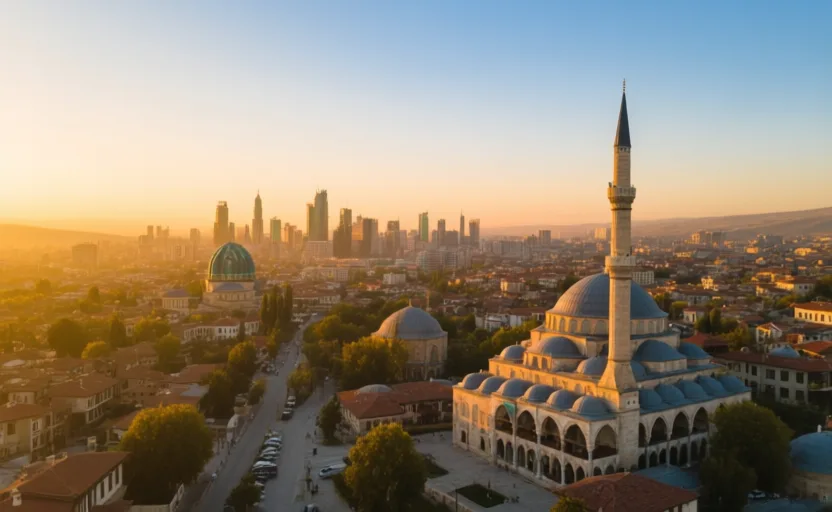 Konya · AI city illustration · Artistic impression
City · Europe
Konya
Saved in this browser — no account needed. Sign in later and it comes with you.
Where it is
Konya lies on the south-western edge of the Central Anatolian Plateau, in the middle of the Konya Plain and with the Taurus Mountains closing off the south of its province. It is the capital of Turkey’s largest province. The climate is cold and semi-arid: summer days average around 30 °C but the nights are cool, rain is low and falls mainly in winter, spring and autumn, and winter temperatures average about −4 °C. The lowest reading on record, −26.5 °C, was taken in 1972.
The land and water around it
The Konya Plainplain
The city sits in the middle of the largest plain in Turkey’s largest province. Agriculture-based industries still draw on it, and Turkey’s largest solar farm stands near Karapınar, east of the city.
The Taurus edgemountains
The southern side of the province is hemmed in by the Taurus. Between the mountains and the plain lies a dry interior, where precipitation is low and falls mainly as winter snow.
A continental steppe climateclimate
Konya has a cold semi-arid climate, with cool summer nights and hard winters. The hottest recorded day, 40.9 °C, came on 14 August 2023.
Its history, in short
Konya is an old plateau town whose name, Ikkuwaniya, appears to go back to the Hittite records of the Late Bronze Age. People lived here by about 3000 BCE, and the Phrygians, Persians, Hellenistic kings and Romans followed, each renaming the city; under Claudius it became Claudiconium. Paul visited around AD 50. The Byzantines made it a metropolitan see about 370, and it was a target of Arab raids into the 10th century. Seljuk Turks conquered it in 1084, and after Nicaea fell it became the capital of the Sultanate of Rum, which it remained until 1243. The second half of the 12th century was its height of wealth and influence, and many Persian and Persianised Turkish scholars and officials arrived, partly to escape the Mongols. Rumi, who spent his last years here, was the inspiration for the Mevlevi order, founded by his followers in 1273. After the Seljuks, the Karamanids and then the Ottomans ruled it, and it was provincial capital for centuries. In 1923 the Greek community of nearby Sille left in the population exchange.
Timeline
Dates are shown on a timeline rather than as changing shapes on the map. The globe draws modern boundaries only, and tinting a modern outline to stand for a historical one would state something we cannot source.
First cities & states
c. 3000 BCE
Early settlement
Excavations show people living in the area as early as the Late Copper Age. The name Ikkuwaniya is believed to match a Late Bronze Age place in Hittite records.
Approximate dateWikipedia
Classical world
c. AD 50
Paul in Iconium
Paul and Silas probably visit Iconium during Paul’s Second Missionary Journey, and again early in his Third. The apocryphal Acts of Paul and Thecla makes it the birthplace of Saint Thecla.
Approximate dateWikipedia
Post-classical world
1084
Seljuk conquest
The Seljuks take the city after an earlier attack in 1069 was beaten off and then renewed. Iconium becomes their second capital after Nicaea falls and remains so until 1243.
Well attestedWikipedia1097 and 1190
Crusader armies pass through
The army of the First Crusade occupies the city briefly in August 1097, and Frederick Barbarossa does so on 18 May 1190 after the Battle of Iconium. Each time, the Turks reoccupy it once the Crusaders leave.
Well attestedWikipedia1273
The Mevlevi order
Rumi’s followers establish the Mevlevi Sufi order after his death, and it becomes known for the whirling dervishes. His turquoise-domed tomb remains the city’s main attraction.
Well attestedWikipedia
Early modern & oceanic
1453
Karaman Eyalet
After the Karamanids fall to the Ottomans in 1420, Konya becomes provincial capital. In 1864 the larger Vilayet of Konya replaces the eyalet, and the Ottoman sultans’ sons govern here in the early period.
Approximate dateWikipedia
Industrial & imperial
1923
The population exchange
Before 1923 about 4,000 Orthodox Christians, Turkish-speaking and Greek-speaking, lived in the city. The Greeks of the nearby village of Sille must leave as refugees and are resettled in Greece.
Well attestedWikipedia
Places that carry meaning
Mevlâna Museum13th century onward
Rumi’s turquoise-domed tomb, the city’s main attraction and the spiritual centre of the Mevlevi order. Whirling dervish performances are held every Saturday at the nearby Mevlana Cultural Centre.
Seljuk medreses and mosquesSeljuk period
The İnce Minaret, Karatay and Sırçalı medreses, the Alaaddin Mosque and the Sahib-i Ata complex are the remains of the sultanate’s capital.
SilleUntil 1923
An old village about 8 kilometres north-west of the Mevlana Museum, with mosques, churches, cave churches and catacombs. Its Greek population was removed in the 1923 exchange.
Languages here
Places are usually multilingual. This lists what is actually spoken, not one language per border.
TurkishTurkic family
The official language and the everyday language of the city.
Turkish is the only official language of Turkey. Konya has a reputation as one of the country’s more religiously conservative cities.
PersianIndo-European family
The language of the Seljuk court and of scholars like Rumi.
The Seljuks were highly Persianised in culture and language, and Persians and Persianised Turks moved to Anatolian cities, many fleeing the Mongols, to serve educated Muslims in a new kingdom.
GreekHellenic family
The language of the former Orthodox community.
About 2,500 Greeks maintained a church and two schools in the city before 1923, and Christians in Sille spoke Greek. After the exchange the language largely disappeared from the area.
Learn the language here
- 1Understand which languages are spoken hereKonya is multilingual. Start with which languages are used, by whom, and for what — the phrase list only covers one of them.Written by Globe Quest
- 2Learn 12 phrasesCurated everyday phrases for Konya, with audio and a written form.Written by Globe Quest
- 3Say them out loudSpeaking practice with pronunciation feedback, one phrase at a time.Globe Quest material, your own additions
- 4Come back to themSpaced review, so what you learned this week is still there next month.Written by Globe Quest
Check yourself
What role did Konya play under the Seljuks?
Capital of the Sultanate of Rum
It became the second capital of the Sultanate of Rum after Nicaea fell, and its wealth and influence peaked in the later 12th century.
How would you describe Konya’s climate?
Cold semi-arid with low rainfall
On the high plateau, precipitation is low and falls mostly in winter, spring and autumn, and the lowest recorded temperature was −26.5 °C.
Worth arguing about
- Konya was both a Seljuk capital full of Persian scholars and a city later known for religious conservatism. What do those two reputations say about each other?
- Greeks from Sille left in 1923 while their churches and cave chapels remain. Who is a heritage site for when its community is gone?
What we have not established
These are open questions, listed rather than filled in. We would rather show a gap than a plausible guess.
How many people live in Konya?
About 1.43 million live in the three urban districts and about 2.33 million in the metropolitan province, so any single figure depends on the boundary used.
Sources
- Wikipedia · KonyaWikipedia · encyclopedia · checked 2026-11-24
- Wikipedia · TurkeyWikipedia · encyclopedia · checked 2026-11-24
Reviewed by Globe Quest editorial on 2026-11-24. Drafted with AI assistance and checked against the sources above before publication.