 Globe Quest
 Human Quest · LearningSign in
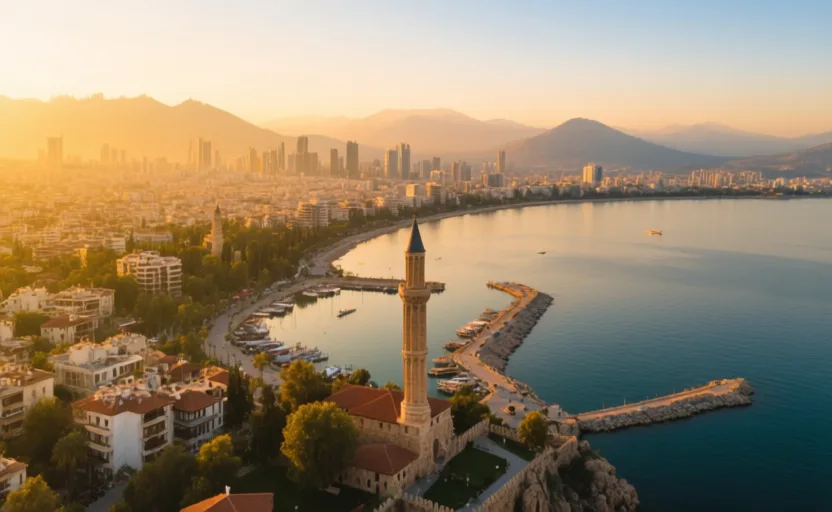 Antalya · AI city illustration · Artistic impression
City · Europe
Antalya
Saved in this browser — no account needed. Sign in later and it comes with you.
Where it is
Antalya is built on the inside curve of a bay on Anatolia’s south-west coast, with the Taurus Mountains rising behind it in nearly every direction. The ground under the city itself changes little in height, but the mountains trap moisture, so winters are wet and often heavy with rain, while the enclosed bay makes summers unusually hot for a coastal place. Frost touches the nights in most winters, yet snow is very rare. Sunshine reaches close to 3,000 hours a year, and the sea runs from about 16 °C in winter to 27 °C in summer. The old walled harbour quarter sits on the seafront; the modern city has been built over most of what lay beyond it.
The land and water around it
The Taurus Mountainsmountains
High ranges close off the interior on most sides. They hold in moisture, which is why Antalya’s winter rainfall is so high, and they long made the city easier to reach by sea than by land: around 1118 it was an isolated outpost that could be approached only from the water.
The Antalya baybay
The bay gave the Pergamene fleet a base and later made the city the most convenient harbour between the Aegean and Cyprus. Its enclosed shape also traps summer heat, and the old harbour was still judged small and unsafe for ships in winter in 1920.
A Mediterranean climateclimate
Hot dry summers and mild wet winters define the year. The recorded high is given as 45 °C and the recorded low as −4.6 °C, and the deepest snow on record is 5 cm.
Its history, in short
Antalya began as a naval base. The Hellenistic king Attalus II of Pergamon gave his name to Attaleia, and excavations in 2008 found third-century BCE remains that suggest he rebuilt and enlarged an earlier town. When Attalus III left his kingdom to Rome in 133 BCE the city passed to the Romans, who left Hadrian’s Gate behind. Under Byzantium it was the capital of the Cibyrrhaeot theme and the main naval station and trading harbour on the southern coast, where Armenians, Jews, Italians and Arabs could be met. Seljuk Turks took it in the early 13th century and it later became the capital of the Teke beylik, before the Ottomans absorbed it. A Greek minority making up a third of the town left in the 1920s exchange and was replaced by Turks from Western Thrace. Italy occupied the city from 1919 to 1922. Large-scale development from the 1970s turned a town that exported grain and timber into one of Turkey’s biggest metropolitan areas, driven by tourism.
Timeline
Dates are shown on a timeline rather than as changing shapes on the map. The globe draws modern boundaries only, and tinting a modern outline to stand for a historical one would state something we cannot source.
Classical world
c. 150 BCE
Attaleia founded
Attalus II of Pergamon founds the city as a naval base for his fleet, naming it after himself. Third-century BCE finds from 2008 suggest it grew on an older settlement.
Approximate dateWikipedia133 BCE
Passes to Rome
Attalus III dies and bequeaths his kingdom to Rome. The city thrives under Roman rule and later receives Hadrian’s Gate.
Well attestedWikipedia
Post-classical world
1207
Seljuk conquest
Sultan Kaykhusraw takes the city a year after a failed attempt and builds its first mosque. Local Christians briefly recapture it in 1212, but the Seljuks end that restored Byzantine rule in 1216.
Well attestedWikipedia1321–1423
Capital of the Teke beylik
Attaleia is the capital of the Turkish beylik of Teke, except for 1361 to 1373, when Cyprus held it. The Arab traveller Ibn Battuta passes through in the years 1335 to 1340.
Approximate dateWikipedia1391 or 1423
Ottoman rule begins
The city passes to the Ottomans, bringing about five centuries of relative peace and stability. Two dates are given for the change.
DisputedWikipediaThe general summary dates Ottoman rule from 1391; the account of the Teke beylik places its end under the Ottomans in 1423.
Industrial & imperial
1919–1922
Italian occupation
Italy occupies the city after the First World War and withdraws during the Turkish War of Independence, handing it to the new Turkish state.
Well attestedWikipedia
Contemporary
From the 1970s
A tourism city
Large-scale development and public funding turn a town of grain, timber and sesame exports into a major metropolitan area. In 2023 it drew more than 16.5 million foreign visitors.
Well attestedWikipedia
Places that carry meaning
KaleiçiHellenistic to Ottoman
The walled old centre, with narrow cobbled streets and Ottoman-era houses. Most surviving historic buildings in the city are medieval Seljuk, and ancient structures elsewhere are poorly preserved because the modern city was built on top of the ancient one.
Hadrian’s Gate2nd century
A triple-arched Roman gateway raised in honour of the emperor Hadrian, one of the monuments of the Roman city.
Kesik Minare5th century onward
The Broken Minaret mosque began as a Christian church of the Virgin in the 5th century, decorated with finely carved marble, and was later turned into a mosque. Another account in the same article calls it a Roman temple first.
Karatay Medrese1250
A theological school built by the emir Celaleddin Karatay, one of the Seljuk buildings that give the old city its Turkish-Islamic character.
Languages here
Places are usually multilingual. This lists what is actually spoken, not one language per border.
TurkishTurkic family
The language of nearly everyone in the city and of the state.
Turkish is Turkey’s only official language. In Antalya the Turkish population was already the vast majority in late Ottoman times, and it grew when Muslim refugees from the Caucasus and the Balkans arrived in the 20th century.
GreekHellenic family
The language of the former Greek third of the town.
Greeks made up about a third of the population until the exchange of the 1920s, and Greek still uses the old name Attaleia, from which the Turkish Antalya developed. About 120,000 foreigners lived in the city in 2022, though the languages they speak are not recorded.
Learn the language here
- 1Understand which languages are spoken hereAntalya is multilingual. Start with which languages are used, by whom, and for what — the phrase list only covers one of them.Written by Globe Quest
- 2Learn 12 phrasesCurated everyday phrases for Antalya, with audio and a written form.Written by Globe Quest
- 3Say them out loudSpeaking practice with pronunciation feedback, one phrase at a time.Globe Quest material, your own additions
- 4Come back to themSpaced review, so what you learned this week is still there next month.Written by Globe Quest
Check yourself
Where does the name Antalya come from?
Attalus II of Pergamon, who founded Attaleia
The city was named Attaleia after its founder Attalus II; the Greek form later became Adalia and then Antalya in Turkish.
Why are Antalya’s summers so hot for a coastal city?
The bay is enclosed by high mountains
The interior bay setting, backed by mountains in all directions, traps heat in summer and moisture in winter.
Worth arguing about
- Antalya grew from a small port into a metropolis of millions mostly through tourism. What does a city lose when its main job is hosting people who do not live there?
- The Greek third of the town left in the 1920s and was replaced by Turks from Western Thrace. How should a city remember a community that was moved out in an exchange?
What we have not established
These are open questions, listed rather than filled in. We would rather show a gap than a plausible guess.
When was the city founded, and when did Ottoman rule begin?
The opening summary of the main account dates the founding to about 200 BCE, while its history section says about 150 BCE and notes earlier remains. It also gives 1391 for the Ottoman conquest, but the Teke beylik is said to last until 1423. Both discrepancies stay open.
How many people live in Antalya?
Figures range from about 1.5 million for the urban area to 2.7 million for the province, and a metropolitan figure of about 2.4 million also exists, because the boundary used changes the answer.
Sources
- Wikipedia · AntalyaWikipedia · encyclopedia · checked 2026-11-24
- Wikipedia · TurkeyWikipedia · encyclopedia · checked 2026-11-24
Reviewed by Globe Quest editorial on 2026-11-24. Drafted with AI assistance and checked against the sources above before publication.