 Globe Quest
 Human Quest · LearningSign in
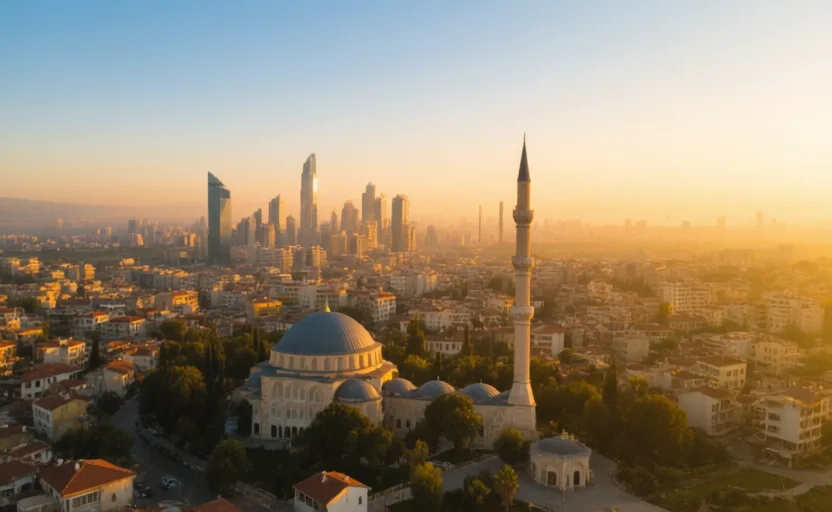 Adana · AI city illustration · Artistic impression
City · Europe
Adana
Saved in this browser — no account needed. Sign in later and it comes with you.
Where it is
The Seyhan River cuts through Adana about 35 kilometres from the Mediterranean, at the centre of the Cilician plain, a broad flat stretch of fertile land south-east of the Taurus Mountains. The river laid down the alluvial soil that feeds the plain, and it also flooded the city every winter and spring until embankments were built in the 1900s; a dam for hydroelectric power followed in 1956. Summers are long, hot, humid and dry, with heatwaves that regularly reach or pass 40 °C, and the winters are mild and wet. A pass in the Taurus nearby made this a corridor for armies and merchants long before it was a farming city.
The land and water around it
The Seyhan Riverriver
The river divides Adana into two main districts and deposited the soil that makes its surroundings so productive. It also brought regular floods until embankments were built, and the Seyhan Dam was finished in 1956 for hydroelectric power.
The Çukurova plainplain
The large fertile plain of Cilicia is the basis of the city’s trade. Cotton, wheat, corn, soybeans, barley, grapes and citrus are grown here, and Adana’s farmers are said to produce half of Turkey’s corn and soybeans.
The Taurus passmountains
Cilicia lies by a pass in the Taurus. That made it important for military campaigns and trade routes in the classical world, alongside its metal and agricultural wealth.
Its history, in short
Adana’s story is that of Cilicia’s gateway. The name is said to have been in use for over four millennia, and by 1335 BCE the Luwian and Hurrian kingdom of Kizzuwatna governed it under Hittite protection. After the Hittite collapse, a series of Neo-Hittite and then Assyrian-dominated states took over, and later empires, Byzantine, Arab, Seljuk and Armenian, passed the city back and forth. The Ramadanid emirs made it their capital from 1352, and the Ottomans incorporated it in 1517. In 1833 it was ceded for a time to the Egyptian ruler Muhammad Ali. Cotton and grain made it one of Turkey’s first industrial cities, and in the early 20th century its Armenian population grew sharply. The massacre of 1909 and the deportations of 1915 broke that community. French forces held Cilicia after 1918, and in 1923 Turkey’s abandoned-property law moved the homes and land of absent Armenians and Greeks to resettled Muslims. In the 1990s many Kurds who had left villages during the conflict in the south-east settled here.
Timeline
Dates are shown on a timeline rather than as changing shapes on the map. The globe draws modern boundaries only, and tinting a modern outline to stand for a historical one would state something we cannot source.
First cities & states
By 1335 BCE
Under Kizzuwatna and the Hittites
A Hittite inscription found at Hattusa shows Kizzuwatna ruling Adana under Hittite protection. After the Hittite empire collapsed around 1191 to 1189 BCE, the plain passed to the Denyen, one of the Sea Peoples.
Approximate dateWikipedia
Post-classical world
April 625
Battle of Sarus
The Byzantine emperor Heraclius routs a Sasanian army camped on the river’s eastern side, after a bold charge over Justinian’s bridge, today’s Taşköprü.
Well attestedWikipedia1352
The Ramadanid emirate
The Mamluks leave the plain to the Yüreğir Turks, whose emir Ramazan Bey makes Adana his capital. The emirate stays largely independent through the 15th century.
Well attestedWikipedia
Early modern & oceanic
1517
Ottoman incorporation
Selim I absorbs the emirate after conquering the Mamluk state. Direct rule by an appointed governor from Constantinople follows in 1608.
Well attestedWikipedia
Industrial & imperial
14 May 1833
Cilicia ceded to Egypt
The Convention of Kütahya hands Cilicia to the de facto independent Egypt of Muhammad Ali Pasha. The sanjak of Adana then has 68,934 inhabitants and few urban services.
Well attestedWikipedia1909 and 1915
Massacre and deportation of Armenians
The Armenian population doubled in the early 20th century, but a massacre in 1909 and an order to deport them in May 1915 ended that growth. The first convoy, of over 4,000 people, left on 20 May 1915 after the governor had delayed the order.
Well attestedWikipedia1918–1923
French rule and the end of Cilicia’s autonomy
After the Armistice of Mudros of 30 October 1918, French forces take over and oversee the return of more than 170,000 Armenians. In 1923 Turkey passes the Law of Abandoned Properties, and Adana is among the places where the most property is seized.
Well attestedWikipedia
Places that carry meaning
TaşköprüReign of Justinian
The old stone bridge over the Seyhan, built under the emperor Justinian. It was the crossing where Heraclius fought the Sasanian army in 625.
The Sinanpaşa neighbourhoodFrom the Balkan Wars
Home to the Conos, a Romani tribe from Romania who settled in Adana during the Balkan Wars. About 8,000 Romani people live in Adana Province today.
Incirlik Air Base20th century onward
A NATO base near the city that brings a community of about 2,000 British and Americans. It numbered up to 22,000 before 2003, and fell as troops were stationed in Iraq.
Languages here
Places are usually multilingual. This lists what is actually spoken, not one language per border.
TurkishTurkic family
The official language and the common language of the city.
Turkish is the only official language of Turkey and the language of the Turkish majority in Adana, which grew with migrants from the Balkans, Crete and the Caucasus.
Kurdish
Spoken by Kurds who moved to the city in large numbers in the 1990s.
Many left villages in the south-east at the height of the conflict with the PKK. Nationally, Kurdish is the widest-spoken minority language, and Kurds are Turkey’s largest ethnic minority.
ArabicSemitic family
The heritage language of Adana’s Arab community.
Most of Adana’s Arabs are Alawites, known locally as Nusayri or Fellah, and are often mistaken for Alevis. Their ancestors were brought from Syria in the 1830s to work the farmland.
ArmenianArmenian family
The language of a once large community, now largely assimilated.
There were about 172,000 Armenians in the area in 1921. Of those who were not exiled, many assimilated, though some thousands of descendants are said to keep Armenian and Christian culture in private.
Learn the language here
- 1Understand which languages are spoken hereAdana is multilingual. Start with which languages are used, by whom, and for what — the phrase list only covers one of them.Written by Globe Quest
- 2Learn 12 phrasesCurated everyday phrases for Adana, with audio and a written form.Written by Globe Quest
- 3Say them out loudSpeaking practice with pronunciation feedback, one phrase at a time.Globe Quest material, your own additions
- 4Come back to themSpaced review, so what you learned this week is still there next month.Written by Globe Quest
- 5Practise with people: Arabic practice · DohaAn in-person practice circle. It is a prepared plan and needs a host before it runs.Run by members
Check yourself
What did the Seyhan River give Adana, and what did it take?
Fertile alluvial soil, and regular winter and spring floods
The river’s alluvium feeds the Çukurova plain, but floods struck the city each winter and spring until embankments were built in the 1900s.
What did Turkey’s Law of Abandoned Properties of 1923 do in Adana?
Confiscated the property of absent Armenians and Greeks
It seized the property of Armenians and Greeks who were not present, and Adana saw more of it seized than most cities, resettling migrants from the Balkans, Crete and Kayseri there.
Worth arguing about
- Adana may hold the largest number of assimilated Armenians in modern Turkey. What does a city owe to families who kept their origins private?
- A fertile plain made the city rich and also drew in successive waves of migrants. Does farmland tend to make cities more open or more divided?
Sources
- Wikipedia · AdanaWikipedia · encyclopedia · checked 2026-11-24
- Wikipedia · TurkeyWikipedia · encyclopedia · checked 2026-11-24
Reviewed by Globe Quest editorial on 2026-11-24. Drafted with AI assistance and checked against the sources above before publication.