 Globe Quest
 Human Quest · LearningSign in
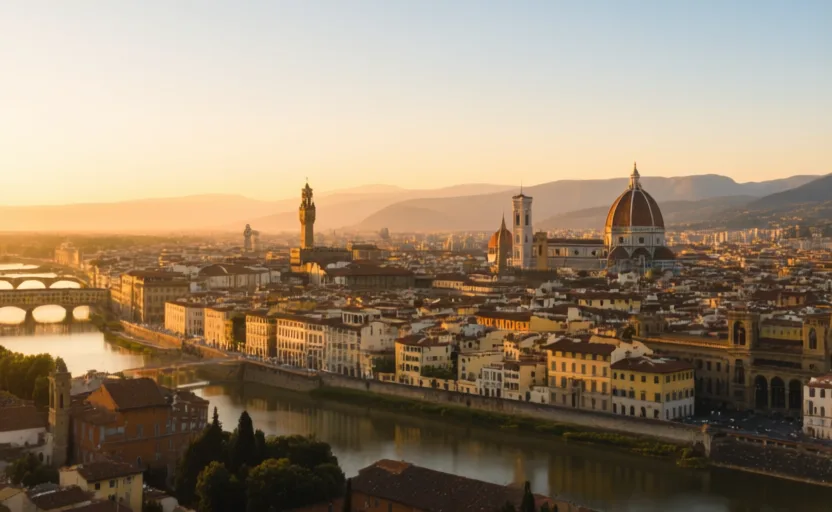 Florence · AI city illustration · Artistic impression
City · Europe
Florence
Also known as Firenze
Saved in this browser — no account needed. Sign in later and it comes with you.
Where it is
Florence fills a basin ringed by hills, among them Fiesole, Settignano, Arcetri and Bellosguardo, about 50 metres above sea level on the Arno. The river runs east to west through the city and is crossed by the Ponte Vecchio and the Ponte Santa Trinita, and smaller streams, the Mugnone, Ema and Greve, run in as well. In prehistory the whole Florence–Prato–Pistoia plain held a great lake, and ponds and marshes lingered until they were drained in the eighteenth century. With no prevailing wind the summers are hotter than on the coast, with about 71 days above 30 °C, and winters are cool and damp. The Arno has also flooded the centre, most seriously in 1966.
The land and water around it
The Arno and its fordriver
Etruscans used the ford near where the Mugnone meets the Arno and may have built a bridge or ferry close to today’s Ponte Vecchio. The river gave the medieval city power for its textile trade and a route to the Mediterranean for international commerce.
The Florence basinvalley
A bowl of fertile plain ringed by hills, once the bed of a Quaternary lake. The Etruscans preferred the hill of Fiesole, about six kilometres away, to the marshy plain, which is why Florence began as a Roman colony rather than an Etruscan town.
Hot, still summersclimate
The city has a Mediterranean climate with hot summers and little wind. The record high is 42.6 °C, set on 26 July 1983, and the record low is −23.2 °C on 12 January 1985.
Its history, in short
The Romans founded Florentia in 59 BCE as a colony for veteran soldiers, laid out like an army camp where the Via Cassia met the Arno valley. Centuries of Ostrogothic and Byzantine fighting cut the population to as few as 1,000 before the Lombards and then Charlemagne brought peace. By 1100 Florence was a commune, using the Arno for textile power and trade, and its merchant bankers pioneered bills of exchange and double-entry bookkeeping. The gold florin financed industry from Britain to Hungary, and the city supported 120,000 people around 1325, before the Black Death of 1348 more than halved it. Guild oligarchs, the Albizzi and then the Medici ruled it, and under Cosimo de’ Medici it became the centre of Renaissance patronage. The Medici line ended in 1737 and Habsburg-Lorraine dukes succeeded, then Napoleon’s clients. Florence was briefly capital of the new Kingdom of Italy from 1865 to 1871, and its fourteenth-century Tuscan became the basis of standard Italian.
Timeline
Dates are shown on a timeline rather than as changing shapes on the map. The globe draws modern boundaries only, and tinting a modern outline to stand for a historical one would state something we cannot source.
Classical world
59 BCE
Roman colony of Florentia
Veteran soldiers settle a camp-style town where the Via Cassia, the principal road from Rome towards the north, crosses the Arno valley. It becomes the capital of the Tuscia region in 285.
Post-classical world
774
Charlemagne
After Ostrogoth and Byzantine fighting had shrunk the population, Florence passes to Charlemagne, joins the March of Tuscany, and begins to grow again.
Well attestedWikipediac. 1100
A commune
Florence is a city-state by 1100, its fortunes tied to the Arno and the wool trade. Banking techniques such as bills of exchange and double-entry bookkeeping spread to medieval fairs.
Approximate dateWikipedia1348
Black Death
The plague cuts the city’s population by over half, from about 120,000 at its peak around 1325. In 1378 wool workers rise in the Revolt of the Ciompi.
Well attestedWikipedia
Early modern & oceanic
23 May 1498
Savonarola burned
The Dominican friar of San Marco, who had pushed political reform after the Medici were exiled, is hanged and burned in the Piazza della Signoria after accusing the pope of corruption.
Well attestedWikipedia1737
End of the Medici
With the dynasty extinct, Francis Stephen of Lorraine becomes duke, and Tuscany passes to the Habsburg-Lorraine line. Napoleon’s empire holds it from 1807 until 1814, and the old dynasty is deposed for good in 1859.
Well attestedWikipedia
Industrial & imperial
August 1944
The bridges
During a year of German occupation, retreating forces demolish the Arno bridges, sparing only the Ponte Vecchio, and Florence is liberated on 4 August 1944.
Contemporary
4 November 1966
The Arno floods
The river floods the centre, killing at least 40 people and soaking countless artworks and rare books. Volunteers from around the world help rescue them, and the effort leads to new methods of art conservation.
Well attestedWikipedia
Places that carry meaning
Historic Centre of Florence14th–16th centuries
A 505-hectare centre bounded by the remains of 14th-century walls, with the Cathedral of Santa Maria del Fiore, Santa Croce, the Palazzo Vecchio, the Uffizi and the Palazzo Pitti. It was inscribed by UNESCO in 1982.
Medici Villas and GardensRenaissance
Twelve villas with gardens and two pleasure gardens across the Tuscan countryside, chosen to show the ideal of a princely country residence that lived in harmony with nature and was devoted to leisure, the arts and knowledge.
The Ponte VecchioSpared in 1944
The only Arno bridge the retreating Germans did not blow up, because the officer in charge, who had studied in Florence, ordered it spared. The streets just to its south, with part of the Corridoio Vasariano, were mined instead.
Languages here
Places are usually multilingual. This lists what is actually spoken, not one language per border.
ItalianRomance family
The language of daily life, born from the local dialect.
The Florentine dialect is a Tuscan dialect and the immediate parent of modern Italian. The fourteenth-century speech of Dante, Petrarch and Boccaccio became the model for a national literary language, even though Latin dominated courts and the Church.
Immigrant languages
Spoken by the 18.9% of residents who were born abroad.
The largest groups come from Peru, Albania, Romania, China and the Philippines. About 6,000 Chinese residents are estimated to live in the city, and an estimated 8% of residents identified as Muslim in 2016.
EnglishGermanic family
The language of a nineteenth-century foreign community.
By the second half of the nineteenth century foreigners, including many English, made up a quarter of the population, and their villas and collections later became museums such as the Horne and Stibbert.
Learn the language here
- 1Understand which languages are spoken hereFlorence is multilingual. Start with which languages are used, by whom, and for what — the phrase list only covers one of them.Written by Globe Quest
- 2Learn 11 phrasesCurated everyday phrases for Florence, with audio and a written form.Written by Globe Quest
- 3Say them out loudSpeaking practice with pronunciation feedback, one phrase at a time.Globe Quest material, your own additions
- 4Come back to themSpaced review, so what you learned this week is still there next month.Written by Globe Quest
Check yourself
Why is Florence important to the Italian language?
Its fourteenth-century dialect, carried by Dante, Petrarch and Boccaccio, became the basis of standard Italian
Writers used their Florentine vernacular instead of Latin, and its prestige made it the model for a national literary language.
Which Arno bridge survived the German retreat in 1944?
Ponte Vecchio
The German officer in charge of the demolitions, who had studied in Florence, ordered that the Ponte Vecchio be spared while the other bridges across the river were blown up.
Worth arguing about
- Florentine bankers financed kings and invented new accounting. Does a city that lives from finance produce its best art because of the money or in spite of it?
- The 1966 flood brought volunteers from all over the world to save art. Who owes the care of a city’s treasures, its residents or everyone?
What we have not established
These are open questions, listed rather than filled in. We would rather show a gap than a plausible guess.
How many people lived in Florence at its medieval peak?
The city proper may have held up to 120,000 people around 1325, with about 300,000 more in the surrounding countryside, but these are estimates, and they reach a different level again for the 15th century, when the city was recorded at about 60,000.
Sources
- Wikipedia · FlorenceWikipedia · encyclopedia · checked 2026-11-24
- Wikipedia · History of FlorenceWikipedia · encyclopedia · checked 2026-11-24
- UNESCO · Historic Centre of FlorenceUNESCO World Heritage Centre · intergovernmental · checked 2026-11-24
- UNESCO · Medici Villas and Gardens in TuscanyUNESCO World Heritage Centre · intergovernmental · checked 2026-11-24
Reviewed by Globe Quest editorial on 2026-11-24. Drafted with AI assistance and checked against the sources above before publication.