 Globe Quest
 Human Quest · LearningSign in
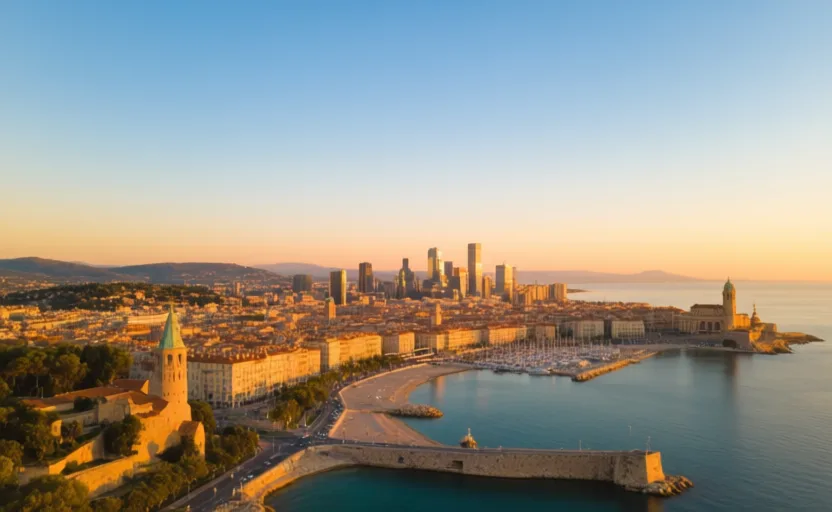 Toulon · AI city illustration · Artistic impression
City · Europe
Toulon
Saved in this browser — no account needed. Sign in later and it comes with you.
Where it is
Toulon wraps a sheltered harbour on the Provençal shore, where the Gulf of Lion ends in the east. A wall of mountains to the north screens it from the weather and gives it a January average of 9.9 °C, higher than any other city in the French mainland. It is also one of the sunniest, with about 2,850 hours a year. Wind is the other defining feature: about 115 days a year bring strong winds, whether the cold dry Mistral or Tramontane from the north, the Sirocco from Africa sometimes carrying red sand, or the stormy Levant from the east.
The land and water around it
The harbour and the Gulf of Lionharbour
A sheltered natural harbour at the point where the Gulf of Lion ends. The Romans used it as a refuge for trading ships, and it is where the French navy built its principal Mediterranean base.
The northern mountain wallmountains
A line of mountains behind the city shields it from the northern weather. This is why Toulon has some of the highest sunshine totals and warmest winters in metropolitan France.
The windsclimate
Strong winds blow about 115 days a year, most in January and least in September. The wind is a defining feature of the Toulon climate.
Its history, in short
Greek traders from Phocaea set up depots along this coast from about the 7th century BC, and the Ligurians settled from the 4th. Rome built Telo Martius, which became one of two main Roman centres for dyeing the imperial purple with the murex sea snail. Provence passed to France in 1486, and from 1494 the crown began to build a military port, which Louis XIV's minister Colbert turned into a major arsenal in 1660 with fortifications by Vauban. In 1543 the Ottoman fleet under Barbarossa wintered in the town as an ally of Francis I. A plague that came from Marseille killed half the population in 1720. In 1793 Toulon joined the Federalist revolts and handed its fleet to the British, and Napoleon Bonaparte served as an artillery captain in the siege that followed; the city was punished by being renamed Port-la-Montagne. During the Second World War, French naval officers scuttled the fleet here on 27 November 1942 rather than see it fall to the Germans. Toulon remains the home port of the French Mediterranean Fleet.
Timeline
Dates are shown on a timeline rather than as changing shapes on the map. The globe draws modern boundaries only, and tinting a modern outline to stand for a historical one would state something we cannot source.
Classical world
c. 7th century BC
Greek trading depots
Colonists from Phocaea in Asia Minor found depots along the coast. The nearest, Olbia, lay near Hyères, east of Toulon.
Approximate dateWikipedia2nd century BC
Telo Martius
After Marseille calls on Rome for help against the Ligurians, a Roman settlement is founded here. It became a centre for making purple dye from sea snails, and its name slowly changed from Telo to Toulon.
Approximate dateWikipedia
Early modern & oceanic
1486
Provence joins France
Provence becomes part of France, and in 1494 Charles VIII begins a military port here to make France a Mediterranean sea power.
Well attestedWikipedia1543
The Ottoman winter
Francis I, allied with the Ottomans, invites the fleet of Admiral Barbarossa to Toulon. Residents are made to leave, apart from heads of household, and the Ottoman sailors occupy the town for the winter.
Well attestedWikipedia1660
Vauban's arsenal
Colbert orders Vauban to build a new arsenal and fortify the town, since Louis XIV is determined to make France a major sea power.
Well attestedWikipedia1720
The plague
Plague coming from Marseille kills 13,000 people, half the population.
Well attestedWikipedia1793
The siege of Toulon
The city rises against the First Republic and surrenders itself and its fleet to the British. Republican forces besiege it and the British leave, destroying the ships they cannot take. Napoleon Bonaparte served in the siege as an artillery captain.
Well attestedWikipedia
Industrial & imperial
27 November 1942
The fleet is scuttled
After the German army occupies southern France, French naval officers sink the fleet based at Toulon. The Allies bombed the city in November 1943, destroying much of the port and killing about 500 residents.
Well attestedWikipedia
Places that carry meaning
The military port and arsenalFrom 1494; arsenal from 1660
The main naval centre on France's Mediterranean coast, base of the French Mediterranean Fleet, including the carrier Charles de Gaulle.
Tour Royale1524
A fort completed by Francis I at the harbour entrance. Within months its commander sold it to an imperial officer and Toulon surrendered, a reminder of how often the harbour changed hands.
The city-centre street plan1849
Georges Eugène Haussmann, serving a year as prefect of the Var, laid out the street plan of the centre, as he would later do for Paris.
Languages here
Places are usually multilingual. This lists what is actually spoken, not one language per border.
FrenchRomance family
The official language and the language of daily life.
French is the language of administration, schools and the naval base.
Occitan (Provençal)Romance family
The traditional regional language of Provence.
The city's name is written in Occitan in two norms, the classical one and the Mistralian one, which gives it as Touloun. Occitan is among the regional languages of France.
Learn the language here
- 1Understand which languages are spoken hereToulon is multilingual. Start with which languages are used, by whom, and for what — the phrase list only covers one of them.Written by Globe Quest
- 2Learn 12 phrasesCurated everyday phrases for Toulon, with audio and a written form.Written by Globe Quest
- 3Say them out loudSpeaking practice with pronunciation feedback, one phrase at a time.Globe Quest material, your own additions
- 4Come back to themSpaced review, so what you learned this week is still there next month.Written by Globe Quest
Check yourself
What gives Toulon its mild winters and high sunshine totals?
A wall of mountains to the north that shields it from northern weather
The mountains block weather from the north, so January is milder here than in any other mainland French city, and sunshine reaches about 2,850 hours a year.
Why was the French fleet sunk at Toulon in November 1942?
French naval officers scuttled it after the German army occupied southern France
Following the Allied landings in North Africa the German Army occupied southern France, and French officers sank the fleet on 27 November 1942.
Worth arguing about
- Toulon has repeatedly been handed to a foreign fleet, from the Ottomans to the British. What does a naval city owe to the country that pays for its harbour?
- A city so tied to one institution, the navy, ties its fate to it. Can a port city stay itself when its main employer is the state?
Sources
- Wikipedia · ToulonWikipedia · encyclopedia · checked 2026-11-24
- Wikipedia · FranceWikipedia · encyclopedia · checked 2026-11-24
Reviewed by Globe Quest editorial on 2026-11-24. Drafted with AI assistance and checked against the sources above before publication.