 Globe Quest
 Human Quest · LearningSign in
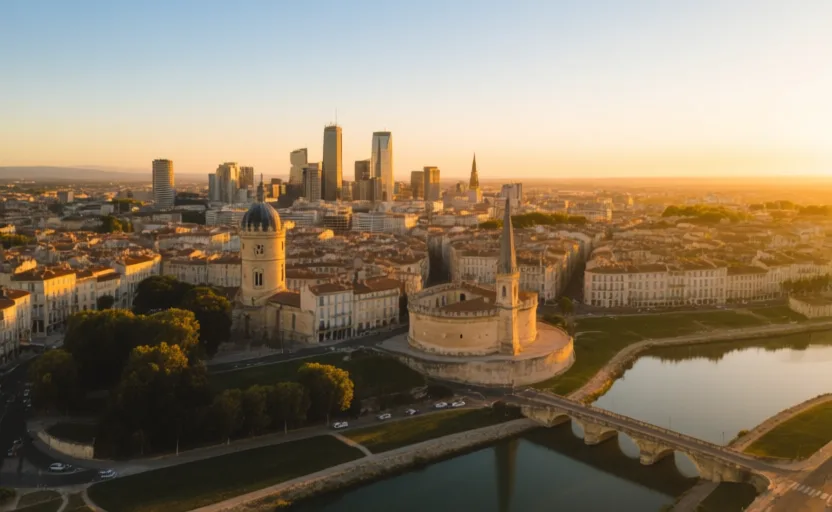 Montpellier · AI city illustration · Artistic impression
City · Europe
Montpellier
Saved in this browser — no account needed. Sign in later and it comes with you.
Where it is
A few kilometres back from the Languedoc shore, Montpellier climbs two low hills above the little river Lez, about 10 kilometres from the Mediterranean. The inland siting follows the earlier episcopal town of Maguelone on the coast, which pirate raids made unsafe, so settlement shifted a little farther from the sea. The ground is hilly but modest, and the highest point of the city is the Place du Peyrou at 57 metres. The climate is properly Mediterranean, with cool damp winters, hot dry summers and about 630 millimetres of rain a year, most of it in autumn and winter.
The land and water around it
The two hillsmountains
The old city was built on two hills, Montpellier and Montpelliéret, which were separate towns in the 10th century. The steep streets between them are narrow and old.
The Lez and the Languedoc coastcoast
The river Lez runs past the city to the sea some 10 kilometres away. The coast gave the early medieval centre at Maguelone, but pirates made it unsafe, which pushed the settlement back to the hills.
The Mediterranean climateclimate
Winters are cool and damp, and summers hot and rather dry: January averages about 7 °C and July about 24 °C. The city has recorded -17.8 °C in February 1963 and 43.5 °C in June 2019.
Its history, in short
The coast here was first settled at Maguelone, a bishop’s town on the coast; pirate raids pushed people inland, and in 737 Charles Martel destroyed it. Montpellier appears in a document of 985, created when a local dynasty, the Guilhems, merged two hamlets and walled them. Its name means “woad mountain”, after a plant used locally for dyeing. In the 12th century it became a trading centre linked across the Mediterranean, where Muslims, Jews and Cathars were tolerated. Its schools of law and medicine, formalised in 1220, made it one of the great teaching centres of Europe. Through marriage the city passed in 1204 to the kings of Aragon and then to Majorca, until it was sold to the king of France in 1349. Protestants held it as a stronghold in the Wars of Religion until Louis XIII besieged it in 1622 and built the royal citadel. The 19th-century wine boom ended with phylloxera in the 1890s, and the arrival of repatriates from Algeria after its independence and a large student body have driven its growth since.
Timeline
Dates are shown on a timeline rather than as changing shapes on the map. The globe draws modern boundaries only, and tinting a modern outline to stand for a historical one would state something we cannot source.
Post-classical world
737
Maguelone destroyed
Charles Martel destroys Maguelone, the episcopal town that had been the main settlement near the coast.
Well attestedWikipedia985
First mention
Montpellier appears in a document. It was founded under the Guilhem dynasty, who combined two hamlets and surrounded them with a castle and walls.
Well attestedWikipedia1204
Passes to Aragon
Marie of Montpellier marries Peter II of Aragon, bringing the city as her dowry. A charter confirms its freedoms and the right to elect twelve consuls each year.
Well attestedWikipedia1220
Faculties of law and medicine
Cardinal Conrad of Urach, a papal legate, establishes the faculties. Its medical school is the oldest still teaching.
Well attestedWikipedia1349
Sold to France
James III of Majorca sells the city to Philip VI of France to raise money for his struggle with Peter IV of Aragon. Before the Black Death it had about 40,000 inhabitants.
Well attestedWikipedia
Early modern & oceanic
1622
The Huguenot siege
After 40 days of bombardment, Louis XIII ends the Protestant hold on the city. The terms require its fortifications to be dismantled and a royal citadel built.
Well attestedWikipedia
Industrial & imperial
1890s
Phylloxera
A vine disease spreads through the vineyards and ends the wine boom that had made the city's people wealthy in the 19th century.
Approximate dateWikipedia
Places that carry meaning
The medical facultySince 1220
Teaching of medicine was freely permitted here from 1180, and the faculty founded in 1220 counts Petrarch, Nostradamus and Rabelais among its alumni.
The Promenade du Peyrou17th century onward
Built under Louis XIV when the city became capital of Bas Languedoc, along with the Esplanade and many houses in the historic centre. It occupies the highest point in the city.
The towers of the city wallsAround 1200
Only two of the towers are left, called the Tour des Pins and the Tour de la Babotte.
Languages here
Places are usually multilingual. This lists what is actually spoken, not one language per border.
FrenchRomance family
The official language and the daily language of the city.
French is the language of schools, administration and the street, in a city whose population has grown quickly through students and arrivals from elsewhere.
OccitanRomance family
The traditional regional language of the south.
The city lies in the region of Occitania, and Occitan is one of the regional languages of France. It is heard far less than French.
SpanishRomance family
A language of long-standing community and heritage.
Montpellier has for most of its history had a significant Spanish population and influence, alongside sizeable Moroccan, Algerian and Italian communities.
Learn the language here
- 1Understand which languages are spoken hereMontpellier is multilingual. Start with which languages are used, by whom, and for what — the phrase list only covers one of them.Written by Globe Quest
- 2Learn 12 phrasesCurated everyday phrases for Montpellier, with audio and a written form.Written by Globe Quest
- 3Say them out loudSpeaking practice with pronunciation feedback, one phrase at a time.Globe Quest material, your own additions
- 4Come back to themSpaced review, so what you learned this week is still there next month.Written by Globe Quest
Check yourself
Why did settlement in this area move inland from Maguelone?
Raids by pirates made the coast unsafe
Maguelone, a bishop's town on the coast, was threatened by pirates, and settlers moved a little farther inland. Charles Martel then destroyed Maguelone in 737.
How did Montpellier come under the French crown?
By a sale in 1349 from James III of Majorca
James III of Majorca, who held the city, sold it to Philip VI of France in 1349 to pay for his fight with Peter IV of Aragon.
Worth arguing about
- A city that was Aragonese, then Majorcan, then French within two centuries. What is left of that mix in the way it thinks of itself?
- Montpellier has one of the fastest-growing urban areas in France and about a quarter of its population are students. What does a city built on that balance gain and lose?
Sources
- Wikipedia · MontpellierWikipedia · encyclopedia · checked 2026-11-24
- Wikipedia · FranceWikipedia · encyclopedia · checked 2026-11-24
Reviewed by Globe Quest editorial on 2026-11-24. Drafted with AI assistance and checked against the sources above before publication.