 Globe Quest
 Human Quest · LearningSign in
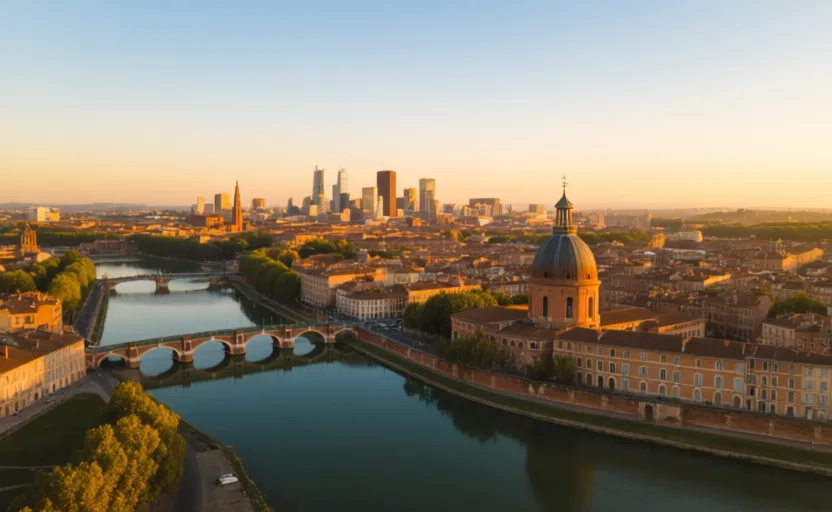 Toulouse · AI city illustration · Artistic impression
City · Europe
Toulouse
Saved in this browser — no account needed. Sign in later and it comes with you.
Where it is
Toulouse stands on the Garonne in the south-west of France, roughly halfway between two seas: 150 kilometres from the Mediterranean and 230 from the Atlantic. The Pyrenees are about 80 kilometres to the south. That position, on the easiest line of travel between the two coasts, has made the Garonne valley a trade route since at least the Iron Age. The river, the Touch and the Hers-Mort run through the city, joined by canals. The climate has four distinct seasons; summer rain is heavy enough that it does not count as Mediterranean.
The land and water around it
The Garonne valleyvalley
The valley is the natural corridor between the Mediterranean and the Atlantic, and the Romans moved the city from its hills onto the river bank to use it. Today the river, the Touch and the Hers-Mort cross the city, along with the Canal de Brienne, the Canal du Midi and the Canal de Garonne.
The Canal du Midiriver
A navigable waterway of 360 kilometres with 328 structures, built between 1667 and 1694 as the first section of a planned link between the two seas. Its designer treated it as a landscape as much as a feat of engineering.
The Pyrenean foothillsmountains
The mountain wall lies some 80 kilometres south, beyond the plain. Charlemagne created the county of Toulouse in 778 partly to guard the frontier with Muslim Spain beyond them.
Its history, in short
Toulouse began as a Celtic hill settlement, Tolosa, which Rome made a garrison in the 2nd century BC and then, around the reign of Augustus, shifted down to the river bank where trade was easier. In the 5th century it became the capital of the Visigothic kingdom, which at its height reached from the Loire to Gibraltar, until the Franks under Clovis took it in the early 6th century. The medieval counts of Toulouse were nearly independent of the French crown, and their court patronised the troubadours who wrote in Occitan. The Cathar crusade of 1209 to 1229 broke that independence, and the county fell to the crown in 1271. The university was founded in 1229, and the city lived off its parlement and its grain trade, helped by the Canal du Midi, until the First World War brought aircraft workshops. From the pioneering airmail company Aéropostale grew the aerospace industry that now defines the city. Its population has risen fast: the metropolitan area grew by 57 per cent between 1990 and 2020.
Timeline
Dates are shown on a timeline rather than as changing shapes on the map. The globe draws modern boundaries only, and tinting a modern outline to stand for a historical one would state something we cannot source.
Classical world
2nd century BC
A Roman outpost
Tolosa, an allied Celtic settlement on the hills, becomes a Roman military outpost on the western edge of the new province. Its name, of unknown origin, is first recorded in this century.
c. 10–30 AD
The city moves to the river
Between the end of Augustus' reign and the start of Tiberius', the people are made to leave the hill and settle a new walled Roman city on the Garonne.
Approximate dateWikipedia418–508
Capital of the Visigoths
Rome grants the Visigoths Aquitania and Toulouse in 418 and they make it their capital. Their kingdom preserves Roman law in the Breviary of Alaric, and falls when Clovis defeats Alaric II at Vouillé in 507.
Post-classical world
1209–1229
The crusade against the Cathars
Pope Innocent III launches a crusade aimed at the Catharism that had spread through the south. The county of Toulouse is the target, and the treaty of 1229 leaves it subordinate to the French crown.
Well attestedWikipedia1229
The university
The University of Toulouse is founded, one of the oldest in Europe.
Well attestedWikipedia1271
The county joins the crown
Joan of Toulouse and her husband die without heirs, and the territory is annexed to the royal domain.
Well attestedWikipedia
Early modern & oceanic
1667–1694
The Canal du Midi
The canal links the Garonne to the Mediterranean and boosts the wheat and corn trade on which 18th-century Toulouse lives.
Industrial & imperial
10 April 1814
The last Franco-British battle in France
Wellington's army fights Marshal Soult just outside the city, days after Napoleon's surrender, though neither army knows it yet. The French withdraw.
Well attestedWikipedia
Places that carry meaning
Basilica of Saint-SerninRomanesque, 11th–12th centuries
The largest surviving Romanesque building in Europe, listed by UNESCO in 1998 with the former Hôtel-Dieu Saint-Jacques for its place on the pilgrimage route to Santiago de Compostela. It stands on the shrine opened in 403 for the relics of Saint Saturnin, the city's first bishop, locally called Sernin.
The Pink City's brickMedieval onward
Pinkish terracotta brick gives the centre its nickname, La Ville rose. Brick suits a plain that offers clay rather than quarried stone.
The Canal du Midi1667–1694
The canal is a World Heritage property shared with other places on its course, and it reaches the city as one of three canals that cross it.
Languages here
Places are usually multilingual. This lists what is actually spoken, not one language per border.
FrenchRomance family
The official language and the language of daily city life.
French has been the national official language since the Renaissance. Toulouse is the capital of the region of Occitania, and the city's population has long been supplemented by Italians and Spaniards in the 1920s and 1930s and repatriates from Algeria in the early 1960s.
OccitanRomance family
The medieval language of the south, now a regional language.
In the 11th and 12th centuries Occitan, then called Provençal, was among the most sophisticated languages of Europe, and the counts of Toulouse kept troubadours who wrote in it. It remains one of the regional languages of France.
Learn the language here
- 1Understand which languages are spoken hereToulouse is multilingual. Start with which languages are used, by whom, and for what — the phrase list only covers one of them.Written by Globe Quest
- 2Learn 11 phrasesCurated everyday phrases for Toulouse, with audio and a written form.Written by Globe Quest
- 3Say them out loudSpeaking practice with pronunciation feedback, one phrase at a time.Globe Quest material, your own additions
- 4Come back to themSpaced review, so what you learned this week is still there next month.Written by Globe Quest
Check yourself
Why did the Romans move Toulouse from its hills?
To put the city on the Garonne, which suited trade better
The river bank was better for trade, and Augustus wanted a major city at the junction of the Via Aquitania and the Garonne. The old Celtic settlement on the hills was abandoned.
Which kingdom had Toulouse as its capital in the 5th century?
The Visigothic kingdom
Rome granted the Visigoths Toulouse and Aquitania in 418. At its largest the kingdom ruled from the Loire to the Strait of Gibraltar until the Franks defeated it in 507.
Worth arguing about
- Toulouse was the heart of a courtly Occitan culture before the crusade of 1209 to 1229. What does a language lose when its court is lost, and what survives?
- The city had no real industrial revolution in the 19th century, yet became Europe's aerospace centre in the 20th. How much of that was luck of place, and how much choice?
Sources
- Wikipedia · ToulouseWikipedia · encyclopedia · checked 2026-11-24
- Wikipedia · History of ToulouseWikipedia · encyclopedia · checked 2026-11-24
- UNESCO · Canal du MidiUNESCO World Heritage Centre · intergovernmental · checked 2026-11-24
- Wikipedia · FranceWikipedia · encyclopedia · checked 2026-11-24
Reviewed by Globe Quest editorial on 2026-11-24. Drafted with AI assistance and checked against the sources above before publication.